Monday, April 25, 2011

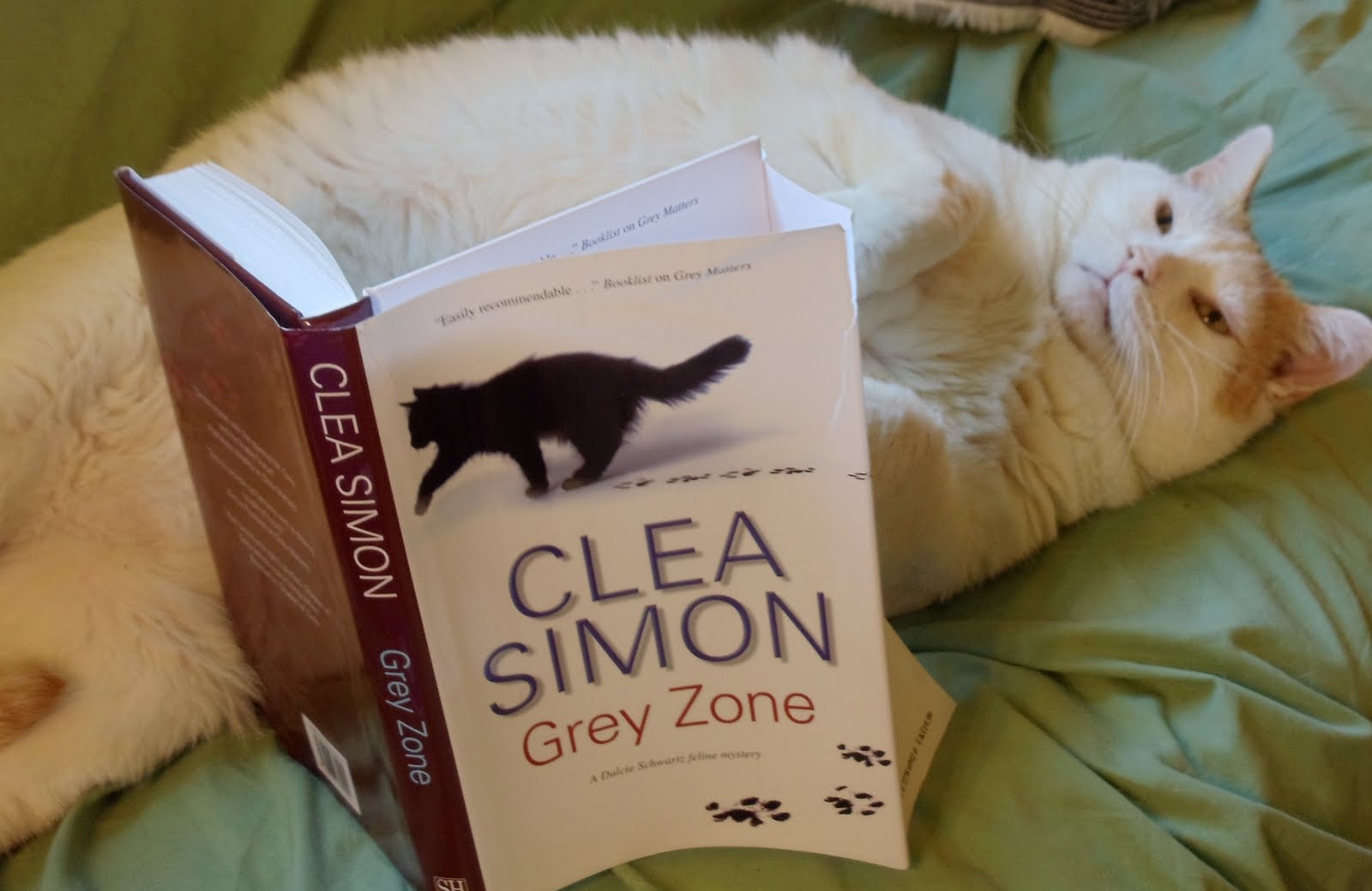
Grey Zone by Clea Simon

Melon is taken aback by a plot twist!


Reviewed by Jeanne

Dulcie Schwartz, the grad student we first met in Shades of Grey, is still trying to juggle her teaching and mentoring duties with finishing her thesis and having an actual life. The latter is definitely on the losing end. She’s still researching her mysterious author, which leads her new advisor to accuse her of stalling—of not wanting to finish and move on. Boyfriend Chris is just as busy, so they haven’t really had any time together and her new kitten is getting into all sorts of mischief. In short, Dulcie feels a bit like Lucille Ball in the infamous candy factory sketch: things are moving too quickly for her to keep up, though she tries valiantly.

Still, Dulcie doesn’t realize quite how disconnected things are until she sees a poster about a missing woman—who just happens to be one of Dulcie’s former students. Overburdened and overworked, Dulcie hadn’t really followed up as to why the girl dropped her class. Determined to make amends, Dulcie tries to track down a current student who also seems to be falling through the cracks—and ends up being at the scene when a professor falls from his upper story office. Did he jump? Or was it murder?

One of the things I like about this series is the academic setting, with its sometimes antique and arcane rules butting up against the electronic age. Dulcie’s particular area of interest is an old gothic novel, which inspires her dreams of castles and fog while her daily routine includes computer searches, email and cell phones. While there are supernatural elements (Mr. Grey, Lucy’s premonitions, and Dulcie’s dreams), these are always grounded in a more pragmatic world. The cats are always a joy: enigmatic Mr. Grey, her ghostly advisor, makes his pronouncements and Esme, the empress in training, exerting her feline will in ways any cat fancier will recognize. I also have to comment on the cover:  gorgeous! I do like well done cover art, and this one is charming.

I found the ending to be most satisfying. It just felt right for the characters and was, for me at least, hopeful and very comforting. To explain further would spoil it for everyone else, but what I will remember most is that moment of pure happiness, when all is right with the world.

You don’t need to have read the other books in the series to enjoy this one. Give it a try!

Grey Zone is by Clea Simon and the call number is F SIM

Sunday, April 17, 2011

People of the Longhouse by W. Michael & Kathleen O’Neal Gear


Reviewed by Susan Wolfe


I found a pristine Indian arrowhead in my backyard while setting out my garden. How long had it been there? Who lost it?

There is little good fiction written about America’s pre-history. This husband & wife team transports you to a place and time that many of us never knew existed. It’s the world where we now live, seen through the eyes of the people who lived there before us.

The Gears are excellent writers. He was nominated for the Pulitzer Prize. She is a former state historian for Kansas, Nebraska and Wyoming for the Department. of the Interior. They are both trained archaeologists.

The People of the Longhouse (F GEA Main) focuses on the Iroquois of the early 15th century. After a raid, young Odion and his little sister, Tutelo are marched away as spoils of war. Their parents set out to rescue them. War chief Koracoo and husband Gonda set an uneasy truce with a neighboring tribe and lead a small rescue party. But this is not an ordinary war party they are chasing. They are following an old witch-woman named Gannajero, a legendary evil trader with sinister plans for captured children.

Koracoo and Gonda are devoted parents and leaders of their tribes, racked with guilt about their obligations and failures. The children are multi-dimensional characters. Clever yet vulnerable. Gannajero is a complicated character. Not all is as it seems with her, she is part victim and part evil. The plot flows smoothly, rippled with glimpses into future and past events.

The Gears have the trademark of selecting a time and place in pre-Columbian America and creating a series around the people of that area. Their love of the Native American culture glows through their work and their archaeological expertise gives it authenticity.

This first book of the “Forgotten Past” series is set during a turning point of the Iroquois nation. Their time and culture was turbulent. A nation fragmented into various tribes with challenges that will change their world forever. And ours too. They created the democracy that our founding fathers acknowledge as the basis for our own.

What a wonderful background for a fascinating story.

Tuesday, April 12, 2011

The Wonderful World of Inventions


Reviewed by Nancy

Have you ever awakened in the middle of the night thinking your life would be complete if you just had a Full Body Umbrella? Probably not. Or have you ever wondered where you might find an Earring Safety Net. Well, no.

Nonetheless, you might want to have a look at 101 Unuseless Japanese Inventions by Kenji Kawakami (608 KAW Main). It will give you a break from the humdrum responsibilities of your life.

In the introduction to his book Mr. Kawakami explains the Japanese art of Chindogu. It's a little hard to describe, but in Chindogu one attempts to make an object that is almost useful, but is so silly it can't really be useful. Or to create an object that actually is useful, but is also so silly that you can't quit laughing long enough to use it.

In the book you will find descriptions and pictures of the Noodle Eater's Hair Guard, the Cat Tongue Soother, and the Eyedrop Funnel Glasses. The Solar Powered Lighter involves the use of a magnifying glass, and Dust and Shake (one of my personal favorites) features a feather duster connected to a martini shaker. According to the author the Dust and Shake provides "well-earned after-chore refreshment."

You must see as well the Heavy Smoker's Mask and the Hydrophobe's Bath Body Suit. Really, these items are not to be missed. I may do some checking to see if I can acquire a Portable Zebra Crossing. Yes, it is what it sounds like... your very own portable pedestrian crosswalk that can be rolled across a busy street when you need to cross. Of course, the book includes a disclaimer pointing out that one might be killed trying to position the crosswalk for use.

Perhaps you will find a "must have" item for yourself in these pages. Just, please, don't ever get on the commuter train and place your Portable Commuter Seat next to me. Once you see the picture of this invention you will understand why.

I could not stop reading this book. Also, I could not stop laughing.

Thursday, April 7, 2011

Blood Harvest: Bolton Thrills Again


Blood Harvest by S. J. Bolton
Reviewed by Jeanne

Heptonclough is a picture-book English village, complete with an old church, moors, and families who have lived in the same place for centuries. The Fletchers, however are new: mum Alice, dad Gareth, the two boys, Tom and Joe, and baby Millie, a blonde toddler. They’ve just built a house there and are learning the village ways. Also new is the vicar, Harry, a young man eager to take his place as leader of his flock. But underneath, there is something not quite so welcoming: there are whispers, voices, like spirits trying to lead people astray, glimpses of someone—something?—that might be there or might be imagination.

The dead children aren’t imaginary, though.

Blood Harvest, the recent thriller from British author S.J. Bolton, opens with the discovery of three bodies in a grave where only one should be. All three are very young girls, blonde, and with similar injuries. The next part of the book picks up earlier, introducing the characters and giving the reader background on the town and its inhabitants, then draws the action inexorably toward the discovery.
I’ve read all three of Bolton’s novels and I’ve come to expect a certain number of things. One, that there will be interesting, believable and well-developed characters in a very distinct setting; two, that folklore will be a factor in some way; three, that there will be enough layers and intriguing themes that I will want to discuss the book with someone else immediately; and four, that the story will be a wild roller coaster ride through a tunnel of horror and when it’s all over I’ll be dazed, breathless and ready to read the whole thing over again to figure out how I could have gotten it all so wrong. Blood Harvest meets or exceeds all of the above.

The characters are especially rich in this one: the story is told from several points of view, all well done. Harry, the vicar, is an engaging, open-hearted young man who is drawn to Evi, the therapist who is treating a young woman who lost a child. Evi has a physical handicap—also a hallmark of Bolton’s writing—but has never let it stop her. She’s a tough, no-nonsense sort of woman. She’s attracted to Harry, but is not one to let her personal life take precedence over her professional obligations. Tom, the eldest Fletcher child, is just old enough to feel responsible for his siblings but young enough that we can’t quite be sure that he’s giving us an accurate picture of what he sees. The children view the world in very different terms than do their parents: a world of bullies, creatures, possible ghosts and definitely things that go bump in the night. Yet another view is offered by Gillian, one of Evi’s patients, a bereaved mother who insists her child did not die in the fire. She roams the moors around Heptonclough at night, searching for her daughter—her young, blonde daughter.

There are a number of themes running through this book. Motherhood and all its ramifications are personified in various female characters, rather like the triple aspected goddess. Ancient ties to land and to the sacred are contrasted with modern medicine and medical ethics. Above all, there is obligation: to the land, to family and to one’s calling.

Given Bolton’s fondness for folklore, I was half-expecting something along the lines of Tom Tyron’s Harvest Home or perhaps Shirley Jackson’s “The Lottery.” Folklore does play a role but more indirectly than I had anticipated. As I said, Bolton never fails to surprise.

The setting is an English village in a rural area. Bolton’s writing is always very atmospheric and tactile. You almost feel the cold of the stones, the damp of the fog and chill air, and see those towers pointing to the sky. To steal lines from Emily Dickenson (and if one is going to steal, by all means steal from the best), “I never saw a moor—“ but Bolton’s writing is the next best thing to being there. The landscape is almost a character in its own right, and always influences Bolton’s characters: in many ways, the land and the people are one, which is why her stories are usually told from an outsider’s point of view.

While there is a good bit of violence, Bolton avoids what some refer to as “torture porn,” that is, describing the violence and injury in excruciating detail with an emphasis on the terror of the victim as she—and it’s usually a she—awaits her fate. Instead, Bolton gives us a retelling after the event has occurred. She does give us the emotional pain and tension, the worry, the dread on the part of others but not the victim. There have been times she’s skated close to the edge, though; I hope she’ll continue to resist the urge to dive in.

I can’t say I’m completely happy with the ending. It was true to the book and it was more than plausible given what had happened. I’ll even reluctantly admit it sort of felt right, given the emotional state of the characters at the time. It just wasn’t the ending for which I hoped. I almost said that I wanted her to tell us more about the aftermath, but then I remembered the old saying about being careful what you wish for. I think I’ll settle for the open-ended ending.
Friday, March 25, 2011

Deliciously Funny: Wicked Appetite


Wicked Appetite by Janet Evanovich

Reviewed by Doris

I used to love Janet Evanovich’s Stephanie Plum books. The first seven or so make me laugh out loud. Stephanie’s adventures as a “bail enforcement agent” were funny, the characters appealing, and the back and forth she does between Joe and Ranger made for good reading. Then, it became rather stale and repetitive. Now Evanovich has a new series featuring Diesel, a new heroine named Lizzy Tucker, a monkey named Carl who has appeared in other Evanovich books, and a ninja cat. Throw in a couple of secondary characters who are definitely off-beat, a setting that includes Salem where they had the witch trials, and the giggles are back. There’s even a belly laugh or two!

Evanovich has had a couple of other books featuring Diesel. He is a supernatural “unmentionable” with a number of talents. He works for the Board of Unmentionable Marshalls--aka BUM-- and his current assignment is to retrieve some ancient stones that represent the Seven Sins. The relics when all brought to together will give the person possessing them world-changing powers. Just to refresh your memory the seven sins are gluttony, envy, anger, lust, greed, sloth, and pride. The first set of stones deal with gluttony which leads to some rather humorous and cunning scenarios. The lust stone also adds a little spice to the menu.

Lizzy creates scrumptious cupcakes. Suddenly Diesel turns up in her house needing her help. Diesel must retrieve the stones or chaos will ensue. Also after the stones is Diesel’s cousin Wulf-- dark, tall, and smelling of just a hint of sulphur--and he is unafraid to use deadly force. Thus begins one of Evanovich’s classic romps with improbable happenings, a bit of magic, trashed cars, silly sidekicks, a touch of sex, and a bunch of laughs. Lizzy is very appealing and Diesel and Wulf add the right blend sexy. Then there’s Carl the monkey who has a way with gestures, Lizzy’s ninja cat who saves the day, and various characters who are just funny. This book is a perfect read for a rainy afternoon or a lazy day when you just want to be amused and relax. Great literature it is not, but it is great fun.

Wicked Appetite is available at both Main and Avoca at F EVA. Main also has an audio version, CD F EVA.

Sunday, March 20, 2011

Pru Marlowe, Pet Psychic


Dogs Don’t Lie by Clea Simon

Reviewed by Jeanne

Pru Marlow doesn’t smile when she hears someone say, “Oh, I wish I knew what my dog was thinking!” because Pru probably does know: she has a psychic connection that allows her to hear/see what some animals are thinking.

That’s how she knows Lily the pit bull didn’t kill her master.

Unfortunately, the cops don’t have Pru’s inside information. When they arrive at the scene to find a man with his throat torn out and a dog covered in blood, they reach an instant conclusion. Pru has been working with Lily and knows about the dog’s horrific stint with a dog fighting ring, but she also knows that Lily is a gentle, wounded soul who adored Charles, her rescuer. The trouble is that Pru’s evidence isn’t admissible in court and just might get her sent to a mental institution. Complicating matters is the fact that as a dog trainer, Pru herself might be a suspect. Could the police believe that she trained Lily to attack her owner?

I will confess up front that I’ve been intrigued by stories of animal communicators, those folks who claim they can talk to pets and receive thoughts back. I would like to believe but then again, I’d like to believe I can win the lottery, too. Simon takes this idea (communication, not my winning the lottery) and makes it plausible. Pru does have conversations with Wallis, a tabby as imperious as the Duchess of Windsor, but for the most part her communications are vague, words or images gleaned from minds that work on somewhat different planes than ours. One of the most fascinating parts for me is the view that Pru gets from the animals about themselves, a view that is often quite different from that their human holds. Bitsy, for example, is a little fluff-ball of a Bichon, but he thinks of himself as Growler.

However, most of the book feels “real,” not at all supernatural. Pru is afraid that her talent will be found out and she’ll be considered insane. Actually, when her talent first revealed itself, it was so frightening that she committed herself to a mental hospital for a few days. Once she got out, she then fled the city without finishing her degree—a stumbling block that makes it difficult for her to find a job. Instead, she’s stuck trying to make ends meet with a series of odd jobs, from dog walking to helping a vet to training. The animals do give Pru some clues—in fact, all the clues she needs—but it’s the interpretation problem than keeps Pru and the reader from seeing the answer until the end.

One thing I also really liked about this book is that it really is a mystery. Some of the paranormal books spend more time on the “out-there” trappings and short change the mystery section. That’s not necessarily a bad thing at times, but I sometimes feel a little cheated. Growing up on some of the classic mysteries, I developed that feeling that the author should play fair with the reader, give her or him enough information to figure it out independently of being told. I like a book that after I read whodunit, I can instantly remember some of the clues that should have led me to that conclusion.

Secondly, and most importantly for me, I liked the characters. The animals tend to be more developed than the humans, though in part that’s due to Pru’s tendency to hold people at arm’s length, afraid of accidentally revealing her talent. One of my favorite characters is Frank, a ferret obsessed with all that is shiny. I also felt for Floyd, a big black Persian who is pining for his person.

Finally, I enjoyed the respect for animals. I have to admit that one of my pet peeves (no pun intended) is when a book introduces an animal character just to have it killed off. Part of that respect is to permit the non-human characters to be individuals, to be snarky or sullen or sweet. Several scenes took place in an animal shelter, which can be unpleasant. It’s an easy place to portray as heartless, but the people I know who volunteer at local shelters are devoted, compassionate people who try to do the best they can under difficult conditions. Simon hit exactly the right notes for me.

I’ve read and enjoyed Clea Simon’s mysteries before, but I think this one might be the book to introduce her to a wider audience. I’ll be looking forward to Pru’s next adventure!

I read this book as an Advanced Reader's Copy. The book is on order for the library but you can still put it on reserve.

Wednesday, March 16, 2011

Walking in Circles Before Lying Down


Reviewed by Nancy
You might guess from the title that Walking In Circles Before Lying Down by Merril Markoe  (F MAR Main) has something to do with dogs. You'd guess right.

I believe this book would be of interest to dog lovers and non-dog lovers alike as it is a very entertaining story. As the narrative unfolds we are offered insights regarding how dogs might view us, and we are pretty much riveted by the trials and tribulations of Dawn, the primary character.

Dawn is trying to pull her life together after two failed marriages and a string of nowhere jobs. Every time she gets close some person or circumstance yanks the rug out from under her. Her support group consists of her sister, a babbling idiot making a living issuing new-age platitudes as a life coach, her mother, who seemed to me to be a manic-depressive alcoholic, although it's never stated outright in the book, her boyfriend, who could only be described as a self-centered jerk, and her dog, Chuck. Guess who the nicest individual in the support group is?

There is a love story of sorts. Not the kind where the subjects end up in a house with a white picket fence happily ever after. It’s more the kind where our beloved main character finally sees the light and dumps the jerk. Whether or not beloved main character ever takes up with the nice guy in the plot is left to our imagination.

There is also an exciting segment of the book in which Dawn allows her dog, Chuck, to pick a potential boyfriend for her. Chuck has assured her that he can tell the good from the bad when it comes to people. So, does Chuck choose well, or is his judgment blurred by the fact that the potential candidate is a butcher?  You'll have to read the book to find out.

One thing's for sure, having read this, I regard my dogs differently. I think a little more about what I say to them, the promises I make to them: "We'll play in a little while, just let me finish this." In my mind now I hear the responses they might make to those promises: "Yeah, that's what you said last time." Etc.

So, read the book and gain insights about dogs. Also, read the book and be very entertained. Also, also, read the book and perhaps be reassured that compared to Dawn's life, your life is calm, orderly and tidy even though it might not seem so to you at times.