Showing posts with label folklore. Show all posts

Friday, January 30, 2026

Cryptid Sea Monsters: A Field Guide by Kelly Milner Halls, Illus. by Rick Spears


Reviewed by Jeanne

Most people are familiar with Nessie, the famed creature said to haunt Scotland’s Loch Ness, but how about Bessie?  That’s the name given to an alleged lake monster in Lake Erie.  People claim to have seen it frolicking in reports dating back to the late 1700s, though descriptions vary.  Is does it have arms?  Fins? Red eyes? Is it black, copper, spotted, or silver? Yes.   The name came after a contest was held in the 1980s to name the monster, and the winning name (inspired by a nearby nuclear plant) was South Bay Besse, which was quickly transformed into Bessie.

Names ending is “sie” seem to be almost par for the course for lake monsters.  There’s Chessie the Chesapeake Bay creature, Cressie of Newfoundland, and Issie, a Japanese lake monster who, according to legend, was once a beautiful white horse who became a sea monster after her foal was stolen. 

All these creatures and many more can be discovered in the pages of Cryptid Sea Monsters, a delightfully illustrated book with brief entries on many. . . uh, animals? The book employs a rating system of one to four starts, with one star meaning probably not real and four stars meaning “proven real.”

Good news, they rate the Loch Ness Monster as real.

It also gives you a pretty good idea of how seriously to regard this book.

Most of the ratings have the creatures at three or four stars, with Merfolk getting a rare one star rating.

While the book is good fun, and the authors admit people may disagree with their ratings, I admit I didn’t care for the fact that they included at least one genuinely real creature in the book:  the Oarfish, which is a very rare creature usually seen only when they are sick, dying, or dead.  It’s a long eel-like fish which may have given rise in part to legends of sea serpents. It’s not a cryptid, a creature for which there is no physical proof of existence.  At least they gave it four stars.

So if mysterious and possibly imaginary animals are your thing, by all means pick up a copy of Cryptid Sea Monsters.

Friday, July 4, 2025

The Little Encyclopedia of Enchanted Woodland Creatures: An A-to-Z Guide to Mythical Beings of the Forest by Jason Lancaster


Reviewed by Jeanne

I picked this one up because I had rather enjoyed The Little Encyclopedia of Fairies:  An A-to-Z Guide to Fae Magic.  It had brief entries but the worldwide focus was interesting. Enchanted Woodland Creatures has equally brief entries and a worldwide focus but the choices for inclusion seem a bit… odd.  I think it’s the word “enchanted” in the main title. 

You see, there are entries for Bigfoot, the Jersey Devil, and even Paul Bunyan and Babe the Blue Ox which I don’t really see as being “enchanted.” Folkloric, yes.  Enchanted, no.  The same can be said of several other entries. The subtitle Mythical Beings of the Forest is more accurate, but there's also an entry for a real bird though a bit of folklore connected with it is included. 

That said, there are some interesting entries for both mythological creatures as well as cryptids.  The entries are very brief, and some are accompanied by illustrations by Kate Forrester. I like her style and it’s worth looking through the book for those alone.  Only the cover is in color; the rest are black and white, and some look as they might be woodcuts or else pen and ink.  I thought they were charming.  In fact, I liked them well enough that I searched for the artist online and found she’s done a number of book covers. She is now on my radar as an artist I admire.

The limited information given in the entries was interesting, and I did like the long list of sources at the end.  The entries are well written.  This is a fun browsing book, despite the sometimes perplexing choices.

I did enjoy it, even if I didn’t fit it into a Book Bingo square.

Friday, June 20, 2025

Ornithography: An Illustrated Guide to Bird Lore and Symbolism by Jessica Roux


Reviewed by Jeanne

Previously, I reviewed Jessica Roux’s Floriography, which is a beautifully illustrated book about Victorian flower language—a romantic and/or secret way to send messages based on the plants used.  In this book, Roux looks at the folklore associated with birds.  While the text is brief, the glorious illustrations are indeed worth a thousand words. 

Starting with Albatross and continuing through to Woodpecker, Roux gives a meaning associated with a bird as well as some information.  The content varies depending on the bird, naturally.  For example, for Crow Roux notes they symbolize cleverness and retells the Aesop story about how a crow figures out how to get a drink of water from a bottle and refers the reader to the related Raven and Magpie.  While the majority of birds are familiar to North American readers, there are some species native to other continents.  Similarly, the folklore comes from a variety of cultures. 

The artwork is stunning.  The color choices tend to give the pieces an old-fashioned feel but are frequently also dramatic.  This is a splendid browsing book, one in which the illustrations will command as much if not more attention than the text.

I found this another wonderful example of Roux’s artistry and love of folklore.

Monday, May 5, 2025

Grimm Curiosities by Sharon Lynn Fisher


Reviewed by Jeanne

Lizzy Grimm is struggling to keep her late father’s antique shop, Grimm Curiosities, open which is proving somewhat difficult in 1850s York, England. Not only are women shopkeepers a rarity, but Lizzy’s mother has been struck with a strange affliction that leaves her unable to speak and limits other responses. This means Lizzy is a young woman alone, unchaperoned. Any whiff of scandal could close the shop for good, leaving both Lizzy and her mother without home or resources.

Then two very different gentlemen take an interest in the shop. The first is Mr. Carlisle, who actually wants to speak with Lizzy’s mother. It turns out that Mr. Carlisle’s beloved sister has been struck with a similar affliction after the death of their mother.  Intrigued, Lizzy dares to hope they may join forces to see if there is some cure, even if Mr. Carlisle’s social standing is a bit of a barrier.  After all, shop girls who consort with the sons of barons will be the subject of gossip at the very least.

The second caller is one Mr. Stokes, who shows up eager to buy books in an old series about the supernatural. While willing to pay handsomely for any volumes, there’s something about him that makes Lizzy uneasy—and unwilling to admit that she has the whole set.  She sells him the one volume he found on the shelf, trying to buy time to decide about the others: it was a set that was precious to her father and even though she needs the money, she is loath to sell.

It soon becomes apparent that there is indeed something otherworldly about, but can Lizzy follow the clues and solve the puzzle? And does she dare trust either of these men to help her?

This is a delightful tale filled with period details and garnished with some folklore and supernatural elements.  At its heart it’s a romance, but with enough other elements to satisfy non-romance readers.  I certainly enjoyed it.  I felt the ending was a bit rushed after the rather leisurely start, but it certainly had its surprising moments.  I wished for a bit more folklore as well, but the strong sense of time and place did help.  I will be looking for other books by this author.

Monday, February 17, 2025

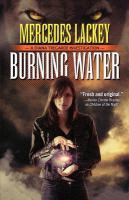
Burning Water by Mercedes Lackey


Reviewed by Jeanne

It started with cattle mutilations.  Then the attacks began targeting people, often leaving bloody and shocking crime scenes. Detective Mark Valdez begins to wonder if the perpetrators are members of some strange cult, Satanic or otherwise.  With no solid leads in sight, he asks to call in someone he knows who might be able to give the police some insight into what’s going on.

Diana Tregarde’s day job is romance novelist, but she’s also a practicing witch and an investigator of supernatural events.  She catches the next flight to Dallas, but even Diana isn’t prepared for what she and Mark may be facing.

Most people know Lackey as the author of the long running Valdemar series, but she’s also the author of several others. Burning Water is the first in a nifty urban fantasy series which came out in the late 80s/early 90s which is about the time I first read this book. While shifting books on my shelves I came across the first three books and realized I hadn’t finished reading the series, so I decided to re-read the first one to see if it held up before tackling the other two.

I found I really enjoyed it the second time around.  There are a few minor things that are dated but none of that affected my enjoyment.  There are a some graphic scenes but those aren’t drawn out and are connected to the ultimate solution.  I also liked the information about folklore and other belief systems. Some reviewers have said Diana is just too perfect, or that the book is too talky. There are sections in which the characters discuss religion and philosophy, but I found it interesting and not preachy.  As to Diana’s goodness, I’m good with it—yes, pun intended. 

I liked the pacing.  While there were times I wanted the characters to be quicker on the uptake, there was a reason for that—and I suspect the author was using that device to ratchet up the tension a bit, letting the reader know what was going on in a way that the main characters couldn’t. When it all comes together, the story moves rapidly to a satisfying conclusion.

Although Lackey just wrote three novels in the series, she has done a few novellas that are available as ebooks.  I may take a look after I finish the others.

Books in the series are:

1.       Burning Water

2.      Children of the Night

3.      Jinx High

Friday, February 7, 2025

The Bog Wife by Kay Chronister


Reviewed by Jeanne


Wenna left home nearly a decade ago, running away from her family’s legacy and the stifling home life ruled over by her father.  Now her youngest sister Nora has written to her, asking her to come back to the family home in West Virginia because her father is dying.  Wenna is needed for the rites which will ensure that the family and the compact will continue.

For generations, so they’ve been told, the Haddesley family has tended the bog and in return, the bog has nourished them and provided the eldest son with a wife after the patriarch dies.  There are rituals to be performed as part of the Haddesleys’ side of the bargain before the wife arrives.

But no wife comes.  The five siblings—Charlie, the eldest son and reluctant heir; Eda the eldest daughter who sees herself as the guardian of the family and its heritage ; Wenna, the middle child who once found the courage to leave; Nora, the youngest daughter who collects injured creatures and cares for them; and Percy, the youngest child who would like to be the heir— are suddenly in uncharted waters, unsure what to do. How do you fix a compact forged thousands of years ago?

Told in alternating chapters from each of the siblings’ points of view, The Bog Wife is a sort of Appalachian gothic, set in a crumbling house where time has stood still.  There’s a sense of claustrophobia, scented with decay; the hand me down clothes, decades out of fashion, old copies of the National Enquirer with lurid stories of celebrities and garish photos showing a life that might as well be taking place on another planet, the odd cans of soup and gathered food that form their meals, and above all, the family secrets.

I picked this up because the reviews all alluded to the Appalachian setting and to the folkloric elements.  I was also in the mood for an atmospheric book, and this one certainly delivered. This is one of those books that raises as many questions as it answers, but that’s part of the enjoyment for me, coming up with my own answers—or not.  The characters are all sympathetic in their own ways; I liked them all and so wanted happy endings for all of them—or at least what I would consider happy.  I’m not sure the Haddesleys would agree with my versions.  There are so many layers in this book.  I found myself re-reading sections, trying to suss out some of the meanings.

This may not be a book for everyone, but if gothic family sagas with supernatural touches and folkloric are a genre you enjoy, then give The Bog Wife a try. Better yet, find a friend to read it at the same time.  You’ll have a lot to talk about.

Monday, July 29, 2024

The Element Encyclopedia of the Celts by Rodney Castleden


Reviewed by Jeanne

Subtitled “The ultimate a-z of the symbols, history, and spirituality of the legendary Celts,” this book does take on a lot of territory.  Author Castleden, a former teacher, divides the book up into six sections: Celtic people and lifestyles; Celtic places; Celtic religion; myths, legends, and stories; symbols, ideas, and archetypes; and Celtic twilight and revival.  Each section has an a-z listing of terms under that topic, with many “see” references for alternate terms and spellings.

The length of entries varies from a couple of sentences to several pages, depending on the topic.  The tone is conversational but not casual; and the author tries to be very even-handed on some controversial topics, such as King Arthur. (Castleden does believe there was a historical Arthur but also explains why others don’t believe he existed.)

To be honest, I got much more than I expected from this book.  I like the detailed explanations and that some things are put in historical context:  as in, this is what was thought about the item when first discovered, this is what other evidence showed, and this is the current thought. I like that it is very browseable, and that I found all the entries both interesting and entertaining.  Under “Bean Si,” I learned that this is the term for a Celtic fairy woman who is often seen washing the bloody clothes of those about to die.  It’s pronounced “banshee”—and that certainly explains a lot.  Another term I looked up was “Claddagh,” the popular symbol of clasped hands and a heart. Castleden says it dates to the sixteenth century and seems to have originated in Galway, though it may have been inspired by a Roman design. The section on “Fairies” was quite enlightening, and certainly explained some references I had come across as to their origin and dress.

There are entries on Druids, Samhain, Celtic Cross, and many more.  There aren’t a lot of illustrations but the information more than makes up for it. As mentioned before, I like that the author is up-front about his biases and beliefs rather than just presenting them as fact; it leaves room for disagreement.  I do wish there was an index, but otherwise I found this a very enjoyable and informative book.

Friday, June 21, 2024

Little Encyclopedia of Fairies by Ojo Opanike


Reviewed by Jeanne

While setting up our cryptid display, I was a bit sidetracked looking at other creatures in folklore.  This small volume with a charming cover is subtitled “An A to Z Guide to Fae Magic” and includes creatures from cultures all over the world.  Unlike the Disney versions, many of these creatures aren’t cute or fond of humans, except perhaps as a snack.  Many are small, some can shape-shift, and they mostly are connected with nature.  Some are helpful to humans; others are indifferent or malevolent; some can be all three, according to their mood.

For many fairies, giving them a place to stay or offerings of food will encourage them to help or bring luck to humans, or at the very least to not create mischief.  Some appear as small humans, while others like the Alpine Aguane are beautiful but who have hooves.  The Abatwa of South Africa are so small that they ride on the backs of ants but they can bring down large game with their poisoned arrows. You can curry favor with them by saying they appear large.

While many were new to me, some readily recognizable ones are also included, such as Brownies or Boggarts. One feature I particularly liked in this book is that the author will often mention a literary appearance although the Boggarts of Harry Potter are different than the traditional forms. Traditionally, a mistreated Brownie becomes a malicious Boggart.

While I’ve read other books on fairies, most have concentrated on European folklore.  This one has global coverage, including entities from Native American tribes.  The entries are mostly brief and there are a few illustrations.

This is by no means a comprehensive look, but it is a fun browser’s book.   

Monday, March 18, 2024

Bittersweet in the Hollow by Kate Pearsall

Reviewed by Jeanne

The first James woman walked alone out of the Forest in Cabal Hollow, West Virginia generations ago.  Since then, all the James women have had certain gifts. The current James family has them too.  They are somewhat small gifts as magic goes; for example Rowan James knows when someone is lying and Sorrel James can charm bees.  Linden James can taste emotions: she knows exactly what people are feeling, whether or not she wants to.

What Linden can’t do is remember what happened last summer when she went missing in the woods during the festival.  She was found with a head injury and no memory of what happened or how she ended up where she was.  Some people seem dubious about her claim of amnesia, but then the James women have always been the object of suspicion even as people come to them for tonics and creams.

Now the summer solstice is here which means festival time:  the Moth Festival, celebrating the legend of the Moth-Winged Man, a folkloric figure who may bring death or at least warn of death. Linden’s friend Dahlia Calhoun has come home from college for the festival.  Dahlia is the reigning Moth Queen, and it’s time for her to relinquish her crown.

But Dahlia goes missing the night of the festival, only to be found dead. Linden knows that she is going to have to discover what happened to her the year before if she is going to be able to solve Dahlia’s murder. She’s also going to have to uncover a lot of secrets—including some about her own family.

Sometimes a novel just has you by the opening paragraph.  That’s what Bittersweet in the Hollow did for me.  I liked the writing and the imagery from the start, and the story just drew me in. This is a beautifully written YA novel set in West Virginia. Appalachian traditions are represented without condescension or judgment.  The book is a wonderful blend of mystery with some supernatural elements, romance, coming of age, and family.  Characters were well developed, and the setting was very vivid.  I liked that Pearsall took the Point Pleasant’s Mothman legend and reshaped it into something else, drawing more on traditional lore. I was drawn to all the characters and the book left me wanting more.  I liked all the sensory descriptions Pearsall employed.  In some ways, the book reminded me of those written by one of my favorite authors, Sarah Addison Allen. 

I understand there is going to be another book in the series, and I’m already looking forward to it.

Monday, February 7, 2022

Death of a Wandering Wolf by Julia Buckley

Reviewed by Jeanne

Hana Keller is thrilled to find a valuable china figurine of a wolf at a garage sale.  It’s a Herend, the product of a famous Hungarian pottery, and priced at only $5.  Hana tells the seller it’s worth much, much more, but he says it came from someone he doesn’t trust and he wants rid of it. He also has some beautiful paintings he’s selling for far less than they’re worth. Hana loads up, and lets a friend who owns an antique shop know about the amazing sale so he can check it out.

Unfortunately, when she shows her prize to Eric Wolf, her detective boyfriend, he doesn’t seem nearly as enchanted.  In fact, he’s downright upset.  The wolf has a tiny metal tracking device attached, meaning whoever has the figurine is being tracked by someone else.  Eric and Hana head back to the seller’s house, only to find that he has been murdered.

This is the second in the Hungarian Tea House Mystery series, following Death in a Budapest Butterfly.  I was anxious to read it because I loved the first one.  Hana and her family run a traditional Hungarian Tea House, so the reader learns not only about Hungarian food but customs and folklore as well.  There’s a touch of the supernatural in that Hana’s grandmother reads tea leaves with uncanny accuracy, and Hana is beginning to realize she may have inherited this gift. 

The plot is more cozy than classic mystery, which is to say that some clues come from supernatural sources and there is as much interest in interpersonal relationships as in the mystery. The characters are interesting and entertaining, and I quite enjoyed meeting Eric’s twin sisters.  That said, I would have liked a bit more action with Hana’s grandmother because she is more steeped in Hungarian ways which is one of the book’s attractions for me.

Death of a Wandering Wolf did not disappoint.  There is a fascinating mystery tied up with an historical event involving Hana’s great grandmother as well as character development.  We’re introduced to some of Eric’s family, Hana explores her gift, and there are wonderful descriptions of art and food.  I’m not one of those who reads cozy mysteries for the recipes—I have to replace smoke detector batteries every time I cook—but I am sorely tempted to try the haluska which involves cabbage, noodles, and butter, three of the major food groups.

I don’t think you would have to read these in order to enjoy them, but I prefer to read series that way.  The first book had more Hungarian folklore and culture, and I was especially intrigued by the various “witches” who populated the folktales.

I already have the third book in the series, and I fully expect it to be a delight as well.


Friday, June 9, 2017

The Kind Folk by Ramsey Campbell


Reviewed by Jeanne


What would you do if you suddenly discovered your parents weren’t your parents?  That’s just what happens to Luke Arnold on national television, no less.  He’s been dragged to the Brittan’s Resolutions show—a sort of British Maury Povich program—because his father Maurice suspects Luke is really the son of his brother, Terrence, despite tearful denials from Freda, Luke’s mother. 

As it turns out, none of them are related to Luke at all.

Luke is left in an uncomfortable situation. His erstwhile mother wants to pretend nothing at all has changed, while others kept asking Luke if he isn’t curious about his biological parents.  His partner, Sophie, is expecting the couple’s first child, but she is content with whatever Luke decides to do.

Luke isn’t sure what he wants, except that he wishes the TV show had never happened.  He has the impression that his Uncle Terrence knows more than he is telling, but Terrence dies suddenly of a heart attack before Luke has a chance to question him.  He leaves his house to Luke, and when Luke goes to look it over, he finds that Terrence left a journal with many curious notations—not to mention an odd collection of artifacts, most of which seem to pertain to ancient folklore. And then Luke begins to feel he's being watched. . . .

Ramsey Campbell has been called “Britain’s greatest living horror writer,” which may be one reason I haven’t read his previous books.  Horror is not my favorite genre, not since Richard Matheson kept me awake several nights; I have enjoyed certain books (The Seeker by R.B. Chesterton springs immediately to mind) that deal more in creepiness and unease instead of gore and projectile regurgitation. I was drawn to The Kind Folk because the reviews said it drew from folklore, which I usually enjoy.

Having finished the book, I’m still not quite sure what to make of it.  The jacket copy didn’t help; it didn’t exactly fit the book I read.  I understood the underlying implication of Luke’s birth, but the broader possibilities left me more than a bit baffled.  This is probably a flaw more in the reader than the writer. I also wonder if it would have helped had I known more about the history and folklore of some of the places visited.

On the other hand, Luke’s uncertain probing into his origins held my attention.  His attempts to decipher exactly what Terrence meant kept me turning the pages but the most mesmerizing parts took place in the woods and fields where Luke feels he is being watched, maybe even glimpsing movement around the trees.  I have to say that I looked at the foliage around my house with deep suspicion after reading the book.

Campbell wrote on his website (www.ramseycampbell.com) that if he cannot achieve awe, then he strives for “a lingering disquiet.”  I think he has achieved that with The Kind Folk.

Monday, January 9, 2017

The Truth is a Cave in the Black Mountains by Neil Gaiman


Reviewed by Jeanne

The subtitle to this book is “A Tale of Travel and Darkness with Pictures of All Kinds,” and that does give the reader a hint about this story.  It’s a bit hard to categorize, but the same could be said of much of Gaiman’s work. It began life as a story to be read aloud at a festival at the Sydney Opera House, complete with art and music; won the Shirley Jackson Award for Best Novelette as text, and now is a book with many and various pictures: paintings, collage, cartoon boxes with dialog, a bit of everything—pictures of all kinds, indeed. There is also much darkness of all sorts.

The story is told in first person by a diminutive Scotsman who has spent a decade searching for a man by the name of Calum MacInnes.  As the story opens, he is asking MacInnes to be his guide to a certain cave in the Misty Isles, a legendary cave, which is said to contain gold. . . and something else. Both men are wary, especially MacInnes, but the desire to obtain a goal is stronger than any doubts and they set off on a perilous journey.

Gaiman has the knack of writing in such a way that you feel you’re reading an ancient story, one passed down through generations.  There’s also the sense that you’re not getting the full unvarnished story.  Things are held back and left unsaid.  It’s up to the reader to piece it all together.  There’s a definite layer of darkness all through the tale along with vivid descriptions of the winds and cold and the wild terrain that made me want to put on a jacket or at least turn up my collar. The writing itself is beautiful and evocative—nobody spins a tale quite like Gaiman—and the ending took my breath away. I didn’t like this book, I thought. 

And yet I go back to it again and again, reading passages to see how he shaped the story, and understanding the main character more and more. I can’t help but wonder, though, if I would have seen it differently without the illustrations.  I almost think I would have appreciated it more because I would have internalized and admired the words more from the start. And yet certain of the illustrations speak very strongly and deeply. The cover is absolutely perfect. 

This is a story to raise the hair on your neck, to make you weep, and to make you empathize. It’s one of those rare tales that will walk beside you in the dark but not menace you.  It’s a deeply human tale, told by a master.