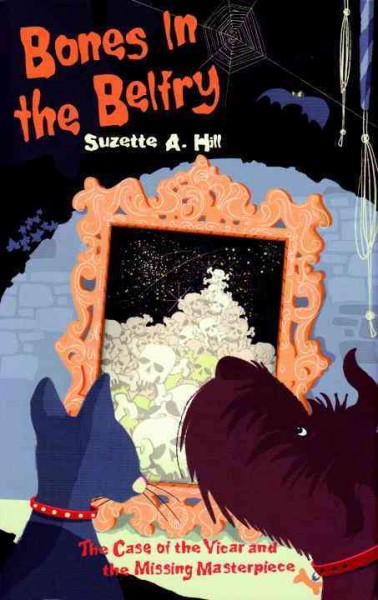
Bones in the Belfry by Suzette Hill (F HIL Main)
(Please forgive the heading. I couldn't resist the alliteration.)
Reviewed by Jeanne
Do you watch the Britcoms on PBS? You know, the shows like “Keeping Up Appearances” or “Are You Being Served,” in which people end up in increasingly ridiculous situations all while trying to keep their dignity intact. If you like that sort, then do I have the book for you!
It’s the late 1950s and the Reverend Francis Oughterard is very happy in his work as vicar of a small village. He does a lovely funeral, for instance, and doesn’t mind the sermons or weddings. Baptisms are a bit of bother, mainly because the infants are often squirmy and occasionally go headfirst into the font, which is disconcerting and upsets some people. Other than that, and handling the tantrums of the organist and smoothing things over with some of the parishioners who squabble about who’s in charge of what, he finds he has a lovely existence, treating himself to some fine wines and enjoying the company of his dog and cat. Well, there was that business when he strangled Mrs. Elizabeth Fotherington but she really had it coming to her. Honestly, he didn’t really mean to do it and he certainly won’t do it again.
The trouble starts when his friend Nicholas brings by some paintings that he wants put in a safe place, paintings that Francis is sure are stolen. Normally, he would have refused but Nicholas provided him with an alibi, no questions asked, in that little matter of Mrs. Fotherington. While Nicholas hasn’t actually said anything, the vicar has the distinct impression that if he refused to stash the paintings Nicholas might recant.
The plot thickens when Maud Tubbly Pole turns up. She’s a crime novelist who thinks the strange unsolved murder of Mrs. Fotherinton would be a perfectly thrilling premise for her next mystery. What’s more, she thinks the vicar is just the person to help her research the story.
The story is narrated from three points of view in three distinct voices. The first is Francis himself, a fussy somewhat nervous man who just wants to sip his wines and perform his duties in peace. The second is Bouncer the dog, whose former owner was a banker who absconded with a suitcase full of cash. Bouncer is an energetic soul, obsessed with his bones—the chewing kind—and rambling around with his canine buddies. Maurice the cat is the third narrator, former pet of Mrs. Fotherington and who seconds the vicar’s vote of “good riddance.” Bouncer finds Maurice to be smug and superior, Maurice thinks Bouncer is scatterbrained and none too bright even if he has learned bits of Latin from his jaunts in the graveyard, and they both know that Francis is their bumbling meal ticket. They are well aware of the vicar’s little misadventure, and (unbeknownst to Francis) actually helped cover up the crime. After all, as Maurice points out, if Francis goes to the gaol, they’ll be out on the street again. All three are quite self-centered and determined to maintain their own status quo.
I found this to be a rollicking tale. I could almost picture some of the scenes in my head and would have sworn I heard Hyacinth Bucket’s voice: it’s that type of book. This is actually the second in the series. I’ve requested an interlibrary loan of the first book, but I didn’t have any trouble following the plot at all.
Update: I borrowed and read the first book in the series, A Load of Old Bones. It was good, but not as good as the second book. I don’t know if that was because I already knew much of what was going to happen from hints in the first book or if it was because it took awhile to introduce the characters and situation. A colleague tried to read it and gave up. I think this may be one of those cases when the author sort of hit her stride in the second book. I’ll know more after I read the third in the series, Bone Idle.
Reviews by the Reference Department of the Bristol Public Library, Bristol, Virginia/Tennessee.
Friday, February 25, 2011
Saturday, February 19, 2011
2000-2009: What a Difference a Decade Makes!
Reviewed by Nancy
As a youngster, back in the eighteen hundreds, uh, no, I'm sorry it was the early nineteen hundreds. Oh, no, I guess it was the mid twentieth century. Well, whatever. Anyway, a LONG TIME AGO when I was young and in school, anytime I was issued a new textbook the first thing I did was flip through the book and look at the pictures. Text only became important to me later in life. When I was young, I was all about the photographs.
I suppose that's why I so enjoyed looking at 2000 - 2009 The Decade That Changed The World by the editors of Life Books. (909.831 TWO Main)
Turning the pages of this book you can remember George Bush in his flight suit, Saddam Hussein in his hole in the ground, Tina Fey pretending to be Sarah Palin while playing the flute, the Boston Red Sox, Lance Armstrong, the flood of Hurricane Katrina, Michael Phelps, and on and on and on.
The book progresses through the decade year by year with a text summary of each year at the beginning of the section.
The 2001 section features only photographs of the inauguration of George Bush, the World Trade Center disaster, and the war in Afghanistan. For other highlights of that year, one must read the text.
If, after this, you feel the need to dwell on more lighthearted images, flip to one of the two "of the moment" sections and entertain yourself with a sassy picture of Amy Winehouse or an elegant photo of Brad Pitt and Angelina Jolie.
2000 - 2009 The Decade That Changed The World closes with a "farewell" section that presents photos of some of the national figures that exited this earthly plane during the decade.
Throughout the book I found myself thinking over and over again, "Oh, yeah, I forgot about that." If you'd like to review the things you remember, or check to see what you've forgotten, have a look at this book. It's fun!
Tuesday, February 15, 2011
Bearers of the Black Staff: Legends of Shannara
Reviewed by Susan Wolfe
Elves. Magic. Adventures that rival Tolkien's Hobbit.
Terry Brooks has long been known for his science fiction and fantasy. He worked with George Lucas to write Star Wars: Episode I The Phantom Menace.
Like Tolkien and J.K. Rowling's Harry Potter series, he has created a whole, fully-developed world, bringing together elves, Druids, trolls and men to battle demons. The Shannara series occur years after the "Great Wars" of men, wherein which civilization is pretty much wiped out. A handful of survivors were led to a valley in the mountains. From there, the world is slowly recreated. The Shannara trilogies cover later generations of a family that reluctantly is called to fight magic that has been twisted. The stories are wonderful. This book backs up in time to the beginning of the story, when their peaceful valley is breached by demons.
For 500 years, one man is chosen by his predecessor to be the Bearer of the Black Staff. Not used in centuries, the staff is said to contain magic. Syder is the current Bearer. He discovers a rift in the magic that has both protected and hidden their peaceful valley. Worse than that, he finds that the whole protective barrier is failing. Already some monsters have entered. He saves a couple of young trackers, Pan and Prue, from a savage death. They rush to warn the valley peoples, but few believe it is happening.
These characters are fully developed. Syder's background and a lost opportunity at love are touching. How he is unwillingly selected to be the Bearer is tantalizingly hinted at and finally explained at the very end. The humans Prue and Pan, are nicely portrayed, pragmatic yet youthfully inexperienced. An elfin princess, Phyrne, is eager be part of the adventure, yet drawn to the human Pan which is a major taboo in their world. The valley settlements are fully drawn out societies: bickering leaders, a king blinded by love, intrigue and murder.
Then there is a threat from without: a Troll army wants the valley for themselves.
As a long-term follower of the Shannara books, this is a story that I've been awaiting. The background is a foundation for all the other series. It's the beginning thread that leads to the other stories. For someone new to Shannara, it is an interesting book that ends on a cliffhanger. It might just hook you into wanting more, like it did me all those many years ago.
One thing for sure, Terry Brooks has a master's touch.
Bearers of the Black Staff is available at both Main & Avoca under F BRO. Main also owns a copy of the audio book (CD F BRO).
Thursday, February 10, 2011
In the Still of the Night: Rule Rules!
In the Still of the Night by Ann Rule (364.1523 RUL Main)
Reviewed by Sue Wolfe
When Ann Rule speaks, people listen. She’s a dynamic true crime writer. She often takes on subjects that make you cringe, like Ted Bundy. She thoroughly researches the material.
Barb Thompson is a strong independent woman. Nine days before Christmas in 1998, Ronda, her only daughter, had arranged to visit her mother in Seattle. Ronda never made that visit. Instead, she died that morning with a gunshot wound to the head.
Ronda Reynolds had been a Washington State Trooper. She had divorced another trooper and made enemies with the public and within the department. She had then remarried a respected high school principal, but the marriage was in trouble. The coroner declared it a suicide. So did the local police and her estranged husband. But . . .
There were several inconsistencies and poor detective work in the case. The husband claimed to have slept through the shooting, only 15 feet away. Her stepchildren were removed from the scene before being questioned, including a teenage stepson who hated Ronda. His friends reported that the stepson was heavily into drugs, and had been peeping at Rhonda while she showered. Ronda’s husband's ex-wife may have been involved too.
This story is a tragedy. It is also a story of a loving and devoted mother who wanted justice for her daughter. Frustrated and angry with an investigation so obviously botched and incompetent, Barb Thompson never accepted the ruling of suicide. The coroner who ruled it a suicide on the day of the death became the center of the later civil suit.
The case became well known in the region. It began and finished the careers of elected officials. It was a locally famous case that was in Ann Rule's backyard. It is obvious that Ann Rule admires Barb Thompson. In fact, this is the only book by Ann Rule that I've read in which she allows her feelings to leak through. This may turn off some readers, but this still evolving story deserves to be told. I don't think anyone else could have done it better.
The case was declared a murder in November, 2009. The case is still unresolved, but Ann Rule sheds light on the mystery surrounding it. Some people will have egg on their face. Others should be expecting a knock on the door from the FBI with a search warrant.
Wednesday, February 2, 2011
Victorian Shades: The Woman in Black
The Woman in Black by Susan Hill (F HIL Main)
Reviewed by Jeanne
Young solicitor Arthur Kipps is sent by his firm to a rather secluded English village in order to tie up the affairs of the late Mrs. Alice Drablow, a recently deceased elderly client. The villagers don’t seem inclined to discuss Mrs. Drablow, or anything else for that matter, though they do make Arthur welcome. At the funeral service, Arthur catches a glimpse of a woman in black lurking around the churchyard, but his inquiries are brushed aside. Resolutely, he prepares to go to Eel Marsh House, Mrs. Drablow’s residence, which is in a marshy area accessible only at certain times due to the tides. Once there, he will be cut off from the outside world until such a time as the pony cart can cross the causeway to fetch him.
He’s going to wish he had taken a tide chart with him.
The subtitle of the book is “A Ghost Story” and that’s exactly what this is, in the best sense of the phrase. The old fashioned setting, the formal narration, even the nature of the story itself harkens back to those wonderful early ghost tales where the chills and thrills came from the mind and not blood spatter. Hill has perfectly captured the flavor of these Victorian tales but without the sometimes purple prose. It’s beautifully written; Arthur, the narrator, is looking back at an event which shaped his life and he tells his tale without hyperbole or exaggeration. It has the ring of authenticity.
The book is just so wonderfully atmospheric. I could practically smell the sea air and shivered a bit in the dampness. While there were definitely warning signs, the book wasn’t over laden with signs and portents. The villagers may not have been over communicative, but there was nary a pitchfork nor cackling crone in sight. Arthur enjoys a hearty meal at the inn, a warm fire and a comfortable bed. The skies are blue and largely clear but cold. No air of menace hangs overhead.
The haunted aspects come later.
The ending is abrupt and I was taken aback at first, but it is the perfect ending. He has told his tale; there’s no analyzing or rationalization that this might have been just his imagination. This is what happened and, like the villagers, he has no wish to discuss it further.
My impetus for reading this book came originally from a mention on DorothyL, the listserv for mystery lovers. At the time I wasn’t really in the mood for either a ghost story or a period piece, so I put it aside for another time. I was reminded of the book when I saw that Harry Potter’s Daniel Radcliffe had chosen it for his next role. I was a bit curious as to why, so I tried the book again. This time I had no trouble starting the book at all and certainly see why it’s a plum part. I puzzled a bit over how some of it will be handled, but discovered there has been a stage version running in London’s West End for a couple of years now. I’ll still be interested to see how they rework the book for the screen, but I don’t think it can possibly measure up to the scenes Hill evokes in her novel.
Monday, January 24, 2011
Flavia de Luce Redux!
The Weed That Strings the Hangman’s Bag by Alan Bradley (F BRA Main)
Reviewed by Jeanne
Life has returned to normal for Flavia de Luce, eleven year old chemist, would-be sleuth and resident of Bishop’s Lacey. After all, it’s probably too much to expect to find yet another stranger lying dead in one’s cucumber patch. Flavia is making the best of things by continuing her experiments and trying to find new ways to torment her older sisters, Daffy and Feely, who cheerfully return the favor. Things start to look up a bit when Rupert Porson, puppeteer extraordinaire, and his beautiful assistant Nialla turn up in the village and agree to do a performance at the church. They have very little choice in the matter: their van has broken down and they’re stuck until it’s repaired. Flavia soon has reason to suspect that Rupert is no stranger to Bishop’s Lacey: one of his puppets bears an uncanny resemblance to a child who died several years earlier under somewhat unusual circumstances.
When Rupert has a fatal encounter with large amounts of electricity, Flavia knows at once that it’s no accident. The police tend to agree, but they seem less than enthusiastic about having an underage detective doing her own investigations. That doesn’t deter Flavia in the slightest, of course, and she sets out to learn all she can about the tangled relationships and dark pasts of those involved.
I for one cheered the return of the indomitable Flavia de Luce whom we first met in The Sweetness at the Bottom of the Pie. Some people found Flavia too precocious and too smug, but I found her delightful. She has a sharp tongue and quick wit. (In regard to the vicar’s wife, Flavia says “I have to admit… that Cynthia was a great organizer, but then, so were the men with the whips who got the pyramids built.”)
She’s extremely well read, extremely bright and more than a bit stubborn, but she’s still a child. She understands a great deal but not quite as much as she thinks she does, especially where emotions are concerned. She’s read Madame Bovary, for instance, but doesn’t quite grasp some of the implications. She goes to her friend Dogger, an ex-soldier suffering from shell-shock who serves the family as chauffeur and general handyman, and inquires about a particular passage:
“What did Flaubert mean… when he said that Madame Bovary gave herself up to Rudolphe?”
“He meant,” Dogger said, “That they became the greatest of friends. The very greatest of friends.”
To which Flavia replies, “Ah! Just as I thought.”
The supporting cast is wonderful. The family plays a lesser role in this second book, though the scenes with visiting Aunt Felicity are not to be missed. Instead we have a fine cast of suspects with complex motivations and dark histories. Bradley seems to evoke England of the 1950s with ease.
You don’t need to have read the first book to enjoy this one; each stands alone. There’s a lot of humor but it’s thoughtful rather than slap-stick. I find Flavia delightful and I hope you will too.
Reviewed by Jeanne
Life has returned to normal for Flavia de Luce, eleven year old chemist, would-be sleuth and resident of Bishop’s Lacey. After all, it’s probably too much to expect to find yet another stranger lying dead in one’s cucumber patch. Flavia is making the best of things by continuing her experiments and trying to find new ways to torment her older sisters, Daffy and Feely, who cheerfully return the favor. Things start to look up a bit when Rupert Porson, puppeteer extraordinaire, and his beautiful assistant Nialla turn up in the village and agree to do a performance at the church. They have very little choice in the matter: their van has broken down and they’re stuck until it’s repaired. Flavia soon has reason to suspect that Rupert is no stranger to Bishop’s Lacey: one of his puppets bears an uncanny resemblance to a child who died several years earlier under somewhat unusual circumstances.
When Rupert has a fatal encounter with large amounts of electricity, Flavia knows at once that it’s no accident. The police tend to agree, but they seem less than enthusiastic about having an underage detective doing her own investigations. That doesn’t deter Flavia in the slightest, of course, and she sets out to learn all she can about the tangled relationships and dark pasts of those involved.
I for one cheered the return of the indomitable Flavia de Luce whom we first met in The Sweetness at the Bottom of the Pie. Some people found Flavia too precocious and too smug, but I found her delightful. She has a sharp tongue and quick wit. (In regard to the vicar’s wife, Flavia says “I have to admit… that Cynthia was a great organizer, but then, so were the men with the whips who got the pyramids built.”)
She’s extremely well read, extremely bright and more than a bit stubborn, but she’s still a child. She understands a great deal but not quite as much as she thinks she does, especially where emotions are concerned. She’s read Madame Bovary, for instance, but doesn’t quite grasp some of the implications. She goes to her friend Dogger, an ex-soldier suffering from shell-shock who serves the family as chauffeur and general handyman, and inquires about a particular passage:
“What did Flaubert mean… when he said that Madame Bovary gave herself up to Rudolphe?”
“He meant,” Dogger said, “That they became the greatest of friends. The very greatest of friends.”
To which Flavia replies, “Ah! Just as I thought.”
The supporting cast is wonderful. The family plays a lesser role in this second book, though the scenes with visiting Aunt Felicity are not to be missed. Instead we have a fine cast of suspects with complex motivations and dark histories. Bradley seems to evoke England of the 1950s with ease.
You don’t need to have read the first book to enjoy this one; each stands alone. There’s a lot of humor but it’s thoughtful rather than slap-stick. I find Flavia delightful and I hope you will too.
Tuesday, January 18, 2011
New Cats on the Block: How to Wash a Cat & Murder Past Due
Reviewed by Jeanne
I’m not sure when cats became mystery series stars. It may have been when Lilian Jackson Braun’s “Cat Who” series took off, although the Gordons (a husband and wife writing team) produced books with DC the cat earlier. (DC's name was edited by Disney to be That Darn Cat in the movie version.) Then we saw the advent of Carole Nelson Douglas’ “Midnight Louie,” Lydia Adams’ Cat Sitter series, Garrison Allen’s “Big Mike,” Shirley Rousseau Murphy’s “Joe Grey,” and several others. Not long after, some dog mysteries began to appear, such as Susan Conant’s Dog Sitter series, the wonderful Virginia Lanier Bloodhound series, Carol Lea Benjamin’s “Alexandra and Dash” mysteries, Lauren Berenson’s Melanie Travis books and, more recently, the Chet and Bernie books by Spencer Quinn. Some authors, like Rita Mae Brown, even included both dogs and cats.
Since I was planning a trip involving airplanes, I started looking at the new paperback mysteries and discovered a new litter of cat mystery stars. There are no fewer than four series starring felines, and probably more. So I picked out a couple and took them with me. There’s nothing like being a captive audience to get me into a book. (I'll admit I did a bit of judging a book by its cover: both these have wonderful cover art!)
How to Wash a Cat by Rebecca Hale is the first in the “Cats and Curios” series. Our heroine gets the sad news that her beloved Uncle Oscar has died suddenly of a stroke. As his only heir, she inherits his antique shop in San Francisco. At first, she isn’t sure if she wants to take over the store; she already has a full time job as an accountant and she really doesn’t know much about antiques and curios. Her abrupt termination at her job makes the prospect of the shop much more appealing, so she moves in with Rupert and Isabelle, her two cats. It turns out the neighborhood is full of interesting characters—some annoying and some dangerous. It isn’t long before some suspicious circumstances have her questioning what she’s been told about her uncle’s death. Hale packs a lot of information about the history of San Francisco in the story, from its rough and tumble past to the present, and her descriptions of the city are vivid. It's also obvious that she’s very fond of the cats.
I have to say I wasn’t exactly enthralled by this book. The writing was competent enough, but there were a number of odd flashbacks in which the heroine imagined herself back in early San Francisco, to the point that another character even asks her about it. (And by the way, the lead character is unnamed for a good part of the book. I think her name turns out to be the same as the author’s but I honestly can’t quite remember.) I found Monty the neighbor-comic-relief character to be a bit too over the top for my taste, and much though I hate to say it, the cats weren’t very catlike to me. It was little things, like an odd tail thump--not a twitch--when stalking and not being freaked at the idea of being dressed up and walking a runway. Maybe I just have the wrong cats. (Melon does occasionally don accouterments but not for very long, and definitely not in front of an audience in a strange place.)
The ending left me a bit befuddled: the story had started to become increasingly implausible, and not just because she was talking about someone owning a Siamese cat mix years before Siamese were imported to the US. While I do enjoy a book with fantastical elements, this one gave very little hint of any such leanings until near the end. I also wondered quite a bit about the heroine and her lack of curiosity about some things, such as the exact circumstances of her uncle’s death and her failure to follow up on some fairly important questions. Still, I’ve read worse books and I’ll give the sequel a chance. I’ve had other authors make a false start or two before hitting his or her stride.
Murder Past Due by Miranda James also has an atypical cat, but Diesel the Maine Coon is closer to the cats I’ve known. (He looks a bit like my Elmer, but Diesel is MUCH brighter.) He doesn’t solve any mysteries but he does walk on a leash and seems a perfectly amiable sort. Diesel’s human is Charlie Harris, a good-natured librarian who works in the archives of a local college in sleepy Athena, Mississippi and volunteers at his local library. Charlie’s beloved wife has died, as has his elderly aunt, and his children are grown and living out of state. Justin, the 18 year old son of a friend of Charlie’s, has moved in as a boarder. Justin’s a good kid, but there’s obviously something on his mind lately.
This relatively tranquil scene is upset by the appearance of Godfrey Priest, a former classmate of Charlie’s who has become a best-selling author of thrillers. Charlie remembers Godfrey as being arrogant, condescending and obnoxious, and it becomes obvious that success hasn’t really changed him. Still, it’s a bit of a surprise when Godfrey turns up dead. Things get even worse when it appears Justin may be a suspect, and Charlie feels he needs to do a bit of sleuthing on his own to get to the truth.
I found Murder Past Due to be much more enjoyable and not just because the author apparently does know her way around a library. I liked Charlie. He seems the sort of solid, dependable person who is the backbone of most small towns. Some reviewers found him to be too staid, too set in his ways; I didn’t agree, but that may be because I am too staid and set in my ways. The setting was gently Southern: recognizable, but the author didn’t feel the need to have someone whip up a pot of grits or have a possum amble by every second page or so. It was also rather refreshing to have a cozy mystery with a male protagonist. I have to say, though, that the part which impressed me most was the way Charlie and the deputy worked—or didn’t work—together. In most amateur sleuth series, if the police and the sleuth aren’t friends, then the police are portrayed as idiots. In this book, while the deputy was a bit stiff and impatient, she was open to help within reason and she was careful to explain to Charlie why some of his good intentions went awry: things like chain of evidence, for example. For me, this was a satisfying mystery with companionable characters and a comfortable setting. I’ll be looking forward to the sequel.
There are some other new cat mystery series I'll be reviewing as soon as I complete a few steps. Step one: Find where I put the books. Step two: Read books. Step one will probably take longer than step two...
There are copies of both books available in our system. If you need help locating or reserving them, please check with the folks at Reference.
I’m not sure when cats became mystery series stars. It may have been when Lilian Jackson Braun’s “Cat Who” series took off, although the Gordons (a husband and wife writing team) produced books with DC the cat earlier. (DC's name was edited by Disney to be That Darn Cat in the movie version.) Then we saw the advent of Carole Nelson Douglas’ “Midnight Louie,” Lydia Adams’ Cat Sitter series, Garrison Allen’s “Big Mike,” Shirley Rousseau Murphy’s “Joe Grey,” and several others. Not long after, some dog mysteries began to appear, such as Susan Conant’s Dog Sitter series, the wonderful Virginia Lanier Bloodhound series, Carol Lea Benjamin’s “Alexandra and Dash” mysteries, Lauren Berenson’s Melanie Travis books and, more recently, the Chet and Bernie books by Spencer Quinn. Some authors, like Rita Mae Brown, even included both dogs and cats.
Since I was planning a trip involving airplanes, I started looking at the new paperback mysteries and discovered a new litter of cat mystery stars. There are no fewer than four series starring felines, and probably more. So I picked out a couple and took them with me. There’s nothing like being a captive audience to get me into a book. (I'll admit I did a bit of judging a book by its cover: both these have wonderful cover art!)
How to Wash a Cat by Rebecca Hale is the first in the “Cats and Curios” series. Our heroine gets the sad news that her beloved Uncle Oscar has died suddenly of a stroke. As his only heir, she inherits his antique shop in San Francisco. At first, she isn’t sure if she wants to take over the store; she already has a full time job as an accountant and she really doesn’t know much about antiques and curios. Her abrupt termination at her job makes the prospect of the shop much more appealing, so she moves in with Rupert and Isabelle, her two cats. It turns out the neighborhood is full of interesting characters—some annoying and some dangerous. It isn’t long before some suspicious circumstances have her questioning what she’s been told about her uncle’s death. Hale packs a lot of information about the history of San Francisco in the story, from its rough and tumble past to the present, and her descriptions of the city are vivid. It's also obvious that she’s very fond of the cats.
I have to say I wasn’t exactly enthralled by this book. The writing was competent enough, but there were a number of odd flashbacks in which the heroine imagined herself back in early San Francisco, to the point that another character even asks her about it. (And by the way, the lead character is unnamed for a good part of the book. I think her name turns out to be the same as the author’s but I honestly can’t quite remember.) I found Monty the neighbor-comic-relief character to be a bit too over the top for my taste, and much though I hate to say it, the cats weren’t very catlike to me. It was little things, like an odd tail thump--not a twitch--when stalking and not being freaked at the idea of being dressed up and walking a runway. Maybe I just have the wrong cats. (Melon does occasionally don accouterments but not for very long, and definitely not in front of an audience in a strange place.)
The ending left me a bit befuddled: the story had started to become increasingly implausible, and not just because she was talking about someone owning a Siamese cat mix years before Siamese were imported to the US. While I do enjoy a book with fantastical elements, this one gave very little hint of any such leanings until near the end. I also wondered quite a bit about the heroine and her lack of curiosity about some things, such as the exact circumstances of her uncle’s death and her failure to follow up on some fairly important questions. Still, I’ve read worse books and I’ll give the sequel a chance. I’ve had other authors make a false start or two before hitting his or her stride.
If you like books about San Francisco, especially ones that deal with the early history, a plucky heroine, antiques, and cats, give How To Wash A Cat a try and let me know what you think.
Murder Past Due by Miranda James also has an atypical cat, but Diesel the Maine Coon is closer to the cats I’ve known. (He looks a bit like my Elmer, but Diesel is MUCH brighter.) He doesn’t solve any mysteries but he does walk on a leash and seems a perfectly amiable sort. Diesel’s human is Charlie Harris, a good-natured librarian who works in the archives of a local college in sleepy Athena, Mississippi and volunteers at his local library. Charlie’s beloved wife has died, as has his elderly aunt, and his children are grown and living out of state. Justin, the 18 year old son of a friend of Charlie’s, has moved in as a boarder. Justin’s a good kid, but there’s obviously something on his mind lately.
This relatively tranquil scene is upset by the appearance of Godfrey Priest, a former classmate of Charlie’s who has become a best-selling author of thrillers. Charlie remembers Godfrey as being arrogant, condescending and obnoxious, and it becomes obvious that success hasn’t really changed him. Still, it’s a bit of a surprise when Godfrey turns up dead. Things get even worse when it appears Justin may be a suspect, and Charlie feels he needs to do a bit of sleuthing on his own to get to the truth.
I found Murder Past Due to be much more enjoyable and not just because the author apparently does know her way around a library. I liked Charlie. He seems the sort of solid, dependable person who is the backbone of most small towns. Some reviewers found him to be too staid, too set in his ways; I didn’t agree, but that may be because I am too staid and set in my ways. The setting was gently Southern: recognizable, but the author didn’t feel the need to have someone whip up a pot of grits or have a possum amble by every second page or so. It was also rather refreshing to have a cozy mystery with a male protagonist. I have to say, though, that the part which impressed me most was the way Charlie and the deputy worked—or didn’t work—together. In most amateur sleuth series, if the police and the sleuth aren’t friends, then the police are portrayed as idiots. In this book, while the deputy was a bit stiff and impatient, she was open to help within reason and she was careful to explain to Charlie why some of his good intentions went awry: things like chain of evidence, for example. For me, this was a satisfying mystery with companionable characters and a comfortable setting. I’ll be looking forward to the sequel.
There are some other new cat mystery series I'll be reviewing as soon as I complete a few steps. Step one: Find where I put the books. Step two: Read books. Step one will probably take longer than step two...
| Elmer practices posing, just in case. |
Subscribe to:
Posts (Atom)


