Showing posts with label puppets. Show all posts

Friday, February 24, 2023

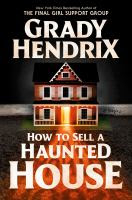
How to Sell a Haunted House by Grady Hendrix


Reviewed by Christy

            Louise has made a fairly happy life in California with her daughter Poppy. She loves her parents and her extended family, but she’s perfectly content living across the country from her childhood home in South Carolina. However, when her parents unexpectedly pass away, she’s forced to travel home and deal with all the unpleasantness of a sudden death: crushing grief, whether or not there's a will, clearing out the house, and an immature, ne'er-do-well brother who has no interest in making anything easy for Louise.

            I am a huge fan of Grady Hendrix, and one of things he does so well is give rich backstories to his characters that help them feel three-dimensional. Walking through Louise's childhood home with her as she assesses her and her family's past, I felt like I got to know her parents quite well just by that alone. The details really make it: the shag carpet, the attic string they keep tucked behind a picture frame, the pile of wood in the backyard from an unfinished deck project, and the masses upon masses of hand puppets. Yeah. There are puppets. And this brings me to why this is my least-favorite Hendrix book. Puppets do nothing for me. I just don't find them scary. They can definitely be a little creepy in a fun way (like clowns!), but that's about it. The horror in this novel heavily relies on puppets and dolls freaking you out. I know Hendrix is a fan of campy horror movies and pulp books, so I can see where his inspiration came from. But this had me questioning if I even understood what camp is. I really struggled with figuring out what tone he was going for. In his past work, he's always done well with striking the right balance with humor and horror. I don't think he is as successful here.

My reading experience wasn't all negative. I did like the discussion of generational trauma among families, and found it effective and touching. Mark, Louise's brother, starts as an extremely annoying character who develops into someone quite loveable; I loved his story arc. There are unsettling scenes and scenes that filled me with absolute dread. The history of Pupkin, the main puppet, is so heartbreaking I thought I might cry. There are definitely some good moments in here. However, I don't think this is a good representation of Hendrix's work – especially for a new reader. Unless puppets really freak you out!

Monday, January 24, 2011

Flavia de Luce Redux!

The Weed That Strings the Hangman’s Bag by Alan Bradley (F BRA Main)

Reviewed by Jeanne


Life has returned to normal for Flavia de Luce, eleven year old chemist, would-be sleuth and resident of Bishop’s Lacey.  After all, it’s probably too much to expect to find yet another stranger lying dead in one’s cucumber patch.  Flavia is making the best of things by continuing her experiments and trying to find new ways to torment her older sisters, Daffy and Feely, who cheerfully return the favor.  Things start to look up a bit when Rupert Porson, puppeteer extraordinaire, and  his beautiful assistant Nialla turn up in the village and agree to do a performance at the church.  They have very little choice in the matter:  their van has broken down and they’re stuck until it’s repaired.  Flavia soon has reason to suspect that Rupert is no stranger to Bishop’s Lacey:  one of his puppets bears an uncanny resemblance to a child who died several years earlier under somewhat unusual circumstances.

When Rupert has a fatal encounter with large amounts of electricity, Flavia knows at once that it’s no accident.  The police tend to agree, but they seem less than enthusiastic about having an underage detective doing her own investigations.  That doesn’t deter Flavia in the slightest, of course, and she sets out to learn all she can about the tangled relationships and dark pasts of those involved.

I for one cheered the return of the indomitable Flavia de Luce whom we first met in The Sweetness at the Bottom of the Pie.  Some people found Flavia too precocious and too smug, but I found her delightful.  She has a sharp tongue and quick wit. (In regard to the vicar’s wife, Flavia says “I have to admit… that Cynthia was a great organizer, but then, so were the men with the whips who got the pyramids built.”)


She’s extremely well read, extremely bright and more than a bit stubborn, but she’s still a child. She understands a great deal but not quite as much as she thinks she does, especially where emotions are concerned.  She’s read Madame Bovary, for instance, but doesn’t quite grasp some of the implications.  She goes to her friend Dogger, an ex-soldier suffering from shell-shock who serves the family as chauffeur and general handyman, and inquires about a particular passage:

“What did Flaubert mean… when he said that Madame Bovary gave herself up to Rudolphe?”

“He meant,” Dogger said, “That they became the greatest of friends.  The very greatest of friends.”

To which Flavia replies, “Ah!  Just as I thought.”

The supporting cast is wonderful. The family plays a lesser role in this second book, though the scenes with visiting Aunt Felicity are not to be missed.  Instead we have a fine cast of suspects with complex motivations and dark histories.  Bradley seems to evoke England of the 1950s with ease.

You don’t need to have read the first book to enjoy this one; each stands alone.  There’s a lot of humor but it’s thoughtful rather than slap-stick.  I find Flavia delightful and I hope you will too.