Tuesday, May 10, 2011

Unleashed: Melanie Travis Solves Again!


Unleashed (Melanie Travis Mystery)by Laurien Berenson (F BER Main; SSB F BER Main)
Reviewed by Susan Wolfe

This is a charming series.  The stories are like eating potato chips – you will want to gobble them all up.  Each book is a satisfying mystery, linked by the up-and-down career and somewhat normal life of Melanie.   Melanie is a teacher and a divorced single mom.  She loves poodles.  Melanie has another passion too– solving mysteries. 

In fact, almost all of the characters are connected to the dog show world one way or another. Her Aunt Peg is dogmatic (pun intended).  She is a breeder of championship poodles and is very opinionated and determined to interfere in Melanie’s life.   Although a novice showing dogs, Melanie’s pet poodle is quickly becoming a star. 

The stories are set in the dog show world.  It’s an interesting and varied backdrop that includes a lot of quirky people involved with dogs in some way.  There are groomers, professional showers, and breeders.  There are also links to canine related topics such as doggie daycare and pet food. 

In Unleashed, Melanie is planning a wedding – her own.   Her fiancĂ©e Sam also raises poodles. Everything is going right in her world, with one exception.  Sam’s ex-wife, Sheila has moved into the area and Shelia has made it apparent that she wants Sam back.  She calls Melanie to bury the hatchet by inviting them to dinner.  To their surprise, Sam’s former best friend is there.  Not only that, but they are starting a National Enquirer type of magazine about dog shows.  Soon afterward, Shelia is murdered.  The police think it was a burglary gone bad, but Melanie and Sam suspect otherwise.  It affects Sam deeply and he asks Melanie to do some checking around.  The list of suspects is long. 

There are some interesting side plots too.  Faith, Melanie’s poodle is pregnant.  Her son Davey has a bully at school picking on him.  The bully issue is resolved in a funny way with Aunt Peg’s interference.  She calls the kids parents to tell them they won free dog training lessons.  She plans on training not only their dog, but also their son.

This series is delightful.  The behind scenes look at dog shows is fascinating.  If you love animals, you will be hooked.

Thursday, May 5, 2011

Charlaine Harris: More than just vampires!

Some people really enjoy reading books in series. We're going to be including a list of some popular authors and series on the blog occasionally so that folks can find a list of the series books in order.

Charlaine Harris is a bestselling mystery author who likes to add a dollop of the supernatural to some of her books. While she's best known for her Sookie Stackhouse series, she already had several books to her credit.

Southern Vampire Series:
Sookie Stackhouse is a barmaid in Louisiana. Vampires, shape-shifters and other supernatural beings have come out of the shadows and been granted citizenship, so the bar has quite the varied clientele. Sookie herself is telepathic, a gift—or curse—that has made relationships with humans rather difficult, but she feels quite at home with the “others.” These books are the basis for the “True Blood” TV series. You can read them as standalones, but are somewhat more enjoyable read in order:

Dead Until Dark
• Living Dead in Dallas
• Club Dead
• Dead to the World
• Dead as a Doornail
• Definitely Dead
• All Together Dead
• From Dead to Worse
• Dead and Gone
• Dead in the Family
• Dead Reckoning
(2011)

A Touch of Dead is a collection of the Sookie short stories, many of which have appeared in other story collections.
Note: The library also holds DVD copies of the “True Blood” series.


Harper Connelly Series:
After being struck by lightning, Harper finds she can locate bodies and know how people died. Together with her step-brother/manager Tolliver, Harper travels the country to help solve murders and missing person cases.
Grave Sight
• Grave Surprise
• An Ice Cold Grave
• Grave Secret


Harris also did two very well regarded non-supernatural mystery series. Aurora “Roe” Teagarden is a librarian and true crime enthusiast in Georgia who meets with a group to rehash murders such as Jack the Ripper or Lizzie Borden. When real murders occur, Roe uses her talents to solve those as well. These books tend to be a bit more lighthearted and don’t necessarily have to be read in order.
Real Murders
• A Bone to Pick
• Three Bedrooms, One Corpse
• The Julius House
• Dead Over Heels
• A Fool And His Honey
• Last Scene Alive
• Poppy Done to Death


The second series featured Lily Bard, a martial arts expert in Shakespeare, Arkansas is trying to escape her past. These stories were darker and more serious, and should be read in order because of the way Lily’s characters changes. Harris has said that she is finished with the Lily Bard series and doesn’t plan to write any more. In order, the books are:
Shakespeare's Landlord
• Shakespeare's Champion
• Shakespeare's Christmas
• Shakespeare's Trollop
• Shakespeare's Counselor


Happy reading!

Tuesday, May 3, 2011

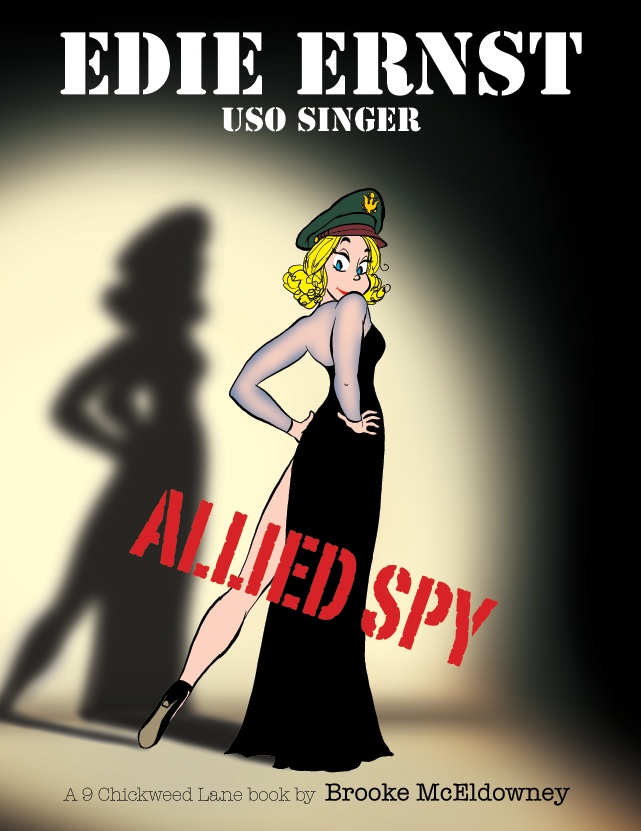
Edie Ernst, USO Singer-- Allied Spy


Edie Ernst USO Singer—Allied Spy by Brooke McEldowney (741.5 MCE Main)
Reviewed by Jeanne


Juliette rushes to the hospital after learning her elderly, cantankerous mother, Edna O’Malley, had collapsed. She finds Edna to be her usual irascible self, but then Edna surprises Juliette by asking, “Did I ever tell you how I met and fell in love with your father?” Juliette replies, “I never heard you use the word ‘love’ in the same sentence, for that matter in the same hemisphere, with any mention of Dad.” Edna then proceeds to tell her daughter about her youth. She was Edie Ernst, a young, idealistic USO singer during World War II. She remembers her first meeting with Lt. Bill O’Malley, but not exactly what she said. It was enough to have her summoned to meet a colonel who wants to know if she speaks German. When she says she does, he offers her the opportunity to serve her country—by singing to enemy POWs. She’ll be gathering intelligence information, but to a lot of people she will appear to be a traitor, giving comfort to the enemy. Edie is torn, but in the end decides to risk her reputation for the greater good of service.

Also, Lt. O’Malley will be her OSS contact, and Edna finds him very attractive. Even more so after he gives Edna her first ever kiss.

Edie, renamed Eva to sound more German, is sent to POW camps in the UK where the German soldiers are as receptive as were the Americans. All but one: a German officer. The German officer, as Edna describes him. He regards her with disdain, but sings like an angel. Edie is fascinated and infatuated. She asks him to teach her how to sing with such emotion. His response is a “withering look of disdain,” which, of course, only makes her more determined to confront him.


Thus starts one of my favorite recent stories. It’s nuanced, with well-developed characters and an intriguing plot. In some ways, it’s an old fashioned tale; it deals with loyalty, honor and love.

I suppose at this juncture I should tell you that this story is told in comic strip form. Not graphic novel, but strips that ran daily for some 11 months, keeping me on the edge of my seat each morning as I waited to read the next installment.These strips have now been collected into a book, so you can read the whole story at one sitting. If you do –and I hope you will—take note how almost every strip ends with a line that will give you pause. I hate to call it a punchline, because makes the whole thing sound cheap. The humor grows out of situation and character and is often poignant.

McEldowney does a marvelous job of explaining a situation through his characters. For example, Juliette asks if Edna was in any danger. Not from the prisoners she replies, then goes on to explain,” Well, there was this little thing called ‘The War’… and you have no idea how hot feelings can run at such a time. . . . Somehow people knew I had been visiting a POW camp and I could feel their hostility. I consorted with the enemy. . . . There was also the problem with being a Yank. Americans got a reputation for arrogance when we entered the war. We strode in among a population that had been frustrated and battered for years. . . and they quickly hated us more than they did their actual enemy.”

In those lines, Edna sums up a situation more elegantly and compassionately than many books I’ve read. That’s part of the appeal of this book for me.  There’s a personal view of history, yet it’s viewed with the perspective time gives.  Most of all, it feels real.

Brooke McEldowney is a man of many talents. His background in both art and music (he was a professional musician for a time, playing the viola) shines through his strips.  They’re literate but accessible.  He has a fluid style and in this series uses shading to grand effect.  It’s like reading a classic black and white movie like “Casablanca.” The appeal is visceral, however.  He engages our emotions. In the forward for the collection, McEldowney reveals his reason for doing this story. He found an item that had belonged to his father when he was a young man, and he decided he wanted to tell a story to remind us that those members of the “Greatest Generation” were that, but were also young men and women first.  He wanted us to look at our parents and grandparents not as icons or crotchety caricatures but as human beings.  By the end of the story, our view of Edna has changed in a profound way, and in a way that can cause us to rethink the way we have perceived some of those we love.

Coincidentally, not long after I re-read this series I found my father’s own cache of photos and a few letters he had had written while overseas in WWII.  Among them was a note which said there were two things he wanted to do for sure when he got home and nothing should stop him.  One was to get a life time subscription to Reader’s Digest.  I chuckled, but for the first time I pictured him as a twenty something young man, still a bit wide-eyed about the world

Thank you, Brooke McEldowney.

(P.S.  If you check for the book in our card catalog, please ignore the description of the book.  The description is for Pipgorn, the second of Brooke McEldowney’s strips.)

Monday, April 25, 2011

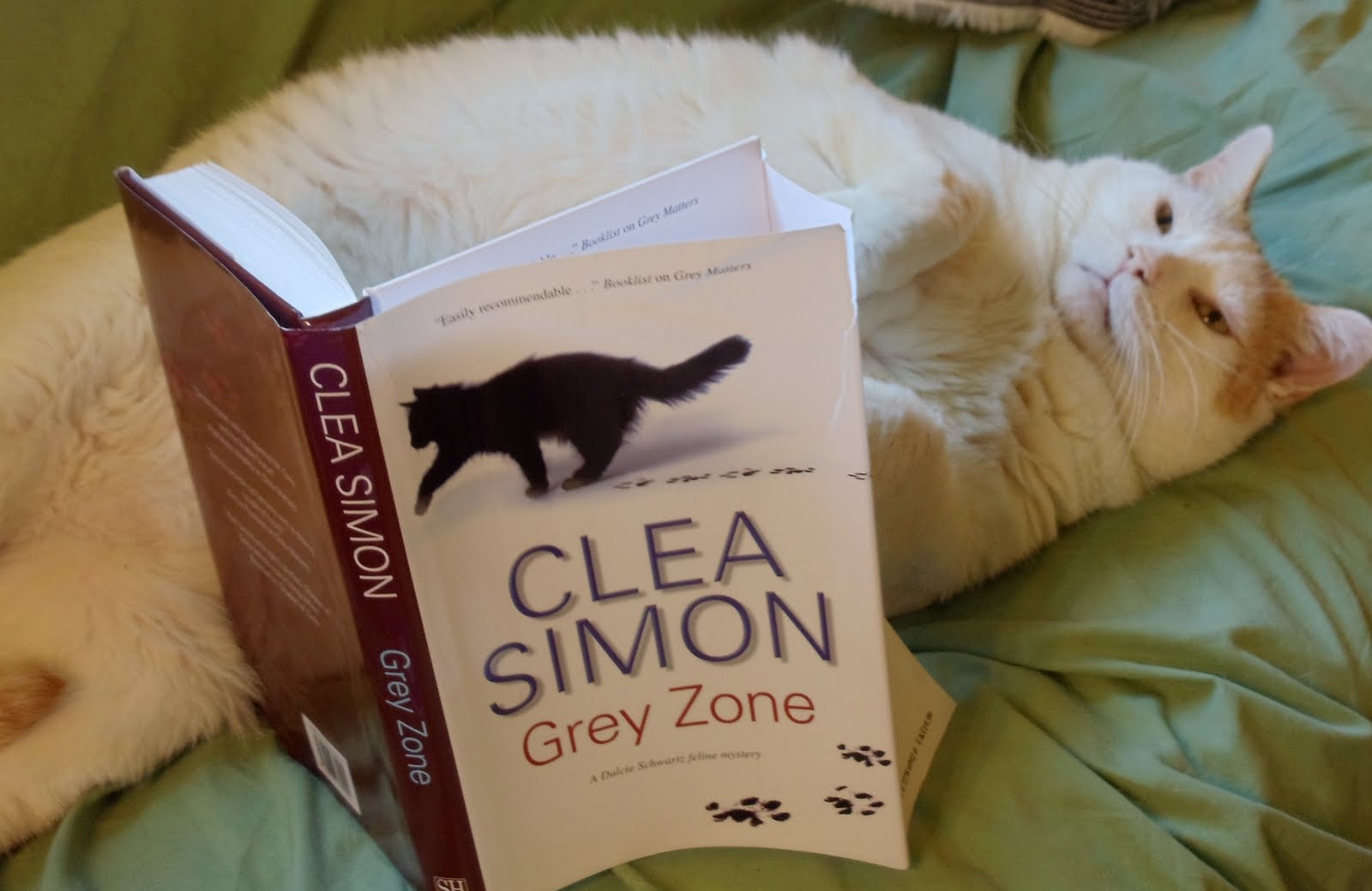
Grey Zone by Clea Simon

Melon is taken aback by a plot twist!


Reviewed by Jeanne

Dulcie Schwartz, the grad student we first met in Shades of Grey, is still trying to juggle her teaching and mentoring duties with finishing her thesis and having an actual life. The latter is definitely on the losing end. She’s still researching her mysterious author, which leads her new advisor to accuse her of stalling—of not wanting to finish and move on. Boyfriend Chris is just as busy, so they haven’t really had any time together and her new kitten is getting into all sorts of mischief. In short, Dulcie feels a bit like Lucille Ball in the infamous candy factory sketch: things are moving too quickly for her to keep up, though she tries valiantly.

Still, Dulcie doesn’t realize quite how disconnected things are until she sees a poster about a missing woman—who just happens to be one of Dulcie’s former students. Overburdened and overworked, Dulcie hadn’t really followed up as to why the girl dropped her class. Determined to make amends, Dulcie tries to track down a current student who also seems to be falling through the cracks—and ends up being at the scene when a professor falls from his upper story office. Did he jump? Or was it murder?

One of the things I like about this series is the academic setting, with its sometimes antique and arcane rules butting up against the electronic age. Dulcie’s particular area of interest is an old gothic novel, which inspires her dreams of castles and fog while her daily routine includes computer searches, email and cell phones. While there are supernatural elements (Mr. Grey, Lucy’s premonitions, and Dulcie’s dreams), these are always grounded in a more pragmatic world. The cats are always a joy: enigmatic Mr. Grey, her ghostly advisor, makes his pronouncements and Esme, the empress in training, exerting her feline will in ways any cat fancier will recognize. I also have to comment on the cover:  gorgeous! I do like well done cover art, and this one is charming.

I found the ending to be most satisfying. It just felt right for the characters and was, for me at least, hopeful and very comforting. To explain further would spoil it for everyone else, but what I will remember most is that moment of pure happiness, when all is right with the world.

You don’t need to have read the other books in the series to enjoy this one. Give it a try!

Grey Zone is by Clea Simon and the call number is F SIM

Sunday, April 17, 2011

People of the Longhouse by W. Michael & Kathleen O’Neal Gear


Reviewed by Susan Wolfe


I found a pristine Indian arrowhead in my backyard while setting out my garden. How long had it been there? Who lost it?

There is little good fiction written about America’s pre-history. This husband & wife team transports you to a place and time that many of us never knew existed. It’s the world where we now live, seen through the eyes of the people who lived there before us.

The Gears are excellent writers. He was nominated for the Pulitzer Prize. She is a former state historian for Kansas, Nebraska and Wyoming for the Department. of the Interior. They are both trained archaeologists.

The People of the Longhouse (F GEA Main) focuses on the Iroquois of the early 15th century. After a raid, young Odion and his little sister, Tutelo are marched away as spoils of war. Their parents set out to rescue them. War chief Koracoo and husband Gonda set an uneasy truce with a neighboring tribe and lead a small rescue party. But this is not an ordinary war party they are chasing. They are following an old witch-woman named Gannajero, a legendary evil trader with sinister plans for captured children.

Koracoo and Gonda are devoted parents and leaders of their tribes, racked with guilt about their obligations and failures. The children are multi-dimensional characters. Clever yet vulnerable. Gannajero is a complicated character. Not all is as it seems with her, she is part victim and part evil. The plot flows smoothly, rippled with glimpses into future and past events.

The Gears have the trademark of selecting a time and place in pre-Columbian America and creating a series around the people of that area. Their love of the Native American culture glows through their work and their archaeological expertise gives it authenticity.

This first book of the “Forgotten Past” series is set during a turning point of the Iroquois nation. Their time and culture was turbulent. A nation fragmented into various tribes with challenges that will change their world forever. And ours too. They created the democracy that our founding fathers acknowledge as the basis for our own.

What a wonderful background for a fascinating story.

Tuesday, April 12, 2011

The Wonderful World of Inventions


Reviewed by Nancy

Have you ever awakened in the middle of the night thinking your life would be complete if you just had a Full Body Umbrella? Probably not. Or have you ever wondered where you might find an Earring Safety Net. Well, no.

Nonetheless, you might want to have a look at 101 Unuseless Japanese Inventions by Kenji Kawakami (608 KAW Main). It will give you a break from the humdrum responsibilities of your life.

In the introduction to his book Mr. Kawakami explains the Japanese art of Chindogu. It's a little hard to describe, but in Chindogu one attempts to make an object that is almost useful, but is so silly it can't really be useful. Or to create an object that actually is useful, but is also so silly that you can't quit laughing long enough to use it.

In the book you will find descriptions and pictures of the Noodle Eater's Hair Guard, the Cat Tongue Soother, and the Eyedrop Funnel Glasses. The Solar Powered Lighter involves the use of a magnifying glass, and Dust and Shake (one of my personal favorites) features a feather duster connected to a martini shaker. According to the author the Dust and Shake provides "well-earned after-chore refreshment."

You must see as well the Heavy Smoker's Mask and the Hydrophobe's Bath Body Suit. Really, these items are not to be missed. I may do some checking to see if I can acquire a Portable Zebra Crossing. Yes, it is what it sounds like... your very own portable pedestrian crosswalk that can be rolled across a busy street when you need to cross. Of course, the book includes a disclaimer pointing out that one might be killed trying to position the crosswalk for use.

Perhaps you will find a "must have" item for yourself in these pages. Just, please, don't ever get on the commuter train and place your Portable Commuter Seat next to me. Once you see the picture of this invention you will understand why.

I could not stop reading this book. Also, I could not stop laughing.

Thursday, April 7, 2011

Blood Harvest: Bolton Thrills Again


Blood Harvest by S. J. Bolton
Reviewed by Jeanne

Heptonclough is a picture-book English village, complete with an old church, moors, and families who have lived in the same place for centuries. The Fletchers, however are new: mum Alice, dad Gareth, the two boys, Tom and Joe, and baby Millie, a blonde toddler. They’ve just built a house there and are learning the village ways. Also new is the vicar, Harry, a young man eager to take his place as leader of his flock. But underneath, there is something not quite so welcoming: there are whispers, voices, like spirits trying to lead people astray, glimpses of someone—something?—that might be there or might be imagination.

The dead children aren’t imaginary, though.

Blood Harvest, the recent thriller from British author S.J. Bolton, opens with the discovery of three bodies in a grave where only one should be. All three are very young girls, blonde, and with similar injuries. The next part of the book picks up earlier, introducing the characters and giving the reader background on the town and its inhabitants, then draws the action inexorably toward the discovery.
I’ve read all three of Bolton’s novels and I’ve come to expect a certain number of things. One, that there will be interesting, believable and well-developed characters in a very distinct setting; two, that folklore will be a factor in some way; three, that there will be enough layers and intriguing themes that I will want to discuss the book with someone else immediately; and four, that the story will be a wild roller coaster ride through a tunnel of horror and when it’s all over I’ll be dazed, breathless and ready to read the whole thing over again to figure out how I could have gotten it all so wrong. Blood Harvest meets or exceeds all of the above.

The characters are especially rich in this one: the story is told from several points of view, all well done. Harry, the vicar, is an engaging, open-hearted young man who is drawn to Evi, the therapist who is treating a young woman who lost a child. Evi has a physical handicap—also a hallmark of Bolton’s writing—but has never let it stop her. She’s a tough, no-nonsense sort of woman. She’s attracted to Harry, but is not one to let her personal life take precedence over her professional obligations. Tom, the eldest Fletcher child, is just old enough to feel responsible for his siblings but young enough that we can’t quite be sure that he’s giving us an accurate picture of what he sees. The children view the world in very different terms than do their parents: a world of bullies, creatures, possible ghosts and definitely things that go bump in the night. Yet another view is offered by Gillian, one of Evi’s patients, a bereaved mother who insists her child did not die in the fire. She roams the moors around Heptonclough at night, searching for her daughter—her young, blonde daughter.

There are a number of themes running through this book. Motherhood and all its ramifications are personified in various female characters, rather like the triple aspected goddess. Ancient ties to land and to the sacred are contrasted with modern medicine and medical ethics. Above all, there is obligation: to the land, to family and to one’s calling.

Given Bolton’s fondness for folklore, I was half-expecting something along the lines of Tom Tyron’s Harvest Home or perhaps Shirley Jackson’s “The Lottery.” Folklore does play a role but more indirectly than I had anticipated. As I said, Bolton never fails to surprise.

The setting is an English village in a rural area. Bolton’s writing is always very atmospheric and tactile. You almost feel the cold of the stones, the damp of the fog and chill air, and see those towers pointing to the sky. To steal lines from Emily Dickenson (and if one is going to steal, by all means steal from the best), “I never saw a moor—“ but Bolton’s writing is the next best thing to being there. The landscape is almost a character in its own right, and always influences Bolton’s characters: in many ways, the land and the people are one, which is why her stories are usually told from an outsider’s point of view.

While there is a good bit of violence, Bolton avoids what some refer to as “torture porn,” that is, describing the violence and injury in excruciating detail with an emphasis on the terror of the victim as she—and it’s usually a she—awaits her fate. Instead, Bolton gives us a retelling after the event has occurred. She does give us the emotional pain and tension, the worry, the dread on the part of others but not the victim. There have been times she’s skated close to the edge, though; I hope she’ll continue to resist the urge to dive in.

I can’t say I’m completely happy with the ending. It was true to the book and it was more than plausible given what had happened. I’ll even reluctantly admit it sort of felt right, given the emotional state of the characters at the time. It just wasn’t the ending for which I hoped. I almost said that I wanted her to tell us more about the aftermath, but then I remembered the old saying about being careful what you wish for. I think I’ll settle for the open-ended ending.