Showing posts with label Maisie Dobbs. Show all posts

Wednesday, August 5, 2020

Nevermore: Winspear, Possibility Dogs, Atwood, Lee Smith, Erik Larson


Reported by Kristin


Maisie Dobbs is a favorite character of a few Nevermore readers, and this time she showed up in An Incomplete Revenge by Jacqueline Winspear. This series takes place after the Great War in England, as Maisie undertakes criminal investigations with a psychological bent. This outing has her researching a small village in Kent, and is full of the historical detail that readers of the series enjoy. Our reader recommends starting at the beginning with the first book, simply titled Maisie Dobbs.


Returning to non-fiction, another Nevermore member read and enjoyed The Possibility Dogs: What I Learned from Second-Chance Rescues about Service, Hope, and Healing by Susannah Charleston. The author was involved in search-and-rescue operations and began to find shelter dogs who had the potential to be of service to people with disabilities. Our reader found that she was amazed at how much the dogs have to learn to do, and found their capabilities heartwarming.


Graphic novels pop up in the group once in a while, and today it was Angel CatBird by Margaret Atwood. The author of the well-known The Handmaid's Tale and the more recent sequel The Testaments, Atwood wrote this fantasy novel of genetic engineer Strig Feleedus who ends up as part of his own science experiment based on cat and owl DNA. Strig becomes a superhero in this first part of a trilogy. Our reader noted that Atwood wrote this book as a bit of an apology to birds as she realized that her indoor-outdoor cats over the years had been stalking and killing avian prey. This book comes recommended if you would like something just a little different.


Fair and Tender Ladies by Lee Smith has been passed around to several book club members, and is usually praised highly. Ivy Rowe was born in the Virginia mountains and never ventures far, but tells her tale of Appalachia through a series of letters. Written using local dialogue, this novel is touching and very identifiable to those who live in this region.


Finally, a reader discussed Thunderstruck by Erik Larson. With two interwoven stories of Guglielmo Marconi, inventor of the telegraph, and Hawley Crippen, a man who probably would have gotten away with murder if he just hadn't chopped up his wife. As news was able to be communicated more quickly due to the telegraph, the murder investigation travelled across the Atlantic faster than the sailing ships could. This strange juxtaposition of stories sounds odd, but it works as Larson is skilled at telling the tales of quirky people.

Wednesday, August 28, 2019

Nevermore: Maisie Dobbs, Fly Away, Pachinko, Outsider, Things Fall Apart


Reported by Christy

Former World War I nurse Maisie Dobbs decides to set up her own private investigation firm. Her first case seems to be one of simple infidelity but Dobbs soon learns there are much deeper secrets. Our reader called Jacqueline Winspear’s Maisie Dobbs a light read that she enjoyed listening to while packing. She will also continue on with the series.

Our next reader checked out Fly Away by Kristin Hannah. Tully must not only deal with the tragic death of her best friend Kate, and caring for Kate’s teenage daughter, but also the reappearance of her estranged mother. Though our reader didn’t realize this book was second in a series, she liked it and thought it was good.

When teenaged Sunja finds herself pregnant by a wealthy, married man, she accepts a marriage proposal by a minister passing through Korea on his way to Japan. Pachinko, by Min Jin Lee, a family saga spanning generations, was an “excellent” book and our reader highly recommended it.

Next, the discussion moved to Stephen King’s The Outsider. When the body of an 11 year old boy is found in a park, the people of Flint City are in shock. Even more so when fingerprints point to beloved Little League coach and English teacher Terry Maitland. Terry, however, has an airtight alibi. Our reader struggled with her interest in this book, especially after reading the fantastic Pachinko, and ended up not finishing it.

In Chinua Achebe’s classic Things Fall Apart, Achebe tells the story of pre-colonial Nigeria and the 19th century arrival of Europeans.  Our reader tried but could not get into it and ultimately did not finish the novel.

Wednesday, June 22, 2016

Nevermore: Theodore Roosevelt, Hearts, Munich, Autopsies, and Middle Earth


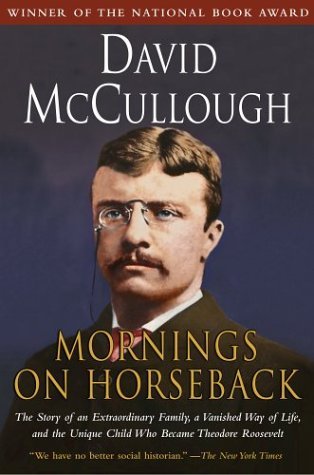
To kick off Nevermore this week, we welcomed back an old friend to our midst and eagerly listened to her review of David McCullough’s Mornings on Horseback.   A National Book Award-winner, Mornings on Horseback:  The Story of an Extraordinary Family, a Vanished Way of Life, and the Unique Child Who Became Theodore Roosevelt was a fascinating biography on the Roosevelt family and the indomintable Theodore Roosevelt.  Our reader was particularly impressed by McCullough’s incredibly thorough—and highly detailed—biography, especially since she had read it during a visit to Medora and the Theodore Roosevelt National Park in North Dakota.  She was fascinated by the personal correspondences of the Roosevelt family, which McCullough included, saying she was struck by the amount of insight they offered into their family life and, more importantly, how the Roosevelts’ would sometimes navigate around personal issues (such as Theodore’s ill health, or his brother’s mysterious addiction, or his sister’s childhood injury).  Overall, she said it was a fascinating book and offered unparalleled insight into the Roosevelt family.


Next, our readers discussed Hearts in Atlantis by Stephen King.  A dark and haunting collection of narratives, Hearts in Atlantis follows several stories that are deeply rooted in the sixties—and the Vietnam War.  In “Low Men in Yellow Coats,” eleven-year-old Bobby Garfield learns a haunting secret about his idyllic hometown and discovers that adults are not always rescuers, but dangers; in “Hearts in Atlantis,” a group of college kids become addicted to a simple card game and discover the possibilities—and dangers—of protesting the war; while in “Blind Willie” and “Why We’re in Vietnam” and “Heavenly Shades of Night Are Falling,” recurring characters find themselves in a post-Vietnam America with the haunting images of the war lingering over their lives.  Our reader said Hearts in Atlantis was a complex story that developed intriguing, fully-imagined characters.  He called it an excellent novel, saying he finished it in just a week—and “at 672 pages, you know it was good,” he said.

Switching gears from the Vietnam War, Nevermore ventured back to the early days of World War II with Jacqueline Winspear’s favorite detective, Maisie Dobbs.  In Journey to Munich, Maisie is once again drafted by the British Secret Service.  This time, she’s sent to Dachau to recover a recently released British prisoner—but there’s a catch:  she has to go under the guise of his daughter to whom she bears a striking resemblance.   Not all is as it seems in Munich, and Maisie Dobbs must once more put her life on the line if she hopes to save herself and her mission.  Our reader said Journey to Munich was a fantastic spy adventure with plenty of mystery and intrigue.  She noted she became really attached to the characters, growing anxious when they were in danger and hoping for the best possible fate.  She became completely immersed in the book, which is a hallmark of a good mystery.


Additionally, Nevermore looked at Morgue:  A Life in Death by Vincent DiMaio.  Gritty and enthralling, DiMaio’s narrative is a look at the complex technology and craft of medical examiners, following his 40 year professional career—and spanning more than 9,000 autopsies (some of which made national headlines).  Both informative and compelling, Morgue:  A Life in Death is a fascinating that manages to chronicle the history of medical and criminal pathologists and offers insight into one of the most macabre—and intriguing—professions in the justice system.  Our reader, who is an ardent fan of true crime novels and police procedural and mysteries, said she really enjoyed DiMaio’s book.  She loved the attention to detail and the author’s personality, which shines through the entire narrative; moreover, she liked that it gave insight into what really happens in morgues and offered an intimate glimpse into the science behind criminal pathology.  She had only high praise for Morgue, especially since pictures were included.


Last, our readers stopped to look at a classic:  The Silmarillion by J.R.R. Tolkien.  Taken from the stories he sketched throughout his illustrious career, The Silmarillion is a fascinating and enthralling look at the First Age of Middle Earth.  Before The Lord of the Rings and The Hobbit, before even The Children of Hurin, J.R.R. Tolkein’s Silmarillion explores the world of Middle Earth when the elves reigned supreme and the first Dark Lord set his sights on the three Silmarils, rings of power created by the most gifted of elves.  Overall, our Nevermore reader enjoyed looking through Tolkien’s collection.  He said, “[It’s] curious, but good.”  It’s well-written and detailed, since maps and a lengthy appendix with additional stories, genealogies, glossaries and elvish dictionaries are included, reflecting much of the style that he liked in The Lord of the Rings; however, he was most impressed by the story.  Intricate and beautifully written, he said it’s an amazing novel for fans of Lord of the Rings and any of Tolkien’s other works.

Wednesday, June 25, 2014

Nevermore: Tami Hoag, Pat Conroy, Sharyn McCrumb and more!


Nevermore opened with praise for Tami Hoag’s novel The 9th Girl, a thriller about a serial killer whose victims are adolescents.   Detectives Nikki Liska and Sam Kovac are faced with trying to identify his latest victim, a girl whose body was found on New Year’s Eve.  Hoag balances the characters’ home lives with the case, and shows a shrewd understanding of high school culture and the role social media plays in the lives of young people—not to mention that this is an extremely well done thriller.  Our reviewer praised the strong characterization and commented that while Hoag isn’t an author that’s usually at the top of the list, this book was very good indeed.  Other reviewers have said that this is one of Hoag’s best.


The next book up was The Death of Santini by Pat Conroy.  Most of Conroy’s fiction is thinly disguised autobiography, but this nonfiction book is very open about its sources: Conroy’s real family.  The book concentrates on the last few years of Conroy’s father, the model for the father of The Great Santini.  Our reviewer said that some sequences bordered on the fantastical, but felt Conroy was trying to tell the story as honestly as he could. He pulls no punches in the telling, either.  All his siblings were strongly influenced by their father, but the reactions to his domineering ways were varied.  The verdict was that this wasn’t a book that she enjoyed as much as some, but it was worth reading.


Innocence by Dean Koontz had been picked up by another reader who felt that parts of it were excellent.  He read a thought-provoking selection but then added that for him the ending fell flat, which was sad in a book that had so much promise.


Two series were recommended without a great deal of in-depth comment.  Jacqueline Winspear’s Maisie Dobbs was praised as a World War I era detective novel series, one that might surprise you with a woman as the private investigator.  The other series applauded was by Oliver Pötzsch, set in Germany in the 1600’s about a man who carries on the familial tradition of being an executioner.  In that time, executioners performed a necessary duty but were shunned by society.  The series contains four books, beginning with The Hangman’s Daughter.


Finally, King’s Mountain by Sharyn McCrumb was brought to the table once again.  With a nod to the local history of the North Carolina/Tennessee area, McCrumb writes novels that are a great blend of fiction and history.  Set during the American Revolution, this is a story of the Carolina Overmountain Men and their commander John Sevier.