Friday, September 12, 2014

Girls of August by Anne Rivers Siddons


Reviewed by Kristin

Summer may be almost over, but The Girls of August by Anne Rivers Siddons is lingering in my mind.  Maddy, Rachel, Barbara and Melinda are the somewhat stereotypical doctor's wives who have been friends since medical school days.  Their tradition has been always to take a week in August for a beach vacation.  No husbands, no kids, just the women.

The problem with continuing the tradition is that Melinda was killed in a car accident a few years ago, and none of the other women have been able to bring themselves together to continue the beach tradition with such a vital character missing.  When Melinda's husband gets engaged to an extremely young woman who everyone calls Baby, the women are strongly encouraged to take advantage of Baby's family home on an isolated barrier island off the coast of South Carolina.

Maddy, Rachel and Barbara are all forty-ish with well established connections to each other and strong opinions on everyone around them.  Each of them is going through some major life problems and at first are reluctant to share their issues even with their dearest friends.  Of course, throwing a twenty-two year old into the mix may have something to do with the initial shakiness of their rapport on this trip.  At first, Baby is practically run over by the older women, but soon shows some backbone and maturity.

Now I have to admit that a girls beach vacation sounds like an appealing idea, although one that perhaps has been done previously in a book or two or twenty.  In fact, I reviewed All The Summer Girls by Meg Donohue earlier in the summer, and it was somewhat similar: title, plot, well—you get the idea.  Siddons' writing is so elegant that the business of reading was pleasurable, but there was just a little something missing.  At only 240 pages, the story felt somewhat half-hearted and underdeveloped.  I think part of the reason that the book is lingering in my mind is that there was so much potential for further character development and a longer story.

I have always enjoyed Anne Rivers Siddons as she evokes the very atmosphere of the South.  While this book was not one of her best, I would still recommend it for any reader willing to take it as it is: a short, poignant story of friends reunited after a tragedy, who find courage and strength in each other.

Wednesday, September 10, 2014

Nevermore: Dracula, Romanov Sisters, Camelot's Court, Book Thief, and Purity of Vengeance


Our Nevermore readers choose books of all sorts: fiction and nonfiction, the newest books to the classics. It makes for an interesting mix. This time the first book up was Dracula by Bram Stoker, arguably the most influential vampire book of all time. While Stoker had his own literary influences (Camilla by Sheridan Le Fanu and Varney the Vampire by James Malcolm Rymer spring to mind), it was Dracula which stoked the public’s imagination.  Our reviewer had just started the book, but said that at 25 pages in, it was “very readable.”

A new non-fiction book about the ill-fated Russian grand duchesses was up next.  The Romanov Sisters by Helen Rappaport uses diaries and letters to tell the stories of the four daughters of Nicholas and Alexandra who were executed along with the rest of their family in 1917.  Rappaport specializes in Victorian history and Russian history of the era, and has written several other books on the subject.  While for the most part the sisters have been treated as a group (except for books on Anastasia, due to rumors that she survived), this book seeks to present them as individuals.  Our reader found the book “really interesting” and recommended it.

Another new non-fiction history book discussed was Camelot’s Court by Robert Dallek.  This is a detailed account of the Kennedy White House with an emphasis on policy and advisors.  Dallek has written a number of books about modern presidents, including  titles on Roosevelt, Nixon, Reagan, and Johnson.  Our reviewer said it was well written and filled with quotations, and he thought the epilogue was especially interesting.

The Book Thief by Markus Zusak is narrated by Death himself. The title refers to Liesl,  a young girl in Nazi Germany who is sent to live with a foster family.  At her younger brother’s funeral she steals a book even though she cannot read.  After her foster father teaches her to read, she steals more books and finds that stories can be transformative, no matter the circumstances.  This is a compelling book, and our reviewer highly recommends it.

Jussi Adler Olsen is one of the “Nordic Noir” writers whose work has been translated into English following the popularity of Stieg Larsson’s books.  Set in Copenhagen, the books feature Detective Carl Morck of Department Q who specializes in solving cold cases.  Our reviewer had just read The Purity of Vengeance, the fourth book in the series, which finds Morck investigating the 1980s disappearance of  a brothel owner.  Our reviewer said this was another good entry in the series.

Monday, September 8, 2014

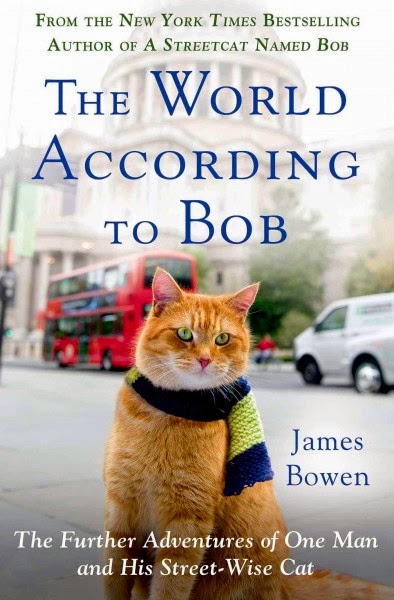
The World According to Bob by James Bowen


 Reviewed by Jeanne

Londoner James Bowen was a struggling drug addict, living in government housing, trying to find some direction in his life.  He earned some money by busking (street performing) and by selling copies of The Big Issue. One morning he finds an injured orange cat and offers aid.  To steal a line from “Casablanca,” it was the beginning of a beautiful friendship.  

It also produced an international best-seller, A Street Cat Named Bob. (You can read our earlier review here.)  The story of a young man and a stray cat tugged heart-strings all over the world.  It was on the UK best-seller lists for 52 weeks and has been sold in 26 countries.

Naturally, this meant there had to be a sequel, hence The World According To Bob.  Actually, “sequel” is a bit misleading because it covers much of the same time period as the first book.  The difference is that Bowen goes into a bit more detail about the struggles he faced and more about his bond with Bob. 

 For the first book, there was more than a little concern about how the reading public would take to a book about someone who was, shall we say, not a member of mainstream society. In this second book Bowen is able to speak more honestly about his life. The result is a moving and memorable account of life when one is truly down and out.  Part of Bowen’s appeal is that, while he decries parts of the system, he is forthcoming about his own role in his problems.  He takes responsibility for his own actions.  Another part is that he gives us some insight into what it’s like to be without resources and at the mercy of authoritarian whims.  We can understand his frustration even as we can see the other side of it.

Bob the cat is as charming as ever, whether he’s checking to see if an ill James is still breathing or fighting off a mugger.  James is in awe of a creature so loyal, so loving, and above all so trusting.  Bob gives James back a bit of faith. More importantly, James finds he can care for something other than himself. He says, wonderingly, that it’s a bit like being a parent—and understands for the first time how his parents must have felt when he disappeared into street life.

Bowen does go a bit more into the process that produced the book, including a briefing on how to handle interviews with the media.  It also explains that, contrary to reader assumptions,the book didn't make James immediately wealthy.

In short, if you loved the first book, you’ll enjoy the second as well though you don’t have to have read the first book to appreciate this one. 

Note:  The library also owns a copy of My Name is Bob, a picture book version which imagines what life was like for Bob before he met James.  There is a third book planned for this fall, entitled A Gift From Bob:  How a Street Cat Helped One Man Learn the Meaning of Christmas.

James and Bob have a very active Facebook page at https://www.facebook.com/StreetCatBob. It’s a great way to keep up with their adventures.

Friday, September 5, 2014

Following Atticus by Tom Ryan


 Reviewed by Meygan

When Tom Ryan learns that his friend is diagnosed with cancer, he is devastated. They had been friends for years and he can’t believe that her life is going to come to a premature end. After his friend passes, Tom wants to do something in her memory. He decides he and Atticus will hike New Hampshire’s 48 mountains twice in one winter to raise money and awareness for cancer.  

At this point, you need to understand that Tom is an overweight, middle-aged journalist and owner of a local newspaper called The Undertoad, and that Atticus is a 20 pound schnauzer. In other words, these two wouldn’t be anyone’s idea of typical mountain climbers or hikers.

When the people of the town learn of his plan, they love the idea and ask Tom if he will dedicate each hike in name of a person who died from cancer. His personal quest becomes a community effort.

Now, Tom and Atticus are certainly not new to hiking, but hiking 48 mountains twice in one winter is certainly a challenge! But Tom looks forward to the fundraiser because he believes so much good will come from it. He also knows how much Atticus loves the mountains. (Tom often refers to Atticus as “Little Buddha” because Atticus seems to “reflect” during their endeavors in nature.)

His father is another factor in Tom’s decision. Tom doesn’t have a close relationship with his father. In fact, there are many years of silence and anger between them.  Tom knows that one of his father’s regrets is that he didn’t climb mountains himself before illness took control of his life.  Tom hopes that, by sharing his adventures with his father via an article in The Undertoad, there will be some sort of reconciliation.

Following Atticus is one of my favorite animal stories because even though there are parts that tug at the ol’ heartstrings, the ending will not disappoint. Readers will follow Tom’s and Atticus’ journey of loss and grief but, most of all, happiness. You can still follow Tom and Atticus online! 


Tom often posts pictures of Atticus and gives a brief description of where their next journey will be. I would recommend this book to animal lovers and nature lovers. Not only will you fall in love with Atticus, but you’ll feel inspired by the glories of nature. In fact, after reading Following Atticus, you may yearn to go on your own adventure!

If you like Following Atticus, try these:

Comet’s Tale: How the Dog I Rescued Saved My Life by Steven Wolf
Wallace: The Underdog Who Conquered a Sport, Saved a Marriage, and Championed Pit Bulls—One Flying Disk at a Time by Jim Gorant
Katie Up and Down the Hall by Glenn Plaskin
Homer’s Odyssey: A Fearless Feline Tale, or How I learned About Love and Life with a Blind Cat by Gwen Cooper
Dewey: The Small Town Library Cat Who Touched the World by Vicki Myron
Cleo- How an Uppity Cat Helped Heal a Family by Helen Brown
A Lion Called Christian: The True Story of the Remarkable Bond between Two Friends and a Lion by Anthony Bourke

(Note:  Meygan has just joined the staff and has volunteered to do reviews, so look for more of her work here!)

Monday, September 1, 2014

Stages of Grey by Clea Simon

Elmer is not happy at having his reading disturbed by a photographer.


 Reviewed by Jeanne

Graduate student Dulcie Schwartz is preoccupied as usual.  She’s still trying to solve the mystery of the identity of the anonymous author of The Ravages of Umbra, work on her thesis, teach her sections, and find out if her boyfriend Chris is a werewolf.  Her mentor, the ghost of her beloved cat Mr. Grey, has remained silent on the subject, though he does offer occasional life advice. It’s also a blustery winter in Boston (is there any other kind?) and the ice and snow make travel difficult, but it’s certainly a great atmosphere to be studying a gothic novel.  

Maybe a bit too perfect, as Dulcie is taken in by a bit of theatrics that has her believing she’s seen a man being dragged away by wolves. It’s a promotion for a new production of Ovid’s “Metamorphoses” which features some rather unconventional staging—think Roman deities and a disco beat. Under the circumstances, Dulcie isn’t inclined to go see the play, not even with free tickets but her friends finally convince her to go. In addition to strobe lights, the production includes a gorgeous Russian Blue cat who walks a tightrope as well as a bit of unexpected sleight of hand when Chris discovers his wallet is missing and ends up as part of the performance. It turns out to be a lot more fun than any of them had expected—until one of the performers is found dead, her throat slashed.

Dulcie being Dulcie, she soon finds herself involved in the investigation and discovers that nothing is what it seems.

This is a fun entry in the series and, because the focus is on the mystery at hand, it’s particularly accessible one for newcomers.  Longtime fans won’t be disappointed either, as some progress is made on continuing storylines.  Dulcie likes to think that she’s very practical and realistic, unlike her mother who still lives in a commune and calls her daughter with vague warnings from the spirit world, but she has her share of imagination and a tender heart for those in trouble, especially those of the feline persuasion.  Like Don Quixote, she wants to save the world but tends to run into a lot of windmills. (I don't think it's coincidence that her real name is Dulcinea.) She gets some guidance from Mr. Grey and kitten Esme (when her little feline nose isn’t out of joint) and is ably supported by Chris and her other friends. The academic setting brings back fond memories, especially to those of us who belong to Garrison Keillor’s POEM (Professional Organization of English Majors). As usual, Simon strikes a nice balance between the supernatural (talking ghost cats) and the realistic, always taking care to see that the solutions are dependent on real world clues and not messages from beyond.  I of course am always interested in the scenes with the cats, and Gus the Russian Blue makes a nice addition.  

I always enjoy Simon’s work and Stages of Grey is no exception.  As with many of Simon’s heroines, Dulcie struggles to overcome the past and a fear of abandonment while moving ahead with her life.  At times, she also has a charming naivety and behaves impulsively—much like the heroines of the gothic literature she studies. Another thing I enjoy is the way the books effortlessly juxtapose the past (18th century literature, with samples of the overwrought style appearing at times) with the present (computers and electronics usually play a role in the plot somewhere). The mysteries are well done, appropriate clues presented, and there’s a sense of fun in the books.  Finally, these are all books I can recommend to those folks who don’t like a lot of explicitness in their stories, be it excessive gore, sex or language, but these aren’t fluffy, sugary tales either. 

 In short these are entertaining mysteries with solid plots and characters which are fun without being silly.  If you like to read in order, start with Shades of Grey and don’t put a “50” in front of it or you’ll get something else entirely.

Full disclosure:  I was sent a review copy of this book but that did not influence my review except in timing:  the book won't be generally available until October.

"MY book! Go away!"