Friday, August 1, 2025

Blue Ridge Fire Towers by Robert Sorrell


Reviewed by Jeanne

While the title might sound dull to some, this book is a little gem of local history.  Sorrell has done a very thorough job of telling the history of fire towers in the area, starting in 1910.  In the early years, fire towers were the only game in town for spotting wildfires.  Nowadays, fire spotters have largely been replaced or supplemented by technology, though some towers remain staffed either by employees or volunteers. Even the abandoned ones remain as points of interest for hikers and locals.

Sorrell tells the story chronologically, beginning with the first towers as it became obvious there was a need for lookouts after some damaging fires. This was a bit more controversial than one would think: according to Sorrell the prevailing attitude was that fires were “a force of nature that could not be abated or prevented.”  Some of the early towers were built either by communities or companies, while conservationist and forest enthusiast Gifford Pinchot championed the building of a network of towers to help manage the potential damage from fires.

But let me just jump ahead to “the good stuff”—the wealthy of local stories and information about the towers.  I am not a fire tower buff myself (not crazy about heights) but even I have heard of a number of these towers.  During the fall, people talk about going up to the Mendota fire tower to get the best views of the foliage. Wise County’s High Knob Tower was so iconic that it was rebuilt not once but twice after it was destroyed by fire in the 1970s and again in 2007. The newest tower, dedicated in 2014, is considered fireproof.

Long time residents will enjoy that Sorrell has several references to local journalist Jack Kestner who wrote about his love for the mountains and even did a stint as a watcher in a fire tower. (Fun fact:  Kestner wrote a novel entitled Fire Tower, set in West Virginia.) There is a good index, which helped me find the areas I was especially interested in, and I certainly enjoyed the photos but honestly I could have read the entire book.  Sorrell has an engaging manner of writing that made me want to read more even if I didn’t know the area he was writing about.  It’s a gift that not all non-fiction writers have, so I really appreciate it in those that do.

If you have any interest in local history in general, I recommend giving this book a try. 

Wednesday, July 30, 2025

Nevermore: Poe, Wishing Thread, How to Rate a Cat


Reported by Rita


Poe: Birth of the Detective Story by Edgar Allan Poe

Edgar Allan Poe is often cited as fathering the modern detective story. His trilogy of stories follows amateur detective C. Auguste Dupin as he tries to perfect the idea of "ratiocination" or the "art of reasoning and rational." The trilogy begins with the 1841 short story, "The Murders in the Rue Morgue," which follows Dupin trying to solve a double murder in Paris. The sequel, 1842's "The Mystery of Marie Roget," again follows Dupin as he tries to solve the murder of Marie Roget, whose body is found in a local Paris river. The final installment in the series, 1844's "The Purloined Letter," follows Dupin's attempt to recover a letter stolen from a private sitting room.

It is an interesting choice of stories. I found them very dull. - PP 3 stars


The Wishing Thread by Lisa Van Allen

For fans of Jennifer Chiaverini and Sarah Addison Allen, The Wishing Thread is an enchanting novel about the bonds between sisters, the indelible pull of the past, and the transformational power of love.

I found it a little far-fetched, but it was a nice, easy read. - GP 4 stars


How to Rate a Cat: Rate Any Feline Friend from Their Boopable Nose to Their Sweet Toe Beans by Matthew McGlasson

If you consider yourself a pet parent, love looking at cute kittens online, or are just an all-around animal lover, then this is the book for you. From their spiky bedhead to their adorable paw beans to everything in between, identify, recognize, and celebrate what makes each kitty special and unique. Become an expert cat-rater based on signature characteristics.

This is so cute and enjoyable. I loved it! - MS 5 stars


Other Books Mentioned:

The World of the Pronghorn by Joe Van Wormer

The Boxcar Librarian by Brianna Labuskes

The Girls of Good Fortune by Kristina McMorris

The Man with the Golden Arm by Nelson Algren

The Wayward Bus by John Steinbeck

The Murder of Roger Ackroyd by Agatha Christie

Extreme Survival: Lessons from Those Who Have Triumphed Against All Odds by Michael J. Tougias

The Dirty Life: On Farming, Food, and Love by Kristin Kimball

Demon Copperhead by Barbara Kingsolver

The Book Club for Troublesome Women by Marie Bostwick

The River Knows Your Name by Kelly Mustian

Lies on the Serpent's Tongue by Kate Pearsall

Eleanore of Avignon by Elizabeth DeLozier

Speak to Me of Home by Jeanine Cummins

Harlem Rhapsody by Victoria Christopher Murray

A Month in the Country by J.L. Carr

Hear My Sad Story: The True Tales That Inspired "Stagolee," "John Henry," and Other Traditional American Folk Songs by Richard Polenberg

Over the Edge by Jonathan Kellerman

Book of Shadows by Phyllis Curott

James Acaster's Classic Scrapes by James Acaster

Working Girl Blues: The Life and Music of Hazel Dickens by Hazel Dickens, Bill C. Malone

Friendliest Town on the Trail: Damascus, Virginia by Bunny Medeiros

Walking to Wijiji: ... my journey overcoming loneliness by Bunny Medeiros


New Books:

The Salmon Cannon and the Levitating Frog: And Other Serious Discoveries of Silly Science by Carly Anne York

The Afterlife of Malcolm X: An Outcast Turned Icon's Enduring Impact on America by Mark Whitaker

Mind Magic: The Neuroscience of Manifestation and How It Changes Everything by James R. Doty

Blonde Dust by Tatiana de Rosnay

Monday, July 28, 2025

I Know What You Did Last Summer by Lois Duncan


Reviewed by Jeanne

Four teenagers are heading home after an evening of fun.  Driving down a mountain road, the car hits a young boy on a bicycle.  The teens panic; Barry, the driver, is eighteen and considered an adult.  If they report this, he’ll do jail time.  The four agree, somewhat reluctantly, to keep the accident a secret, but Ray and Julie are deeply troubled about it. Ray insists on at least calling 911 to try to get help for the boy.

That was a year ago.

Julie, once a bubbly cheerleader, has become a more somber, studious girl.  Helen’s life has only changed for the better: she’s a TV personality with her own apartment away from her struggling family. Football hero and only child Barry has finished his first year of college and is looking forward to a backpacking trip to Europe, away from his doting parents. He’s also more than ready to put some distance between himself and Helen.  They aren’t sure about Ray.  He left town after the accident, headed to California.

Then Julie gets a letter with no return address.  “I know what you did last summer” is all it says.  Is it a prank—or a threat?

Back in the day, mystery titles for children were mostly those featuring sleuths such as Nancy Drew, Trixie Belden, Hardy Boys, or the Three Investigators.  There were a few others, including a personal favorite, Brains Benton. From there it was on to adult authors like Agatha Christie.

Then a few authors began writing books that were edgier, books about real teens who found themselves in dire situations. I Know What You Did Last Summer came out in 1973 and created quite the stir. These teens had committed a crime! They mention smoking pot! They drink beer! (None of which is portrayed.) They have a stalker who means bodily harm!

This was definitely not a Nancy Drew book.

Naturally, this attracted the attention of Hollywood who optioned the novel for a movie.  Duncan was thrilled. When the movie opened, she was in the theater with her popcorn ready to see her book on the screen. She did wonder why there a man with a hook.

She soon found out.

She didn’t even eat her popcorn.

Former teen librarian Pam Neal said Duncan wrote an apology to all her fans, regretting that her suspense novel had become an urban legend slasher film. In an interview Duncan said she was “horrified.” The violence was sensationalized, which was particularly painful because Duncan’s daughter Kaitlyn had been shot to death by an unknown person just a few years before the movie.

Now the rebooted version of the I Know What You Did Last Summer is in theatres and from all reports it bears even less resemblance to the book than the first movie did.  I decided it was a good time to go back to the source material, so I picked up a copy of the book, albeit a slightly altered version.  In 2010, Duncan revised her book a bit, adding mentions of things like cell phones and GPS which didn’t exist back in 1973. She changed the war in the background to Iraq instead of Viet Nam, and made a few other changes to suit the times. Of course, that was fifteen years ago; there are a few things that seem slightly dated now but not so much that it took me out of the story.

Overall, I think the book has held up well. While more modern books may have grittier plots, the core parts of the book—the characters and the suspense—still work for me. This was a groundbreaking book in YA literature, one that led the way for such authors as Joan Lowery Nixon, Holly Jackson, and Karen McManus. It makes me sad that the novel is so little known.

As for the movie, I’ll pass.

Friday, July 25, 2025

The Seven Husbands of Evelyn Hugo by Taylor Jenkins Reid


Reviewed by Jeanne

Monique Grant is working for Vivant magazine, hoping to make a name for herself as a reporter when the incredible happens: Evelyn Hugo (or rather, her staff) reaches out to the magazine about doing an interview-- and Evelyn only wants Monique.

Evelyn Hugo is a star. She lit up the box office and the gossip magazines with her performances and with her off-screen life.  Then she became reclusive and elusive. She doesn’t walk the red carpet or visit talk shows or give interviews—at least, not until now.  This will be a huge coup for the magazine and for Monique.

With more than a bit of trepidation, Monique goes to meet Evelyn. It turns out that Evelyn doesn’t want to do an interview.  She wants Monique to write her biography. She doesn’t want a puff piece or a hatchet job. Monique is tasked with writing the truth.

And so Evelyn begins to tell her story, one that starts in Hell’s Kitchen and then heads to Hollywood, through husband after husband, scandals, love affairs, and secrets.  But the biggest secret, why she chose Monique, she saves for last.

Ah, Book Bingo! The way I finally get around to tackling many titles on my TBR list. This was my choice for “Read a historical novel,” since the story begins in the 1950s and continues to the present, more or less. I had heard great things about this book and I must say it lived up to the hype.  I grew up reading the old movie star magazines like Photoplay before moving on to reading novels and biographies of Hollywood, so Evelyn’s story had the ring of truth.  While Evelyn herself is a fictional creation, author Reid has said that she drew from the lives of stars such as Rita Hayworth and Elizabeth Taylor for inspiration.

Evelyn is a fascinating creation. In many ways, she’s a woman before her time.  She isn’t an innocent waif bedazzled by the bright lights:  she sees Hollywood as a way out to build the life she wants and she does what she needs to in order to achieve her goals. I think what intrigued me most is that while Evelyn has regrets, she’s not about to apologize.  She did what she felt she had to.  Agree with her or not, she doesn’t care.

I found Evelyn to be mesmerizing.

Love her or hate her, you will certainly remember her.

We actually had an earlier (and better written) review of this book back in 2019 but I was so enchanted with Evelyn that I had to throw in my two cents.   You can read Christy’s review here.


Wednesday, July 23, 2025

Nevermore: Something for the Pain, Eli the Good, Heartwood

 Reported by Rita


Something for the Pain: Compassion and Burnout in the ER by Paul Austin

An ER doctor's memoir describes the psychological impact of his profession, explaining how his daily exposure to critical illness, injury, and tragedy in the industrial setting of a modern hospital rendered him bitter and estranged from his family.

So real. This book is the best medical book I've ever read. - DC 5 stars


Eli the Good by Silas House

In the summer of 1976, ten-year-old Eli Book's excitement over Bicentennial celebrations is tempered by his father's flashbacks to the Vietnam War and other family problems, as well as concern about his tough but troubled best friend, Edie.

Very detailed and beautifully written. It feels very autobiographical. - MD 5 stars


Heartwood by Amity Gaige

Heartwood takes you on a journey as a search and rescue team races against time when an experienced hiker mysteriously disappears on the Appalachian Trail in Maine.

It is dramatic and cinematic with a cliffhanger ending. - AH 5 stars


Other Books Mentioned: 

Hola Papi!: How to Come Out in a Walmart Parking Lot and Other Life Lessons by John Paul Brammer

My Name is Emilia del Valle by Isabel Allende

Revenge of the Tipping Point: Overstories, Superspreaders, and the Rise of Social Engineering by Malcolm Gladwell

Levi Strauss: The Man Who Gave Blue Jeans to the World by Lynn Downey

Mind Games by Nora Roberts

A Month in the Country by J. L. Carr

Run for the Hills by Kevin Wilson

Dance of the Four Winds: Secrets of the Inca Medicine Wheel by Alberto Villoldo

Cave and Cosmos: Shamanic Encounters with Another Reality by Michael J. Harner

The Indian's Secret World by Robert Hofsinde

American Dirt by Jeanine Cummins

All Systems Red by Martha Wells

Lies on the Serpent's Tongue by Kate Pearsall

How to Rate a Cat: Rate Any Feline Friend from Their Boopable Nose to Their Sweet Toe Beans by Matthew McGlasson


New Books:

Mark Twain by Ron Chernow

Poets Square: a Memoir in Thirty Cats by Courtney Gustafson

Monday, July 21, 2025

Cat in the Stacks Mysteries by Miranda James


Reviewed by Jeanne

As usual, Book Bingo has enticed me to pick up books I’ve been meaning to read but somehow haven’t gotten around to.  I’ve been reading and enjoying the Cat in the Stacks series for several years now, but somehow had gotten distracted and had missed some titles.  Since I found a copy of The Pawful Truth in the library Gift Shop, it fit one of the squares.

The series is set in Athena, Mississippi, a small town where Charlie works as a librarian at the local college.  He’s a long-time widower who lives in a house left to him by his great aunt of fond memory.  He has a housekeeper/cook, Azalea, a host of friends, and an enormous Maine Coon cat named Diesel.  These are low-key, cozy mysteries with all the trappings: lovingly described food, Southern charm, and a dead body or two just to keep the story moving along.

While this is not a series that has to be read in order, there are a few changes over the course of the series.  Charlie’s children get married, grandchildren arrive, and he acquires a fiancée but nothing that one can’t pick up on in the first few pages of any book in the series.

In The Pawful Truth, Charlie decides to take a medieval history course at the college.  History has always been a favorite subject, and he has heard glowing reviews of the young professor who is teaching the course. While the class gets off to a promising start, an argument between the professor and a student piques Charlie’s interest—and even more so when one of them turns up dead.

Since I enjoyed The Pawful Truth, I decided to pick up another in the series for the square “Read a book NOT written by James Patterson.”

Cat Me If You Can is an atypical story in that Charlie, Diesel, and Charlie’s fiancée Helen Louise are travelling to a classic mystery lover’s retreat set up by the charming and formidable Ducote sisters.  The elderly grand dames of Athena society have rented out a boutique hotel to host a gathering of their mystery loving friends with plans to hold discussions of Golden Age mysteries in beautiful Asheville, North Carolina. What should have been a delightful stay turns ugly when an uninvited person shows up and demands to join the group.  His stay doesn’t last long—he turns up dead, and the only suspects are the members of the murder club.

I have to admit that a lot of my enjoyment from this title had to do with Charlie and Helen Louise visiting Biltmore and the surrounding area.  They were appropriately complimentary and appreciative (murder notwithstanding.)

If you want a break from hustle and bustle, the Cat in the Stacks series is a pleasant diversion.  I’m ready to read another but, alas, I don’t have any bingo squares to fit.

Friday, July 18, 2025

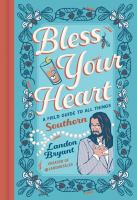
Bless Your Heart: A Field Guide to All Things Southern by Landon Bryant


Reviewed by Jeanne

First a confession:  I hadn’t heard of Landon Bryant until this book came in. I’m sure I read a review and saw the name, but I didn’t know about the videos or online presence or else I’d probably have snapped this up sooner. 

Landon Bryant is not only one funny guy but he’s a very observant one.  I laughed and nodded almost every point.  Even better, he allowed for a difference of opinion, unlike some of the books which want to be the absolute authority on all things Southern.  I name no names.  Landon (I feel that he would not mind me calling him Landon) is open to different versions of the Southern experience.  Nowhere was that more obvious to me than in his discussion of dinner vs. supper: when do you eat which meal?  Now, many folks today would argue that dinner as in “going out to dinner” is an always an evening meal but my grandparents always referred to the mid-day meal as dinner.  People took their food to work in “dinner buckets,” after all and “Sunday dinner” is usually in the middle of the day.  I for one was just happy that Landon brought this up, as I suspect a lot of people nowadays never heard the mid-day meal as “dinner.”

My grandparents didn’t know what to make of “lunch.”

Anyway, Landon is fine with whichever you want to do with, just as long as the food’s good.

Speaking of food, he also addresses other controversies such as chili—beans or no beans, how to construct a proper pear salad and how to eat it (just ignore that bed of lettuce, nobody eats that), the hierarchy of foods served at a gathering and who is allowed to bring them, and best of all, handy charts to determine if something is a salad or a vegetable or a meat. 

Also I would note that he is of the “no sugar in the cornbread” camp, and I am in full agreement on that.  As one of my coworkers used to say, “If God had meant for there to be sugar in cornbread, He would have called it cake.”

This hasn’t even scratched the surface of all the topics Landon handles.  He can tell you all about emotional states like “bein’ ugly” or “hissy fits” or “come to Jesus” meetings, conditions such as “lollygaggin’” and “I’d have to feel better to die.” He also provides helpful information about nature, from bugs to creepy crawlies to the weather. Holidays, cast iron skillets, the differences in grocery stores or dollar stores, Landon covers it all.

There is just a sweetness behind all of this that I find appealing.  He is not one to judge (after all, he has an aluminum Christmas tree) but he does have opinions, like which eye of the stove (and it is an eye, not a burner) to use.  But I also feel that if I were to disagree about which eye to use, he would not be upset with me.

The only thing it lacks is an index so that I could quickly locate sections to compare, say, “piddlin’” and “lollygaggin’” but there is a pretty good table of contents for that.

And while I find it to be basically very true to my experience, it’s also very, very funny.  I may buy copies to give as Christmas gifts.  I’m sure Landon will approve.