Wednesday, March 16, 2011

Walking in Circles Before Lying Down


Reviewed by Nancy
You might guess from the title that Walking In Circles Before Lying Down by Merril Markoe  (F MAR Main) has something to do with dogs. You'd guess right.

I believe this book would be of interest to dog lovers and non-dog lovers alike as it is a very entertaining story. As the narrative unfolds we are offered insights regarding how dogs might view us, and we are pretty much riveted by the trials and tribulations of Dawn, the primary character.

Dawn is trying to pull her life together after two failed marriages and a string of nowhere jobs. Every time she gets close some person or circumstance yanks the rug out from under her. Her support group consists of her sister, a babbling idiot making a living issuing new-age platitudes as a life coach, her mother, who seemed to me to be a manic-depressive alcoholic, although it's never stated outright in the book, her boyfriend, who could only be described as a self-centered jerk, and her dog, Chuck. Guess who the nicest individual in the support group is?

There is a love story of sorts. Not the kind where the subjects end up in a house with a white picket fence happily ever after. It’s more the kind where our beloved main character finally sees the light and dumps the jerk. Whether or not beloved main character ever takes up with the nice guy in the plot is left to our imagination.

There is also an exciting segment of the book in which Dawn allows her dog, Chuck, to pick a potential boyfriend for her. Chuck has assured her that he can tell the good from the bad when it comes to people. So, does Chuck choose well, or is his judgment blurred by the fact that the potential candidate is a butcher?  You'll have to read the book to find out.

One thing's for sure, having read this, I regard my dogs differently. I think a little more about what I say to them, the promises I make to them: "We'll play in a little while, just let me finish this." In my mind now I hear the responses they might make to those promises: "Yeah, that's what you said last time." Etc.

So, read the book and gain insights about dogs. Also, read the book and be very entertained. Also, also, read the book and perhaps be reassured that compared to Dawn's life, your life is calm, orderly and tidy even though it might not seem so to you at times.

Friday, March 11, 2011

Attenbury Emeralds: The Wimseys Return


The Attenbury emeralds:  The new Lord Peter Wimsey/Harriet Vane mystery by Jill Paton Walsh (F PAT Main)

Reviewed by Jeanne


As I’ve mentioned before, I enjoy many of the classic detectives:  Sherlock Holmes, Nero Wolfe, Perry Mason, Ellery Queen and, of course, Dorothy L. Sayers’ Lord Peter Wimsey books. I became attached to the characters and hated to see the series end.  This isn’t to say that I’ve always welcomed other authors coming in to continue the series:  often I find their efforts lack that certain spark which drew me to the original, so I approach these continuations with a bit of trepidation.

I was familiar with Jill Paton-Walsh from her children’s novels, all of which were very well done.  Still, I resisted reading Thrones, Dominations and Presumption of Death, both of which were completed from some material left by Sayers.  Reviews were generally positive, so when this new book came out I resolved to give it a try.


Set after World War II, the Wimseys are changing with the times.  While the warm and loving relationship between Peter and Harriet remains the same, there’s a bit more informality creeping into their lives.  Bunter is still the perfect butler, but he’s also the perfect friend.  His son Peter has grown up with the Wimsey boys and is treated as part of the family.  As the book opens, Lord Peter is regaling Harriet with the story of the first mystery he solved: that of the Attenbury Emeralds.  Actually, it turns out to be three mysteries:  two in the past, then one in the present.

For me, Paton-Walsh does a wonderful job of capturing the relationship between the characters.  She also manages to give a good sense of a time and place—actually, more than one, as her post WWI setting rings as true as does her post-WWII.  She does a wonderful job of putting things into context for those readers who may be unfamiliar with the original series, while gently and unobtrusively explaining some attitudes that may not be particularly palatable to us now.

However, the part of the book that impressed me the most was when Paton-Walsh introduced some life-altering events to the Wimseys’ lives, a daring thing to do with iconic characters.  Yet it didn’t feel gratuitous—an author determined to put her stamp on a character-- but natural, believable, and a reflection of some of the changes British society was undergoing at the time.
  
I found this to be a good, solid British mystery in all the best senses of the term.  The characters are clear- eyed and progressive; they see an era passing but are ready to face change, both good and ill.  There are pots of tea, affectionate exchanges, and some witty banter, but these are characters with steel inside. 

I’ll be reading the other Lord Peter Wimsey books by Paton Walsh.

Tuesday, March 8, 2011

Judging a Book by Its Cover; or, Cover Conundrum

Ramblings by Jeanne

I’ve always been fascinated by book covers. So much planning goes into them: designing the images, the type-face, and the colors. The results can be quite mixed. There are books which accurately reflect content, yet others in which one has to wonder if the artist had any clue as to the contents of the book. Some seem to be rather generic covers, as if the artist has been told “this is a Southern murder book” and so produces a picture of a big ol’ plate of fried chicken or a big ol’ watermelon with a big ol’ dangerous looking knife, setting both on a homey looking checkered tablecloth. Never mind that neither knives nor fried chicken play a noticeable role in the book: it’s just a sort of visual shorthand to say “Hey! Reader! Southern mystery here!” A cozy mystery will have a cat and some other comforting accouterment: a quilt or a china tea cup or flowers and then something vaguely menacing, such as a bottle with a skull on it.

Romance books? I don’t need to describe those! Handsome man, handsome women, either in an embrace (it’s going to be passionate!) or studying each other warily (they hate each other on sight, so naturally they’ll fall in love.)

Other books have covers that reveal little about the contents but intrigue the viewer: what could this book be about?

In many cases, the authors do NOT have any input into what the cover looks like. I often wonder exactly how some choices are made. Obviously, someone believes that this cover will “sell” the book to a specific audience. Recently, I’ve noticed an interesting instance of this with Catalyst: A Tale of the Barque Cats by Anne McCaffrey and Elizabeth Ann Scarborough. The story is set in the future, when cats are used to protect spaceships from vermin and serve as valued members of the crew.

This is the first cover for hardback edition of Catalyst.


However, apparently the publisher decided to go with a different designer, so the cover for the sequel, Catacombs, had a very different look as you can see.


The cover of the paperback version of the first book now resembles the second.

What do you think?  Which cover do you like best and why?  I'll explain my choice in the comments section.

Sunday, March 6, 2011

Barque Cats Return!


Catacombs: A Tale of the Barque Cats
by Anne McCaffrey and Elizabeth Ann Scarborough (F MCC Main)


Reviewed by Jeanne

In the future, spacecraft have cats on board who keep down vermin such as mice who chew on cargo and components that could endanger the ship and its passengers. These highly trained cats also alert the crew of potential hazards such as air leaks. The cats are so valuable that they usually have their own person assigned to keep them well cared for and healthy.

Or that’s the way it used to be, before a panic caused the humans to try to eradicate animals. A whole group of the Barque Cats and some of their humans followed the alien cat Pshaw-Ra to his home planet, a paradise for cats.

As Catacombs opens, Barque Cat Chester and his boy Jubal are beginning to wonder a bit as to whether they jumped out of the proverbial frying pan into the fire. For one thing, this planet is very hot and rather uncomfortable for long haired cats and their humans. For another, their welcome has been a bit. . . reserved. It seems Pshaw-Ra may have misrepresented things just a bit. It soon becomes obvious that there’s something sinister going on and the Barque cats may be just pawns in the struggle for power among the royal cats.

Oh, and Pshaw-Ra has plans to take over the universe for cat kind.

I enjoyed this second book more than the first, in part because the setting is so vivid. The authors did an excellent job of evoking the hot, sandy, arid world—not an easy thing to do when I was surrounded by winter when I read it! The Egyptian imagery and mythology were a plus for me. The scenes in the catacombs were particularly effective. Parts of it reminded me of McCaffrey’s Dragonriders; I won’t say more. Humans and cats work more as a team in this book, with better developed personalities on both sides, and the action scenes are well done. One thing I noticed in the first book was that one character who was supposed to be in her twenties sounded younger than that; in this book, there are no such problems. Both McCaffrey and Scarborough are seasoned writers, though usually they write for adults; I felt there might have been a little bit of adjusting going on in Catalyst which has smoothed out in Catacombs.

This is one of those books that adults or teens would enjoy, and you needn’t have read Catalyst first. Cat lovers will especially enjoy the books, but even if you aren't a feline fan there's plenty to like here. Unfortunately, this appears to be the last book. I for one will miss Chessie, Doc, Pshaw Ra and Chester. I hope many will be inspired to make their acquaintance.

Tuesday, March 1, 2011

Murder in Tudor England: Heartstone


Heartstone: a Matthew Shardlake Tudor Mystery by C.J. Sansom

Reviewed by Susan Wolfe

With two compelling mysteries wrapped up into one book, this page turner is set during the twilight of the reign of Henry VIII. The plot flows smoothly yet there are plenty of twists that you won’t see coming.

Shardlake is the Columbo of Tudor England. He is a lawyer and does his own detective work. He’s a hunchback who handles himself with wit and intelligence. He has managed to antagonize or offend many members of Henry’s court, though he is a favorite of Queen Katherine Parr, the last of Henry VIII’s wives.

On behalf of one of her servants, he is hired to investigate a claim that a noble orphan is being cheated of his property. This takes him to the Court of Wards, known as the most corrupt of the various courts. Shardlake has another case - one that he's been involved with for a while, that of a woman who might (or might not) be wrongly imprisoned in London's Bedlam mental hospital.

Shardlake's involvement in the case of the ward and inheritance takes him to visit the young man in an area near to coast. Coincidentally, the woman in Bedlam is also from that area and Shardlake takes the opportunity to look into her background. The king has declared war on France, ant this area is the projected landing site of the French fleet. Shardlake and his assistant Barack are setting forth on their journey, along with the opposing lawyer and his clerk, to this potential battle area.

The protagonist, Shardlake, has his faults as well as virtues. The other characters are multi-dimensional and well fleshed out. Set when the country is gearing up for war, the historical details are fantastic. The early “draft” and military organization is interesting. The sinking of the “Mary Rose,” the English fleet’s pride, is realistic and emotional. The author has certainly done his research. However, the historical background doesn’t overpower the story: it just makes it more credible.

This book is part of a series, one that I have just recently discovered. The story is richly developed and a pleasure to read. Look for it at Main under F SAN.

Friday, February 25, 2011

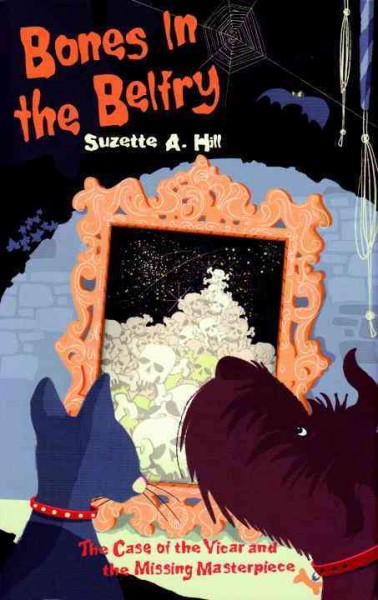
Bones in the Belfry: A Batty British Book

Bones in the Belfry by Suzette Hill (F HIL Main)


(Please forgive the heading. I couldn't resist the alliteration.)


Reviewed by Jeanne

Do you watch the Britcoms on PBS? You know, the shows like “Keeping Up Appearances” or “Are You Being Served,” in which people end up in increasingly ridiculous situations all while trying to keep their dignity intact. If you like that sort, then do I have the book for you!

It’s the late 1950s and the Reverend Francis Oughterard is very happy in his work as vicar of a small village. He does a lovely funeral, for instance, and doesn’t mind the sermons or weddings. Baptisms are a bit of bother, mainly because the infants are often squirmy and occasionally go headfirst into the font, which is disconcerting and upsets some people. Other than that, and handling the tantrums of the organist and smoothing things over with some of the parishioners who squabble about who’s in charge of what, he finds he has a lovely existence, treating himself to some fine wines and enjoying the company of his dog and cat. Well, there was that business when he strangled Mrs. Elizabeth Fotherington but she really had it coming to her. Honestly, he didn’t really mean to do it and he certainly won’t do it again.

The trouble starts when his friend Nicholas brings by some paintings that he wants put in a safe place, paintings that Francis is sure are stolen. Normally, he would have refused but Nicholas provided him with an alibi, no questions asked, in that little matter of Mrs. Fotherington. While Nicholas hasn’t actually said anything, the vicar has the distinct impression that if he refused to stash the paintings Nicholas might recant.

The plot thickens when Maud Tubbly Pole turns up. She’s a crime novelist who thinks the strange unsolved murder of Mrs. Fotherinton would be a perfectly thrilling premise for her next mystery. What’s more, she thinks the vicar is just the person to help her research the story.

The story is narrated from three points of view in three distinct voices. The first is Francis himself, a fussy somewhat nervous man who just wants to sip his wines and perform his duties in peace. The second is Bouncer the dog, whose former owner was a banker who absconded with a suitcase full of cash. Bouncer is an energetic soul, obsessed with his bones—the chewing kind—and rambling around with his canine buddies. Maurice the cat is the third narrator, former pet of Mrs. Fotherington and who seconds the vicar’s vote of “good riddance.” Bouncer finds Maurice to be smug and superior, Maurice thinks Bouncer is scatterbrained and none too bright even if he has learned bits of Latin from his jaunts in the graveyard, and they both know that Francis is their bumbling meal ticket. They are well aware of the vicar’s little misadventure, and (unbeknownst to Francis) actually helped cover up the crime. After all, as Maurice points out, if Francis goes to the gaol, they’ll be out on the street again. All three are quite self-centered and determined to maintain their own status quo.

I found this to be a rollicking tale. I could almost picture some of the scenes in my head and would have sworn I heard Hyacinth Bucket’s voice: it’s that type of book. This is actually the second in the series. I’ve requested an interlibrary loan of the first book, but I didn’t have any trouble following the plot at all.

Update: I borrowed and read the first book in the series, A Load of Old Bones. It was good, but not as good as the second book. I don’t know if that was because I already knew much of what was going to happen from hints in the first book or if it was because it took awhile to introduce the characters and situation. A colleague tried to read it and gave up. I think this may be one of those cases when the author sort of hit her stride in the second book. I’ll know more after I read the third in the series, Bone Idle.

Saturday, February 19, 2011

2000-2009: What a Difference a Decade Makes!


Reviewed by Nancy

As a youngster, back in the eighteen hundreds, uh, no, I'm sorry it was the early nineteen hundreds. Oh, no, I guess it was the mid twentieth century. Well, whatever. Anyway, a LONG TIME AGO when I was young and in school, anytime I was issued a new textbook the first thing I did was flip through the book and look at the pictures. Text only became important to me later in life. When I was young, I was all about the photographs.

I suppose that's why I so enjoyed looking at 2000 - 2009 The Decade That Changed The World by the editors of Life Books. (909.831 TWO Main)

Turning the pages of this book you can remember George Bush in his flight suit, Saddam Hussein in his hole in the ground, Tina Fey pretending to be Sarah Palin while playing the flute, the Boston Red Sox, Lance Armstrong, the flood of Hurricane Katrina, Michael Phelps, and on and on and on.

The book progresses through the decade year by year with a text summary of each year at the beginning of the section.

The 2001 section features only photographs of the inauguration of George Bush, the World Trade Center disaster, and the war in Afghanistan. For other highlights of that year, one must read the text.

If, after this, you feel the need to dwell on more lighthearted images, flip to one of the two "of the moment" sections and entertain yourself with a sassy picture of Amy Winehouse or an elegant photo of Brad Pitt and Angelina Jolie.

2000 - 2009 The Decade That Changed The World closes with a "farewell" section that presents photos of some of the national figures that exited this earthly plane during the decade.

Throughout the book I found myself thinking over and over again, "Oh, yeah, I forgot about that." If you'd like to review the things you remember, or check to see what you've forgotten, have a look at this book. It's fun!