Showing posts with label Trials of the Earth. Show all posts

Wednesday, January 19, 2022

Nevermore: Ninth Hour, Trials of the Earth, What It Means When a Man Falls from the Sky, It Never Rains in Tiger Stadium


Nevermore December 28 2021

Reported by Garry 


The Ninth Hour by Alice McDermott is a novel set in Brooklyn during the early years of the twentieth century, focusing on the Tiernan family and the nuns who help them after the suicide of Annie Tiernan’s husband. Interwoven in this story are tales of the nuns’ lives, the priests and the people (mainly Irish immigrants,) all denizens of the borough, and the tireless work of the nuns who care for the needy in a time before social services. McDermott skillfully brings a wide variety of characters to life with complex, well-realized characters and motivations. WJ


The Trials of the Earth:  The Story of A Pioneer Woman by Mary Mann Hamilton is a fascinating autobiographical look at life in the backwoods of the Mississippi Delta, written during the 1930s. Mary lived from 1866 to 1936 and recorded her history near the end of her life – a life of backbreaking, oftentimes lonely work on a homestead in Mississippi. Our reader was struck by how incredibly strong the writer was to have survived (and thrived) in what would now be considered very primitive, often heartbreaking conditions (Mary had nine children, of whom only five survived to adulthood.) CD
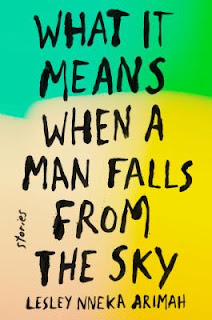


What It Means When A Man Falls From The Sky is a collection of fantastical short stories by the up-and-coming writer Lesley Nneka Arimah.  This anthology explores the ties that bind parents and children, lovers and friends, and husbands and wives not only to each other but to the places that they live. Our reader particularly liked Arimah’s use of magical realism in her stories, and the complex, believable characters who she brings to life in each of these 12 stories. MH

It Never Rains in Tiger Stadium is the memoir of John Bradley, a former college football player who became a sports writer. Bradley describes in heart-touching detail the strength of the bonds that form while playing college sports and the chasm of self-doubt and regret when one believes that their life peaked at age nineteen. Bradley attended Louisiana State University for four years in the late 1970s, and when his football career ended, he cut off all contact with his teammates and coaches in an attempt to put the past behind him. Years later, he realized that doing so left a huge hole in his heart and soul. Our reader says that this book really brings to life the struggle that many young athletes face when the sport that has been central to their lives for so long is no longer there for them, and highly recommends it as an unblinking but heartfelt look at life. BS

Also mentioned:

The City of Mist by Carlos Ruiz Zafon

Sarah, Plain and Tall by Patricia MacLachlan

Both/And: A Life in Many Worlds by Huma Abedin

The World of Plymouth Plantation by Carla Gardina Pestana

On Animals by Susan Orlean

Surrender, White People!: Our Unconditional Terms for Peace by D.L. Hughley and Doug Moe

Creatures of the Deep by Erich Hoyt

The 1619 Project by Nikole Hannah-Jones

The Power of the Dog by Thomas Savage

The Postmistress of Paris by Meg Waite Clayton

The Care and Management of Lies by Jacqueline Winspear

Autopsy by Patricia Cornwell

Wish You Were Here by Jodi Picoult

Call Us What We Carry by Amanda Gorman

Wednesday, March 8, 2017

Nevermore: Vonnegut, Victoria, Pioneers, Principles,Post-American, and Physics


Reported by Jeanne
 

Although Player Piano came out in 1952, our reader found this Kurt Vonnegut debut novel to be quite timely. The setting is sometime in the future, following a third world war, in which engineers have created a world so mechanized that there is little employment for the lower classes.  The result is a population without any purpose.  They spy on each other and are generally miserable.  The former working class people are seen as less than human.  The novel is a bit slow, but quite relevant with its message that people need meaningful work to do.


The next up was Queen Victoria, inspired by the PBS series.  One member brought in a copy of Victoria:  The Heart and Mind of a Young Queen by Helen Rappaport.  The book is billed as a companion to the TV series, including a look at Victoria’s letters and diaries to portray her personal life.  The book was deemed quite enjoyable and our reader is looking forward to the novel Victoria by Daisy Goodwin, who wrote the screenplay for the series.


Trials of the Earth by Mary Hamilton is the memoir of a female pioneer in the Mississippi Delta.  It was originally written in the 1930s but was only published in 2016.  Hamilton writes vividly of the hardships she endured: floods, tornados, bears, panthers, and fire.  Married to an Englishman who refused to talk about his past, Hamilton moved with her family from place to place as they tried to eke out a living.  There were boarding houses and lumber camps, births and deaths, all recorded in her diary.  Our reviewer found it both moving and “terribly true.”


Some books really make the rounds in Nevermore, inspiring much discussion.  The Lucifer Principle by Howard Bloom is one such book.  According to this week’s reader, the most important principle is power. Life is determined by a “pecking order,” be it chickens or humans, meaning that individuals strive for status inside the order.  Violence is part of the natural order in both humans and animals.  Our readers have been divided about the book, but all agree it is thought-provoking.


Another book several readers have recommended is The Post-American World by Fareed Zakaria.  This isn’t a doom and gloom book about the demise of the United States, but an acknowledgement that other countries are gaining influence and power in the world.  Overall, it’s an optimistic view; Zakaria believes the U.S. can survive and even thrive, but only if the country can recognize that change is coming and respond accordingly. 


Finally, The Pope of Physics by Gino Segre is a biography of Enrico Fermi, one of the creators of the nuclear age. Fermi won the Nobel Prize in physics in 1938 at the age of 37 but instead of returning home to Italy after the ceremony in Stockholm, he and his family went to New York instead, thus escaping Mussolini’s regime.  Fermi’s wife was Jewish and he had already seen Jewish colleagues and students suffer under the new laws. Even so, the Italian scientist was regarded with a great deal of skepticism by the FBI who suspected him of fascist leanings.  Our reader said the book was very good, but it wasn’t a favorite.

Wednesday, January 25, 2017

Nevermore: Letters from the Trenches, Trials of the Earth, Sidney Chambers, The Secret War, Incognito

Reported by Ambrea


This week, Nevermore decided to get historical, kicking things off with Letters from the Trenches:  The First World War by Those Who Were There by Jacqueline Wadsworth.  Described as fascinating and insightful, Letters from the Trenches is not a traditional history; rather, it compiles hundreds of letters penned by different men who served in the war—men who only have their letters to survive them.  Our Nevermore reader was thrilled with her book, saying it was an excellent investigation into the history of World War I and, more importantly, to shine a light on the human element of such a brutal conflict.  She said she was particularly interested in Wadsworth’s research into the soldier’s letters, uncovering whatever happened to the men who survived on the front line and relating their stories before and after the war that forever changed the world.


Next, Nevermore explored a little further into the past, taking a look at the pioneering days of the American South from deep in the Mississippi swamps to settlements on the Arkansas frontier with Trials of the Earth.  Penned by Mary Mann Hamilton, Trials of the Earth is, according to the book jacket, the “only known first-person account of one woman’s struggles and triumphs taming the Mississippi Delta.”  In her memoir, Mary Hamilton describes her harrowing life as she, along with her husband, pushed at the boundaries of the frontier.  Our reader said Hamilton’s memoir was “so very good,” beautifully written and incredibly precise.  She highly recommended it to her fellow readers, noting that it was so easy to be “swept along by it” as Mary recounted her time at the fringes of American civilization.


Nevermore also dived right into a historical mystery by James Runcie, his second installment in the Grantchester Mysteries:  Sidney Chambers and the Perils of the Night.  Sidney Chambers, a full-time priest and part-time detective, is called to investigate a number of new mysteries, including the poisoning of Zafar Ali and the unexpected fall of a Cambridge don from the roof of King’s College Chapel.  Richly detailed and woven with hints of humor, Sidney Chambers and the Perils of the Night combines the best of mystery and romance as Sidney makes his way through the 1950s Cambridge campus and continues to deal with his own spiritual struggles.  Our reader said she enjoyed reading Runcie’s novel, and she enjoyed discussing differences between the Grantchester mysteries series and the Grantchester television series appearing on PBS.  Although she noted several critical differences between the book series and the television show, she highly recommended both to her fellow Nevermore members as having merits that made them equally likable.


Proceeding in the historical vein, Nevermore took a good long look at World War II in The Secret War:  Spies, Ciphers, and Guerillas by Max Hastings.  Hastings, one of Britain’s senior historians of World War II, has written more than a dozen books on the subject—including his latest on some of the more secretive aspects of war.  In his book, Hastings puts a magnifying glass to many of World War II’s harshest battles—and some of its lesser known ones—and uncovers many of the leading spies, cryptologists, and guerilla fighters who helped to turn the tides of war.  Our reader said he greatly enjoyed The Secret War, saying, “[Hastings] knows his stuff, and his book is a thorough account of a matter that has received less attention than it deserves.  But modern nations do not like to reveal their secrets, and it takes an experienced scholar of Hastings caliber to ferret out the whole story,” which he does admirably.  Our reader highly recommended it to his fellow readers, noting, “If you like cloak and dagger stories, The Secret War will appeal to you.”


Last (but certainly not least), Nevermore had a long discussion about Incognito:  The Secret Lives of the Brain by David Eagleman.  Like Mary Roach, Eagleman attempts to answer questions readers never even knew they had, like:
“Why can your foot move halfway to the brake pedal before you become consciously aware of danger ahead?  Why do you hear your name being mentioned in a conversation that you didn’t think you were listening to?  What do Ulysses and the credit crunch have in common?  Why did Thomas Edison electrocute an elephant in 1916?  Why are people whose names begin with J more likely to marry other people whose name begins with J?  Why is it so difficult to keep a secret?  And how is it possible to get angry at yourself—who, exactly, is mad at whom?”
Eagleman attempts to answer these questions and more in his book, which our readers were excited to discuss.  Although our reader said she would sometimes get bogged down by the sheer weight of information provided in Incognito, she found Eagleman’s book fascinating.  In between all the research, she found little nuggets of stories that were useful and insightful or just plain fascinating.  After sharing a lengthy discussion of the conscious mind versus the brain and the soul, Incognito was quickly snapped up by another reader who was eager to learn more about the neural pathways of the mind