Since we had been graced with a visit by Mary Kay Andrews, Director Jud chose to read her book Hissy Fit. Interior designer Keeley Rae Murdock sees her business take a nose-dive after she breaks up with her fiancé. Just because she caught him “doing the deed” with the Maid of Honor at the rehearsal dinner was not enough to warrant her “hissy fit”—or so HIS family thinks, and being folk of wealth and influence, they decide to ruin her business. Luckily, she meets Will Mahoney who has just bought an old manufacturing plant and who wants her to redecorate an antebellum mansion. Jud’s descriptions had the whole group laughing. One member pointed out that under her real name, Kathy Hogan Trocheck, she had written a wonderful series of mysteries set in Atlanta.
Guernesy Literary and Potato Peel Pie Society by Mary Ann Shaffer was the next book mentioned. The reader enjoyed it a great deal but said it took some time to get into it, and she found the format a little difficult because she couldn’t picture the characters. The story, however, is excellent. Guernsey spent five years under German occupation during World War II, and the residents had to improvise the Society as a cover for the resistance. The story is told in retrospect through a series of letters from an American journalist looking for a story and some of the island’s residents. Our reader recommended it, though she admitted it was tough going at first. She ended up enjoying the book very much.
Craig Johnson is a West Virginia native who now lives in Wyoming where he sets his Walt Longmire mysteries. Walt is a long time sheriff in the Gary Cooper mold, a man of moral convictions tempered by compassion. Johnson spins a great story and has an excellent supporting cast of characters, including Walt’s friend Henry Lone Bear. In the latest entry in the series, Hell is Empty, one character is given lists of books to read by his co-workers. Each list reflects the interests of the particular compiler, from Pilgrim’s Progress to Madame BovaryKip Carey’s Official Wyoming Fishing Guide. to Our reviewer recommends the series to anyone who likes a good mystery, especially those who favor Western settings.
Policewoman Lacey Flint meets a dead woman standing by her car. Technically, the woman is still alive but at the rate blood is spewing forth it’s obvious that her life span is now to be measured in seconds. There’s no sign of the slayer; the women still wears expensive jewelry, though her purse is gone. There’s no identification on her, no cell phone, no car keys. As the police struggle to identify the victim, a reporter turns up with a letter that refers to Lacey and to the crime, using phrases that would sound alarm bells for any historical crime buff:
Saucy Jacky is back.
As a child, Lacey was fascinated by Jack the Ripper so she knows what the letter means. She also realizes that the woman was murdered on the same day as the Ripper’s first known victim, and that the wounds are similar. It soon becomes apparent that someone is replicating some of those crimes and the police are racing against time to prevent more murders. It’s also apparent that the killer is fixated on Lacey, who has some things in her past that she’d rather forget.
Bolton is a British thriller writer whose books tend to follow a certain follow a pattern, though they aren’t formulaic. Her novels usually feature a strong, gutsy female lead with a damaged past and a willingness to sometimes rush in where angels fear to tread if she feels someone is in danger. There is a well developed supporting cast of characters. Bolton also does a wonderful job with setting, describing places in vivid and tactile terms, and knows just what buttons to push to ratchet up the tension. In her previous books, she kept the violence a bit removed by placing it in the past but in this book certain things are immediate and visceral—no pun intended. She can take something ordinary and make it frightening. For example, the song “My Favorite Things” runs all through the book; it was one of Lacey’s favorite songs, one she found comforting in difficult times. I’m not sure I’ll ever be able to listen to that song again without feeling a sense of unease.
Another factor is always the past: not just the characters’ pasts—which are important—but history and folklore always figure into the story in some fashion. Legend is as apt to lead you down a wrong path as a right one; figuring out the important bits is part of the puzzle. Bolton’s books are good illustrations of the Faulkner quotation that the past isn’t dead. It isn’t even past.
Finally, Bolton’s solutions are complex and riveting; there are twists you don’t see coming. That’s true of this book in particular. It makes it a little difficult to do a review in some ways, because to do it justice the reviewer would have to reveal some things best left for the reader to discover. She also doesn’t seem to believe in the pat happy ending; not all of her books end with folks walking off into the sunset together, holding hands.
I’m not a fan of graphic violence so some sections were definitely unsettling; but I can offer the same comment about many current thrillers and forensic books. (And, to be fair, there are other thrillers that are much more graphic.) I did enjoy the characters and the plotting, the attention to detail and the bits of “Ripper-lore”—I can always count on Ms. Bolton to do her homework in such things!—and the ending was a shocker.
Willpower:Rediscovering the Greatest Human Strength by Roy F. Baumeister was a popular topic in the Nevermore Bookclub.The term “willpower” has been thrown around by self-help gurus and diet mavens, mostly in the context of “lack of willpower.”Psychologist Baumeister’s groundbreaking study on the nature of self-control and willpower explains when and why people give into temptation and how an individual can improve his or her willpower.He contends you can actually strengthen your resolve by practicing will power. A surprising number of things affected the ability to exercise self-control: glucose levels and sleep patterns were factors as well as the number of decisions a person was required to make (more decisions wore away resolve).Usingthe “buddy system” was effective in many cases. Nevermore members found Baumeister’s conclusions fascinating, and a good basis for understanding their own behavior, as well as a good basis for planning how to resist temptation.Willpower is a fascinating book and quite readable for the layperson.
Another new popular science book is Sex on Six Legs: Lessons on Life, Love and Language from the Insect World by Marlene Zuk.People have varied responses to insects: the little creatures are loved, loathed, studied, and even eaten but rarely given credit for being anything other than a sometimes necessary annoyance.Zuk’s book takes a look at the way insects interact, communicate, and reproduce.Did you know some insects seem to have facial recognition?In one experiment, bees that flew toward a particular photograph of a man were rewarded; some of the bees would return regularly to the photograph even if the face was inverted. They also seemed to remember the photograph for weeks. This is a book to entertain and inform the curious!
Roger Ebert has been a movie critic for over 40 years, but it’s his life behind the scenes that takes center stage in his memoir, Life Itself.He does recount some encounters and interviews with celebrities and discuss his sometime tempestuous relationship with his co-star Gene Siskal, but most of the book takes place out of the spotlight.Many reviewers mention his storybook childhood and his often madcap escapades as he embarked on a career in journalism, but the heart of the book recounts his struggle with alcoholism and with the cancer that robbed him of the ability to speak, eat or drink.The book is gracefully written and, as the title indicates, is more of a reflection on life than a gossipy tell-all. Our Nevermore member thought it was marvelous!
It seemed like such a fantasy when I was a child, to be able to talk to the animals. Of course, now I talk to my animals all the time, but who knows what they really understand, and if they talk back to me I don't much get it.
But, it seems, there has been a real-life "Doctor Dolittle" amongst us. Her name was Julie Dicker and with her co-author, Anna Clemence, she wrote the book, "What Horses Say," which details her experiences as an animal healer and communicator.
Ms. Dicker, a resident of the UK who passed away in 2006, developed the ability to communicate with animals during early childhood. It wasn't as if she had learned to speak "horse" and then "cat" and then "bird" and then "dog." I tried this verbal method once myself, and found it to be impossible, especially the "cat." No, Julie Dicker was smarter than I am. She communicated with animals with her mind and her heart.
During the years that she worked as an animal communicator and healer Ms. Dicker built relationships with horse professionals who requested her assistance and insights regarding the behavior of their equine charges.
"What is wrong with my horse?" This is the question that drove many people to seek Ms. Dicker's assistance. According to Ms. Dicker, horses are smart, and have long memories. There is the story of Ozzie, who was a model steed as long as no one got near her wearing green boots. When green boots approached, Ozzie turned from a docile companionable friend into a raging lunatic of a horse, thrashing and churning and lashing out at anyone near.
Ms. Dicker had a session with Ozzie and learned that Ozzie had had some very bad experiences with people wearing green boots in the past. Once Ozzie's owners learned this they ditched their green boots and everything was fine.
This may sound silly to you, but there you have it. The horse was smart enough to connect green boots with bad experiences and also to retain this information for a long period of time.
Five years after learning this little quirk about Ozzie one of her owners forgot about the green boot phenomena one day. It was raining, and since it was raining he was wearing boots, and, uh-oh, they were cursed green boots. When he attempted to bring her in from the pasture she absolutely refused to be caught. He sloshed into the house, complaining to his wife that the usually cooperative Ozzie was determined to stay out in the rain. Once they realized he had on green boots, the wife, who was not wearing green boots, went to the pasture and caught the horse easily.
Then there's Lucy. Lucy was sold at auction, but chose another owner by reaching out of her stall and grabbing the clothes of Pippa, the woman passing by, who smelled good to her. When Pippa looked at the horse's face and body she knew that she had to have her. She went and found the man who had bought the horse and made a deal with him. It turned out that Lucy had been terribly mistreated early in her life, but fully recovered after receiving healing from Julie.
One of my favorites of the tales related was about Dan. Dan was a bay gelding who had been with the same owner for five years. During this time he had been a great horse to ride, never spooking, and had gotten along quite well with his owner. Then suddenly the good times were over, and Dan was a nightmare to ride, scooting and spooking at every turn.
When Ms. Dicker arrived to give Dan healing he was very eager to tell her what was going on. It turned out his owner/rider had recently started riding with a friend and spent the ride conversing with her friend instead of paying attention to Dan. So Dan decided negative attention was better than no attention. He started spooking at bushes and plastic bags and jumping across the road at every opportunity. When he did this conversation stopped and his rider turned her attention to him. Once this was explained to Dan's owner, she cut the chatter and everything was fine.
I suppose there are two ways to view Ms. Dicker's work. Either it's amazing, or it's just another load of hooey. If you are a person who is very invested in the idea of the mystical, magical unseen world around us, I suppose you might fall into the "it's amazing" camp.
On the other hand, if you are one of those individuals who insists that they believe only in things that they can see and touch, only in things that appear to be concrete, this one might be a little too far "out there" for you. If ever there was a book that might pull a person from the "concrete" camp into the "mystical" camp this might be it. Maybe you should risk a look.
There was quite a buzz when it was revealed that Audrey Niffenegger, author of the critically acclaimed The Time Traveler’s Wife, had written and illustrated a graphic novel. Would it work? Was it just a gimmick? As with practically any book, the answer to that depends on the reader. Some have loved it, some have hated it; there are few who are indifferent. The main point made in many reviews is that this is not a book for children, since many people still equate illustrated story with comics for kids and not another form of literature suitable for adults. This isn’t a children’s book anymore than Cancer Vixen by Mary Acocella Marchetto (a graphic novel detailing a woman’s bout with breast cancer) or the classic Maus by Art Spiegelman, which tells the story of the Holocaust.
As the story opens, Alexandra is walking alone in the wee hours of the morning, having had a fight with her boyfriend. She sees an old Winnebago and hears music, so she stops to see what is going on. It’s the Night Bookmobile, the driver tells her, and invites her in. She browses awhile, then discovers her old diary on the shelves. She realizes that she has read all the books on the bookmobile. Of course, she is told, it is her collection. From this seemingly chance encounter, an obsession is born: she must unlock the secrets of the bookmobile.
Here are two viewpoints about the book. First up is Gena:
Even by graphic novel standards, this is a strange piece of work.
I read a lot of graphic novels, though I confess they are usually more of the cape and spandex super hero variety. I respect the literary ambitions of the medium, but I am always a little suspicious when someone from the prose world tries to capitalize on its recent success. Thus, when I first heard that Audrey Niffenegger of The Time Traveler's Wife fame was trying her hand at a graphic novel, I wasn't sure what to expect.
The end result is a disturbing story about the nature of reading and libraries in our lives.
The story is simple enough. The lead character stumbles across a bookmobile on a late night walk. In its collection it has every book she's ever read in her life right down to her own childhood diary. She's drawn to the place and wants to stay, but that is not permitted for reasons that can't be explained. Our heroine obsesses over the
bookmobile and searches for it for years to the detriment of her life and relationships. Eventually she becomes a librarian, and every decade or so, she finds it again. The result is always the same: she cannot stay. Finally, she decides to take drastic measures to change the state of things with unsettling results.
The art is lovely, and while the story is poignant, it is disturbing on a level that makes me question whether or not I want to read as much as I do or ever set foot in a library again!
Jeanne has an alternate view:
Hmm. . . I will say that I found the story memorable and given that I have the memory of a gerbil, that’s saying something. It did make me a bit uneasy, but it didn't turn me against books or libraries! I was more reminded of the lines from the Merle Travis classic, "Dark as a Dungeon":
"Like a fiend with his dope, or a drunkard his wine, a man will have lust for the lure of the mines."
Most of us have obsessions with one thing or another: collecting things, a sport, watching television or whatever. We spend too much time on that and not as much on the everyday business of living and interacting. We get absorbed and neglect other things, possibly more important things. I say “possibly” because we can only judge what really IS important for ourselves; Sequoia’s wife, according to legend, burned his first version of the Cherokee writing system because she felt he was wasting too much time on it instead of taking care of his family. I was intrigued by the whole premise: just think of it, your own private sanctuary where all you’ve read is stored.
Yet that is also the one aspect that gives me pause as a reader (and I mean as a reader in general, not as a reader of this book): there are no new books there, nothing that hasn’t already been read. If Alexandra didn’t finish a book, the pages are blank after the point where she stopped. It’s comfortable and sometimes comforting to reread some books, but wouldn’t you want to read something else once in awhile? Is the Night Bookmobile something that is basically narcissistic, a way of glorifying self? Is it true that we are what we read? Or is there something more?
I don’t have the answers to those questions, but I like that the questions are asked. While I found the ending a bit shocking, I wasn’t repulsed. I thought in some ways it was more reflective of the old adage, “Be careful what you wish for.” Yet, is the ending bad? I don’t know. I found the story both sad and oddly hopeful, a passing of the torch as it were.
I’m a bit ambivalent about the art. I grew up reading comics and am still a fan, though these days I’m more a reader of comic strips than comic books. I can’t start my day without a cup of coffee while reading 9 Chickweed Lane, Rose is Rose, and several other strips. I have not gotten into magna; I’ve read a few but some of the stylistic conventions are off-putting for me. In The Night Bookmobile, the art varies: in places it’s very flat, rather amateurish looking, while in others it’s beautiful and evocative. It works to express certain themes in the story, I think, but if I had just picked the book up and glanced through it I don’t know that I would call it beautiful. The cover I do like a lot, with those wonderful shelves of books and the red carpet looks so inviting: sort of velvety. It makes me want to sit right down on it and start looking at the books.
The Affair by Lee Child is just out. It’s set back in Reacher’s Army days and explores the reasons he left the service. Reserve it today! (Did you know that there’s a Reacher movie in the works, with Tom Cruise as the star? Do you think Cruise can pull it off?)
Nicholas Sparks has a new book out this month! The Best of Me tells the story of two star-crossed high school sweethearts who meet again after 25 years. Nobody does romance like Sparks! Get your name on the reserve list today!
If you’re a Beverly Lewis fan, the wait is over! The Mercy, the third book in “The Rose” trilogy is out now! Call or stop by the library to get your name on the reserve list!
John Sandford is famous for the Lucas Davenport “Prey” books, but some fans are even fonder of his new series starring Virgil Flowers. Shock Wave is the new book out in October and early reviews say this is one of his best!
Janet Evanovich has a new Stephanie Plum adventure due out in November. It’s called Explosive Eighteen. You can put it on reserve now! The movie version of One for the Money starring Katherine Heigl as Stephanie will be in theaters in January.
Dexter fans will definitely want to get on the list for Jeff Lindsay’s latest entry, Double Dexter. Dexter isn’t pleased to find that someone is copying his methods of eliminating other serial killers-- and we all know what happens when Dexter isn’t happy….
Vince Flynn fans, it looks as Kill Shot is going to be delayed until February, 2012. Mr. Flynn has been ill but according to his website, he hopes to back writing as soon as his treatments are finished. The plot sounds intriguing: Mitch Rapp is hunting a target in France when the tables are turned and he becomes the hunted.
Just in time for Halloween, F. Paul Wilson comes out with the last of the Repairman Jack novels, The Dark at the End. What, you don’t know Jack? He’s just one of the best supernatural characters to come along in the past decade or so! If you’re intrigued, start no earlier than Bloodline.
Terry Prachett fans, rejoice! There’s a new Discworld book out, Snuff. The master of satiric fantasy remains at the top of his game. Yep, Snuff is up to snuff!
John Grisham has a new book out in October! The title is The Litigators, and the story revolves around two all but down and out attorneys who suddenly acquire a new associate and maybe a case that will net them millions. Several reviewers have said this one has more humor than some of Grisham's books and it seems like the author is really having fun. When authors have fun, readers usually do too!
If you love British historical fiction, then you know the name Sharon Kay Penman. After a long hiatus, Penman has a new book out: Lionheart, about Richard I. It’s full of the same detail and romance Penman fans have come to expect!
New York to Dallas is the latest installment in J.D. Robb’s very popular “In Death” series. A violent pedophile has escaped prison, and Eve is determined to track him down. The trail leads her back to Dallas and to face some of the ghosts from her past.
The Nevermore Book Club was very lively this week! Russell Banks was still under discussion, with one person championing his novel Rule of the Bone as his best, while others praised The Sweet Hereafter. Director Jud Barry had a serendipitous experience by following Cloudsplitter with Barbara Kingsolver’s The Poisonwood Bible. He felt the themes of the two books complimented each other.
Michael Connelly was praised by several there, especially his novel The Poet. When reporter Jack McEvoy finds evidence that a series of suicides might be the work of a serial killer, he finds himself behind the scenes of an investigation. The killer is leaving quotations from Poe at the scene, so the reader learns quite a lot about Edgar Allan in the course of the investigation. McEvoy turns up in several other Connelly books, including Scarecrow and The Narrows.
Stuart Woods’ Son of Stone was praised as a fun read as were the books of the late Stephen J. Cannell. The latter made his name first in television where he was a successful writer and producer, overcoming dyslexia to do so. His ability to tell a good story makes his Shane Scully novels great escapist reading.
Ken Follett has started a new epic after his best selling Pillars of the Earth. The new book is Fall of Giants and it follows the fortunes of five families from different countries (England, Germany, Russia, America, and Wales) through the tumultuous years of the First World War. There are two sequels planned.
At the other end of the scale is Abide with Me by Elizabeth Strout which deals with a small New England community in the 1950s. The town’s minister suffers a terrible loss and finds himself questioning his faith and his community questioning his fitness as church leader. Strout is also the author of the critically acclaimed Olive Kitteridge.
Non-fiction was well represented, too. 1491 by Charles C. Mann is a new look at the Americans before Columbus. New archaeological research offers challenges to our previously held view of Native American civilizations, which were both thriving, complex and, in some cases, technologically superior to their European counterparts. Mann is careful to explain how these new conclusions have been reached in a fascinating challenge to conventional views.
Howard Zinn’s A People’s History of the United States also questions some standard assumptions. Zinn’s focus is not on towering individuals but on what he perceives as the struggle between various classes and groups of people. It was noted that some of what Zinn says might have particular resonance today with the “Occupy Wall Street” movement.
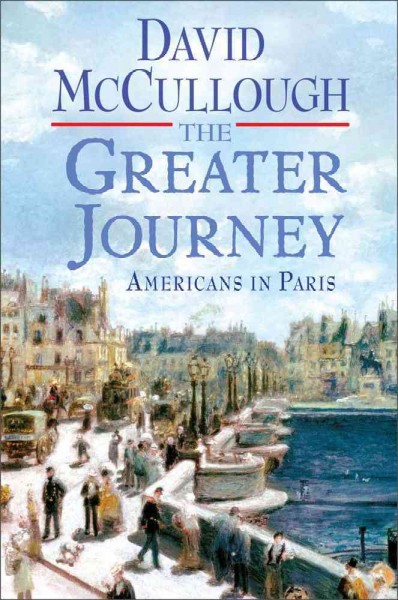
The Greater Journey: American in Paris by David McCullough is another winning look at history from the man who gave us 1776 and John Adams. Americans in the 1800s were venturing abroad in goodly numbers, bringing back with them ideas and inspirations that would change their homeland. At that time France was seen as the center of the arts and sciences, a place where dance and medical advances stood together. Many of the people were accomplished in several areas, though became known for one: Samuel Morse, for example, is justly celebrated for his telegraph, but he was also an accomplished painter. James Fennimore Cooper, Mark Twain, Mary Cassalt, Elizabeth Blackwell and Harriet Beecher Stowe are just a few of the accomplished folk we meet in these pages. As ever, McCullough tells a fine story and makes history come alive.