Showing posts with label vicar. Show all posts

Monday, June 27, 2016

Sidney Chambers and the Shadow of Death by James Runcie


Reviewed by Jeanne


Sidney Chambers, vicar of Grantchester, is an unlikely sleuth.  He is as surprised as anyone when he’s approached by an attractive woman who wants him to investigate the suicide of a local solicitor.  Mrs. Pamela Morton is convinced that her husband’s partner, Stephen Staunton, would not have killed himself because they were making plans to run away together. She can’t go to the police because that would mean the affair would be made public. Sidney can make inquiries, she believes, because he is a priest and people will tell him things.  For his part, Sidney isn’t certain that this is part of his job description; and yet, if what the woman says is true, then there may be a murderer in the community.

So begins the first in the series of Sidney Chambers mysteries. This book is actually composed of several novella type stories, linked closely with characters and subplots but dealing with other crimes, including  the theft of a valuable ring at dinner party and an art forgery. The time is 1953, and the social mores of that period are important to the books: this is an era where England still has the death penalty, opportunities for women are limited and advancement is often through marriage, and the shadow of World War II still looms large. 

  Sidney served in the War and has seen his fair share of death and violence, but he hasn’t become jaded.  In fact, quite the opposite: he looks for the best in everywhere.  He loves jazz, detests sherry (he prefers Scotch), and at 32 is still unmarried, though he is definitely attracted to Amanda.  She’s not the sort who would be happy as a priest’s wife, he feels, so he tries to keep their relationship strictly on a friendly basis. He also finds himself drawn to Stephen Staunton’s widow—who happens to be German. 

Geordie Keating, a local police inspector, is a good friend as well.  They meet to play backgammon at the pub, and Geordie isn’t adverse to encouraging Sidney to ask questions at times, question that the police wouldn’t be able to ask.  Geordie and Sidney don’t always see eye to eye; Geordie’s world is much more black and white, while Sidney’s experiences make him see more shades of grey and his faith demands that he judge not.  And though Sidney finds he enjoys the challenge of the mystery, he is bothered by how it changes the way he views the world.  As he himself notes, being a priest requires that he think the best of people but being a detective requires that he think the worst.

I picked this book up because I had seen the series Grantchester on PBS and was intrigued.  The characters had so much depth and were so nuanced.  I found the book to be even more fascinating.  Sidney is the sort of person we would like in a clergyman: compassionate, understanding, and devout.  He’s more likely to judge himself than to judge others.  But he is also a passionate man, one who sometimes feels he falls short in carrying out his duties, who indulges himself at times, and who can be impatient and frustrated.  He is trying very hard to be a better person and a better priest, and that’s what I find most appealing. 

The relationship between Sidney and Geordie is complex and intriguing:  they are both men of integrity, but their views are sometime quite different which creates a certain amount of conflict between them. I like that there have been no easy answers, no sudden capitulation on either side. 

In addition to Geordie, there’s an interesting cast of supporting characters including the housekeeper who isn’t sure Sidney is up to the job.  She’s also most unhappy when Sidney acquires a puppy, a Lab named Dickens.  Sidney's curate, Leonard, is quietly gay; after all, at this time in British history, homosexuality is a crime punishable by imprisonment.

I also felt that the author did a good job at evoking the 1950s without beating us over the head with it. Some authors feel obliged to stick in all sorts of showy detail to convince a reader that research has been done.  This was more low key, but effective because it dealt more with attitudes and social convention than with physical trappings.

After reading the book, I wanted to know more about the author.  James Runcie knows his subject better than most because his father was an Anglican priest and in fact became Bishop of Canterbury.  While the books aren’t biographical, Runcie said he wanted to pay tribute to his father through the character.  

Runcie was also interested in portraying how British society has changed over the years.  He chose 1953 because it was the coronation year for Queen Elizabeth.  The plan is for there to be six novels that cover 25 years.  I find that idea fascinating and am anxious to read more. 

Note:  The library owns a copy of the first season of Grantchester. Author Runcie is also a filmmaker, which may explain in part why the transition from book to film went so well.  The episode plots vary a bit from the book, but the spirit of the story and the characters translate very well from paper to film at least in this first series.  I gather the differences are greater in the second.


Wednesday, February 27, 2013

Fatal Winter by G.M. Malliet


Reviewed by Jeanne

Oscar, Lord Footrustle, is estranged from most of his family save for his sister Leticia and her granddaughter who live with him in Chednow Castle—and even they aren’t on the warmest of terms.  He’s getting on in years, though, and he decides it’s time to call the relatives in so he can decide how to divvy up his fortune.  The Christmas holiday finds them all living uncomfortably together, including the much younger ex-wife who feels she didn’t get her fair share in the divorce, the aging aspiring actress daughter and her “writer” husband, and two somewhat shady nephews.  The awkward situation only gets more awkward when Oscar is murdered and Leticia found dead in the greenhouse, apparently of natural causes.

DCI Cotton knows this is a case which will draw a lot of attention and he very much wants to be the one to solve it.  He may not have all the means that would be at Scotland Yard’s disposal but he does have an ace in the hole:  Father Max Tudor, a former MI5 agent turned Anglican priest, who sorted out that other bad business a few months earlier.  He’s sure he can prevail on Max to do some snooping for him.

Max, on the other hand, is trying to calm his household which has been invaded by Luther, the church cat, who’s had to be relocated due to the decorative greenery installed for the holidays. Luther and Thea, Max’s faithful canine companion, are getting along like a balloon and a cactus. Max is also becoming await that he’s forming what Jane Marple would have termed “a most unsuitable attachment,” so getting out of the parish for a few days is probably a good thing.  Besides, Lord Footrustle and his sister are to be buried in Max’s church, so it’s only proper he should consult and offer comfort to the bereaved—if he can find any bereaved, that is.  Most seem only too pleased to be rid of both Oscar and Leticia.

A Fatal Winter by G. M. Malliet is the second in the delightful “Max Tudor Mystery” series, and while it's sometimes hard to follow a great debut, I'm happy to say that the sequel is just as good.   I praised Wicked Autumn for its humor, which still very much present in this book but isn’t quite as pronounced.  The characters were interesting and the resolution was clever.  It seemed to me that the characters were a bit better developed this time around, and I enjoyed the conclusion very much.  She puts a fresh spin on the English village mystery, retaining the charm while modernizing the concept. There’s even the occasional curse.

There’s a lovely map of the village, a helpful genealogy chart to keep track of relatives, and a brief list of characters. I’m looking forward to the next book in the series.

Malliet is an American who lived in England for a time.


"This book has a cat named Luther, a svelte mouser!"


"I could totally play that role!"

Monday, December 3, 2012

Wicked Autumn by G.M. Malliet


Reviewed by Jeanne

The village of Nether Monkslip has been all atwitter after the arrival of their new vicar, Max Tudor.  Not only is he good looking and quite eligible, it’s rumored that he has a past that involved MI5.  However, the main concern at the moment is the Harvest Fayre, a major fund raiser sponsored by the church’s Women’s Institute and is being run with an iron hand by Wanda Batton-Smythe.  Wanda is a take-charge person who believes that nothing can be accomplished without her—not that she does any of the actual work.  She delegates all the tasks and then of course finds the work not up to standard.

Obnoxious as she is, it still comes as a bit of a surprise when her body is found in the Village Hall under suspicious circumstances. Max finds himself having to deal with a situation of the sort he thought he’d left far behind.
This is another of those books that seemed to appear out of nowhere and swoop up accolades and bouquets.  It was described as a delightful British cozy; while I like that genre, it didn’t prompt me to rush right out and read it.  I think it just sounded a little too cozy somehow. Really, a vicar who is a former MI5 agent?

Fortunately, I did pick up the book and start to read.  Malliet had me from the first page, when Wanda takes charge of the Women’s Institute meeting and her captive audience members are all wishing themselves elsewhere, sitting on something other than the orange plastic chairs that “might have been rejects from an ergonomics study.”  The neat turns of phrase continued, much to the consternation of friends who had to listen to me read them aloud.  (I especially liked the one in which a woman is offered a book of dubious literary value and regards it as if she were “Queen Victoria being handed a pamphlet on early contraceptive techniques.”) While the characters are somewhat eccentric, they aren’t totally over the top.  I also had visions of the vicar being a James Bond sort, too smooth and too sophisticated for the setting.  Instead the characterizations are all a bit more nuanced than that, making the characters more believable without losing the sense of slight exaggeration and fun. Max, it turns out, was indeed an agent, one who walked away from that life and toward something in which he could believe.  Max is religious but doesn’t feel he has all the answers for either his congregation or himself; nor is he particularly denominational, despite being an Anglican priest.  It was a choice inspired by a relative who was a nun, not from any specific call.

There are several other memorable villagers, including Awena Owen who runs the local New Age shop and who thinks Max is far too other-worldly and not nearly practical enough; Miss Agnes Pitchford, the retired school teacher who knows everybody’s business; and Major Batton-Smythe, Wanda’s somewhat bewildered and blustery husband.

The bottom line is that I enjoyed this book very much, and more for the author’s way with a line than the mystery.  Not that the mystery was bad, mind you; but it’s easier to find a decently plotted mystery than it is to find one that’s so entertaining.  There’s a second book in the series, Fatal Winter, out and I have it on reserve.  I don’t think it can possibly be as much fun to read, but I’m certainly willing to be proven wrong.

Friday, February 25, 2011

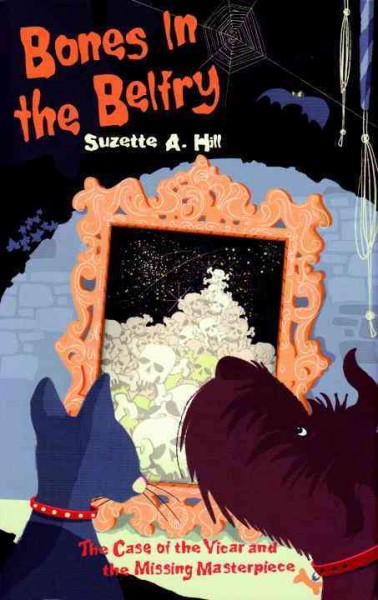
Bones in the Belfry: A Batty British Book

Bones in the Belfry by Suzette Hill (F HIL Main)


(Please forgive the heading. I couldn't resist the alliteration.)


Reviewed by Jeanne

Do you watch the Britcoms on PBS? You know, the shows like “Keeping Up Appearances” or “Are You Being Served,” in which people end up in increasingly ridiculous situations all while trying to keep their dignity intact. If you like that sort, then do I have the book for you!

It’s the late 1950s and the Reverend Francis Oughterard is very happy in his work as vicar of a small village. He does a lovely funeral, for instance, and doesn’t mind the sermons or weddings. Baptisms are a bit of bother, mainly because the infants are often squirmy and occasionally go headfirst into the font, which is disconcerting and upsets some people. Other than that, and handling the tantrums of the organist and smoothing things over with some of the parishioners who squabble about who’s in charge of what, he finds he has a lovely existence, treating himself to some fine wines and enjoying the company of his dog and cat. Well, there was that business when he strangled Mrs. Elizabeth Fotherington but she really had it coming to her. Honestly, he didn’t really mean to do it and he certainly won’t do it again.

The trouble starts when his friend Nicholas brings by some paintings that he wants put in a safe place, paintings that Francis is sure are stolen. Normally, he would have refused but Nicholas provided him with an alibi, no questions asked, in that little matter of Mrs. Fotherington. While Nicholas hasn’t actually said anything, the vicar has the distinct impression that if he refused to stash the paintings Nicholas might recant.

The plot thickens when Maud Tubbly Pole turns up. She’s a crime novelist who thinks the strange unsolved murder of Mrs. Fotherinton would be a perfectly thrilling premise for her next mystery. What’s more, she thinks the vicar is just the person to help her research the story.

The story is narrated from three points of view in three distinct voices. The first is Francis himself, a fussy somewhat nervous man who just wants to sip his wines and perform his duties in peace. The second is Bouncer the dog, whose former owner was a banker who absconded with a suitcase full of cash. Bouncer is an energetic soul, obsessed with his bones—the chewing kind—and rambling around with his canine buddies. Maurice the cat is the third narrator, former pet of Mrs. Fotherington and who seconds the vicar’s vote of “good riddance.” Bouncer finds Maurice to be smug and superior, Maurice thinks Bouncer is scatterbrained and none too bright even if he has learned bits of Latin from his jaunts in the graveyard, and they both know that Francis is their bumbling meal ticket. They are well aware of the vicar’s little misadventure, and (unbeknownst to Francis) actually helped cover up the crime. After all, as Maurice points out, if Francis goes to the gaol, they’ll be out on the street again. All three are quite self-centered and determined to maintain their own status quo.

I found this to be a rollicking tale. I could almost picture some of the scenes in my head and would have sworn I heard Hyacinth Bucket’s voice: it’s that type of book. This is actually the second in the series. I’ve requested an interlibrary loan of the first book, but I didn’t have any trouble following the plot at all.

Update: I borrowed and read the first book in the series, A Load of Old Bones. It was good, but not as good as the second book. I don’t know if that was because I already knew much of what was going to happen from hints in the first book or if it was because it took awhile to introduce the characters and situation. A colleague tried to read it and gave up. I think this may be one of those cases when the author sort of hit her stride in the second book. I’ll know more after I read the third in the series, Bone Idle.