Showing posts with label food. Show all posts

Friday, September 9, 2022

The Secret History of Food by Matt Siegel


Reviewed by Christy

            Why is vanilla – an expensive and finicky spice – also used to call things “bland” or “boring”? Why were people afraid to eat tomatoes for hundreds of years? And how do food photographers keep ice cream from melting under hot lights? If any of these questions interest you, you might want to check out Matt Siegel’s quick read The Secret History of Food.

            This non-fiction work is an enjoyable, fast read packed with lots of interesting little facts to tuck away for trivia questions around the dinner table (my stepson’s preferred table talk). Siegel meanders throughout world history, bouncing from food topic to food topic but also discusses some modern day “secrets” about the food industry. (Those parts aren’t quite so fun.) You’ll learn that World War II soldiers made up their dream Christmas menus to pass the time. To paraphrase one soldier: “Full belly, you think of women. Empty belly, you think of food.” You’ll see how the extremely wealthy would quite literally play with their food just because they could – serving pig heads sewed onto chicken bodies and vice versa. And ice cream doesn’t melt for photographers because they use colored lard!

            The variety of food covered kept me engaged, and Siegel’s authorial voice is wry and often times funny. One particular favorite anecdote was when he discussed a BBC segment on a “spaghetti plantation” where farmers would pick the cooked noodles out of trees (an April Fool’s joke). According to Siegel, many people called into the station to find out just where this plantation was located so they could go. “Keep in mind this was 1957, 12 years after the creation of the atom bomb.” Ok, that made me laugh out loud. (The segment is available on YouTube for those interested!) My only real quibble is that sometimes Siegel’s commentary would veer into snide and smug territory, which I found unpleasant.

            Overall, however, I was pleased with this, and the audiobook narrator Roger Wayne does a great job as well. It’s a good book to pick up during a reading slump because it doesn’t overstay its welcome on any one subject, and it’s a breeze to get through.


Wednesday, March 30, 2022

Nevermore: Chasing History, Absolutely Remarkable Thing, Melungeon Winter, The Poison Squad


Reported by Ben


Chasing History by Carl Bernstein: this book is the famous reporter's account of his personal journey as a reporter. Bernstein first faced difficulty establishing himself in the profession. He was a poor student who barely graduated high school and flunked out of college after spending too much time working for a newspaper instead of studying. Then he lost his job after a new editor took over the newsroom, stating reporters needed a college degree. Undaunted, Bernstein found a way to stay in the journalism profession and would cover big stories during a tumultuous time in US history. Our Nevermore club member loved Bernstein's writing style. She couldn't put the book down!


An Absolutely Remarkable Thing by Hank Green: 20-something protagonist April May stumbles upon a strange figure, appearing to be a transformer robot or monolith. She posts a picture of her find to social media, which goes viral, earning her notoriety. What April had stumbled upon was a mysterious phenomenon soon to be known as "The Carls," many more of which are being discovered in other cities. The plot thickens as April contends with her newfound fame and society faces a divide over what to do with these strange visitors. The Nevermore reader who shared this book went into it with a little apprehension, since it was a young adult novel. However she really liked the book and recommended it to the group.


A Melungeon Winter by Patrick Bone: in the 1950s, two friends--one white and one black--team up to exonerate the father of one of the boys who was accused of murder. The boys must work with a local Melungeon hermit named Mr. Mullins to solve the mystery. Nevermore's reader fell in love with the book, emphasizing how well it represented the region and time period she came from. Bone's novel is one of the few she will keep and read again!


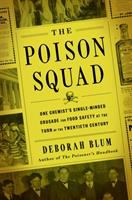
The Poison Squad: One Chemist's Single-Minded Crusade for Food Safety at the Turn of the Twentieth Century by Deborah Blum: this nonfiction title details the struggle to make food safe, from the late 1800s through the early 1900s. What was the problem? Your milk might have been just water with chalk mixed in. The meat at your table could contain borax. The food industry was experimenting with preservatives and being reckless with the contents of the country's food. Complicating the crusade to clean up everyone's food were changing government administration staffs which brought new priorities with them and a lack of funding for research. Our woman-on-assignment reading this book indicated that this one was not for the faint of heart. She was unable to finish reading it, being disturbed by what she learned. Blum's book did generate a lot of discussion and questions at the table, however. An eager Nevermore regular quickly snatched it up at the end of the discussion.


Other titles mentioned:


Black Potatoes: The Story of the Great Irish Famine, 1845–1850 by Susan Campbell Bartoletti


The Snow Leopard by Peter Matthiessen


The Women of Chateau Lafayette by Stephanie Dray


Amy and Isabelle: A Novel by Elizabeth Strout


The Adventures of Maya the Bee by Waldemar Bonsels


Green Dolphin Street by Elizabeth Goudge


At Bertram's Hotel by Agatha Christie


The Russia House by John le Carré


A Bad Day for Sunshine and A Good Day for Chardonnay by Darynda Jones


Iron Lake by William Kent Krueger


Look for Me by Lisa Gardner


The Silkworm by Robert Galbraith

Wednesday, August 11, 2021

Nevermore: Undertakers, Invisible Husband, Animal Vegetable Junk, Maidens


Reported by Garry


We had a surreal bunch of books discussed this week, with a great mix of fiction and non-fiction!


Over Our Dead Bodies: Undertakers Lift the Lid by Kenneth McKenzie and Todd Harra. Sometimes life (and death) are truly stranger than fiction, and this book typifies that. Chock full of weird, shocking and just plain hilarious true stories from undertakers, this book both shows the lighter side of death, but also the deep humanity practiced by those in the undertaking business. Our reader said that this book is very funny and helps to normalize what is often thought of as a near-otherworldly job.


The Invisible Husband of Frick Island by Colleen Oakley is a heartwarming tale of love, loss and growth on a small Chesapeake Bay island. Piper Parrish’s husband, Tom, is presumed dead – his crabbing boat capsized and his body was never found. In her idiosyncratic way of coping, Piper continues on life as if Tom is still alive – talking to him, taking walks with him, and going out to dinner with him. The other 92 inhabitants of the island support Piper by playing along, acting also as if Tom is right there by Piper’s side. Into this reality-warping bubble comes Anders Caldwell, a reporter who has been given the task of writing a fluff-piece about Frick Island’s Cake Walk fundraiser. Instead, Anders stumbles across the story of Piper and her dead husband. Will this outsider make a national mockery of the small, tight knit community, or will Ander’s eyes be opened by the support and love shown by the islanders?


Animal, Vegetable, Junk: A History of Food from Sustainable to Suicidal by Mark Bittman. Our reader says this is a very interesting look at the history of food and cultures and how humanity’s approach to growing food has changed over the millennia from being sustainable to being destructive to the very earth and soil that we rely upon. Bittman is a recognized food authority and in this in-depth look at the way that modern food is grown, processed and marketed, he lays bare the many ways in which our modern production of food is detrimental and outright dangerous – both to our bodies and to our planet. Our reader says that this book is not all doom and gloom and that Bittman does offer some solutions, although they will not be easy to implement.


The Maidens by Alex Michaelides was our next book to be reviewed. This murder mystery follows Mariana Andros, a troubled group therapist, who becomes convinced that Cambridge professor, Edward Fosca, is a murderer. The victim was a friend of Mariana’s niece, and a member of “The Maidens,” a group of students who are followers of the charismatic Fosca. Mariana herself went to Cambridge and her search for the truth places her in mortal and mental peril. Will she be able to expose the killer, or be consumed in her quest? Our reader liked this fast-paced, tight thriller, and recommends it.


Also mentioned:


Paris Trout by Pete Dexter

Blowback: The Costs and Consequences of American Empire by Chalmers Johnson

Nemesis: The Last Days of the American Republic by Chalmers Johnson

The Sorrows of Empire: Militarism, Secrecy, and the End of the Republic by Chalmers Johnson

An American Marriage by Tayari Jones

Saint Patrick’s Battalion by James Alexander Thom

The Orphan’s Tale by Pam Jenoff

The Underground Railroad by Colson Whitehead

The Angel Makers by Jessica Gregson

Saturday, July 17, 2021

Aunty Lee’s Deadly Specials by Ovidia Yu


Reviewed by Jeanne

Rosie Lee, better known as Aunty Lee, runs her own restaurant in Singapore where she specializes in traditional Peranakan dishes. Certain food purists who want to argue that some of her dishes aren’t “authentic” are met with Aunty Lee’s unassailable logic that since she is Peranakan anything she cooks is a Peranakan dish. This gives you a good overview of Aunty Lee. She always knows the correct way to cook everything and the correct way to behave and she believes in offering her advice freely, asked for or not.

She also does catering. As the book opens she is catering a brunch for fifty people at the Sungs’ house in honor of Sharon Sung being made a partner in her mother’s law firm.  The estate is lavish, the food is prepared to perfection, and Aunty Lee is consumed by curiosity—as usual.  Unfortunately, all the meticulous preparation is spoiled when two people die, and it appears that one of Aunty Lee’s special dishes might be to blame.

This is the second book in this series that I have read and I’ve enjoyed both.  I always like when I learn something from a novel, and I am intrigued by the depiction of Singaporean society.  It’s less of a melting pot and more of a stew pot (to use foodie terms!) in that there are many different cultures represented but each tends to retain its own customs and food preferences. 

Yu’s mysteries, which generally are classified as cozies, tend to have some to them.  This book opens with the disappearance of a young man who had been enticed to come to Singapore to be an organ donor—high prices are paid for kidneys, for example.  Of course this is illegal, but that’s why some are willing to offer extravagant sums to desperate people.

There’s a bit of humor to the books, Aunty Lee being the iron-willed and outspoken person she is. She’s also strong, resilient, and clever.  These traits plus her intense interest in everyone’s business are definite assets if you are going to solve crimes as an amateur sleuth. She’s aided by a diverse cast of friends and relatives, some of whom have their own agendas.  I like that the author is a Singapore native who describes situations briefly but never allows explanations to bog the story down and she never talks down to the reader.

There are also intriguing descriptions of food. A couple of recipes are included at the end which sound very interesting.  I am a non-cook, so there are brief helpful tips about where to eat and what to order the next time I am in Singapore.

The books in the series are:

Aunty Lee’s Delights

Aunty Lee’s Deadly Specials

Aunty Lee’s Chilled Revenge

Meddling and Murder