Showing posts with label Man From the Train. Show all posts

Wednesday, January 24, 2018

Nevermore: Six Wakes, Lady Bird, It's All Relative, Man from the Train, Truevine, Unquiet Grave


Nevermore members read widely, and this week one reader read Six Wakes by Mur Lafferty, a science fiction murder mystery.  The Dormire is a sleeper ship, carrying thousands of colonists from a war-torn, atmosphere-wrecked, socially disintegrating Earth to a new start on the planet Artemis.  But when Maria Arena and her crewmates awaken, as clones of their original selves, finding blood floating through the air leads them to believe that their former selves have been murdered.  Our reader greatly enjoyed this book and said that he could really see someone making this novel into a movie.


Turning to American history, another reader enjoyed Lady Bird: A Biography of Mrs. Johnson by Jan Jarboe Russell.  This revealing biography of the First Lady shows how much she contributed to LBJ’s presidency in the midst of the Civil Rights movement.  Conversations with family members and political associates make this a well-rounded picture of President and Mrs. Lyndon Johnson.  Our reader said that she enjoyed the book and that Lady Bird was a lovely person.


It’s All Relative: Adventures Up and Down the World’s Family Tree by A. J. Jacobs was enjoyed by yet another reader, as the author has explored the DNA connectivity of the worldwide community.  After Jacobs received an email from an eighth cousin who had been able to connect 80,000 relatives, he began a globe spanning journey to explore the far flung branches of his family tree.  Our reader enjoyed the humor, as Jacobs told his own family stories within the scientific explanations of how we are all related.


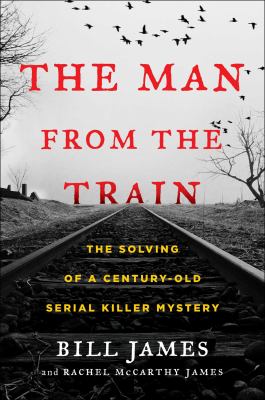
Our next reader began to read The Man from the Train: The Solving of a Century-Old Serial Killer Mystery by Bill James and Rachel McCarthy James, but sadly could not finish it.  Although the book was praised by other critics, our reader found that it was simply murder after murder, bludgeon after bludgeon.  She stated emphatically:  “It has 461 pages of murder and not all of them were near the train tracks.”


Truevine: Two Brothers, a Kidnapping, and a Mother’s Quest: A True Story of the Jim Crow South by Beth Macy shocked another reader as it recounted the story of two albino African-American brothers who were stolen from their family in 1899 and forced to be part of a circus sideshow for almost thirty years.  George and Willie Muse were depicted as caricatures of themselves as they traveled the world with the circus, and eventually reunited with their mother.  Our reader said that it was an extremely well-researched book and that she learned a lot about Virginian society and race relations in the early 1900’s.


 Another novel was enjoyed by another reader, Abraham’s Well by Sharon Ewell Foster.  The story centers around the Trail of Tears, the removal of Native Americans from the southeastern United States and their forced march to what is now Oklahoma.  Foster’s characters are not just Native American, but Black Cherokee African Americans, whose bloodlines were also mixed with white slave owners.  The Cherokee removal is here told from the point of a young girl, Armentia, who experiences tragedy and loss as her family is forced from North Carolina to Oklahoma.


Finally, The Unquiet Grave by Sharyn McCrumb told the story of Zona Heaster, married to Trout Shue in 1896 and dead a few short months later.  Zona appears in a waking dream to her mother Mary Jane, insisting that she was murdered, and Mary Jane has no choice but to pursue justice for her daughter.  Set in recently created West Virginia, the story jumps in time from the actual happenings to a recounting by an aging lawyer more than thirty years later.  Our reader said that everything McCrumb writes is wonderful, and she only wishes the author had included maps in this novel based on historical facts.

Friday, December 22, 2017

The Man From the Train by Bill James and Rachel James


Reviewed by Jeanne

(Note:  while two authors are credited, Bill James’ is the dominant voice, so instead of trying to tease out who said what, I’m just going to use “he” and “James” to indicate author.)

While public fascination with serial killers is fairly modern, such killers are not: Jack the Ripper, H.H. Holmes, Mary Ann Cotton, and Jesse Pomeroy were all active pre-1900. Bill James, best known as a baseball analyst, became interested in two historical murder cases. The first was a horrific murder in June, 1912, in which a family was massacred in Villisca, Iowa. Several books have been written about this one, as the perpetrator was never found.  Just about a year earlier, there were two families murdered by axe on the same night in Colorado Springs.  In all these cases, the murderer was organized and brutally efficient—professional, almost.  James hired his daughter to research newspaper databases of the era to try to discover if there were other such murders.

There were. During the course of the book, James describes a number of cases, noting similarities and deviations, and invites the reader to join in the speculation.  At the end, James believes he has found a definite pattern, and, indeed, a suspect.

I read a bit of true crime, but I prefer historical cases rather than contemporary; this book appeared to fit the bill.  I opened the book to discover that the first instance was in a little town in rural southwest Virginia called Hurley—about 95 miles from Bristol.

Naturally, I was hooked.

In some of the cases, people were actually convicted of the crime and executed, but often on very little evidence.  For example, while robbery was the usual motive given, but in many instances money and other valuables were found in plain sight.  This became one hallmark James used to sift through the cases.  Other features included use of the blunt end of an axe in commission of the crime, the events usually taking place late at night, victims found in their beds with their faces covered by a cloth, indications that the murderer spent time in the house after committing the crime, locking doors, and covering windows.

Of course, the main feature that connected these murders was the proximity of the home to railroad tracks.  James’ theory (and others) is that the murderer would hop a train and leave town, hence the title of the book.

Some reviewers took exception to the light tone James employs in describing events, but as he explains, the book is about occurrences so dreadful that the only way to deal with the continuous horror is to try to lighten the mood. I agree with his choice, but others may not.  He also doesn’t linger over details except when they pertain to his pattern, so he avoids gruesome images inasmuch as possible.

Another thing I appreciated is that James doesn’t take the stance that he is right in all instances but allows the reader to agree or disagree.  Some cases may have four or five features in common with the profile but have others that seem to be at odds with it.  James gives his reasons for including or excluding that event but doesn’t insist that others agree with his conclusion. I have to say this is rather unusual in my experience.  Often, an author is fixated on getting the reader to conclude that the author’s explanation is the only possible one. (It seems to me that this is especially true of books about Jack the Ripper, but isn’t limited to those.)

Part of what I like about historical mysteries is that usually the author sets the stage by telling us about the social, economic, and/or governmental situation of the day.  In James’ book, we get a bit of a lesson in how police departments and crime scene investigation evolved, not to mention the role of the press.  It’s not surprising that in several cases when the crime is “solved,” the accepted solution is usually a person of color or low social standing in the community. Some of the accused were lynched before a trial could take place. As I mentioned at the beginning, serial killers have been around a long time, but the concept that someone could be murdering people for the thrill of it is newer.  This hampered many investigations because authorities were certain the perpetrator had to have some connection with the victims; even when two families were murdered in very similar ways in the same area, the police looked for connections between the families, not really considering the attack could have been from a stranger. I think most eye-opening to me was the information about detectives, a job for which there were very few (if any) qualifications except a desire to make a buck.

My only real complaint about the book is the lack of an index.  With so many cases and so much ground to cover, I sometimes wanted to refresh my memory on details but locating specifics was difficult without aforementioned index. A more minor complaint is the lack of a bibliography.  Sources are cited, and due credit is given to authors (Beth Klingensmith gets especial thanks) and newspapers but sometimes a bit more information would have been helpful if someone wanted to read the original material. 

Overall, I found this to be a fascinating book and recommend it. I will say it’s sometimes enjoyed best in small doses as the body count rises; even the light tone adopted can’t gloss over the fact that a large number of people are brutally murdered, usually in their beds.  It went down much better when  read during the day and not in the evenings. This would be a good book for a reader’s group, wherein people could debate the various murders and decide which ones were part of a pattern and which weren’t.