Showing posts with label Edie Ernst. Show all posts

Friday, November 11, 2016

Veterans Day Books


In honor of Veterans Day, we asked several staff members to name a book they would think appropriate for the day.  Here are their responses:

Nicki:  Mila 18 by Leon Uris is a book I read years ago but it has stayed with me all this time. It takes place during World War II, in Poland. Mila 18 is the name of a street, and it’s where a Jewish resistance group in the Warsaw ghetto had their headquarters.


Brenda G.:  I always think of Lord Jim by Joseph Conrad.  It’s not a war story per se, but it deals with the honor and duty in a thoughtful way.  As the story opens, a young seaman abandons ship with the rest of the crew, leaving their passengers on a sinking ship.  The consequences of that action make up the rest of the story.


Brenda D.: For me, the book is Tom Brokaw’s The Greatest Generation. It’s a collection of personal interviews with people who lived through the Great Depression, survived World War II, and then came home to build their lives and families.  It’s a real tribute.


Ambrea: When I think about books for Veteran’s Day, I often think about The Things They Carried by Tim O’Brien.  Although I read O’Brien’s novel several years ago as a junior in high school, The Things They Carried has stayed with me since then as a quintessential war story.  I know it’s just fiction.  I know Kiowa, Norman Bowker, Jimmy Cross, and even the Tim O’Brien as we know him in the book does not actually exist—but they could.  The Things They Carried is a collection of stories based during and after the Vietnam War and, while largely fiction, it has a thread of truth to it that made it feel profound and, truthfully, jarring.  It’s not an autobiography or a memoir, as we might normally think of it, but so much of it feels like the real thing.  It’s a heart-wrenching story of loss and guilt, hope and desperation, and living with the knowledge that you were the one who didn’t get left behind.


Kristin:  I have two books.  Liar, Temptress, Soldier, Spy: Four Women Undercover in the Civil War by Karen Abbott is a well written history of four women who broke free from the societal expectations of their day.  Alternating chapters draw the strings of the stories together as the book progresses.  


Next, The Girls of Atomic City: The Untold Story of the Women Who Helped Win World War II by Denise Kiernen shows the lives of the workers who were brought into Oak Ridge, Tennessee in order to enrich uranium for the first atomic bombs.  Nestled within the mountainous ridges and cut off from the surrounding towns, the complex became a community of thousands practically overnight.  After reading this, I visited the American Museum of Science and Industry in Oak Ridge and was fascinated to see exhibits explaining the science of the uranium refinement and the housing and social opportunities available to workers.

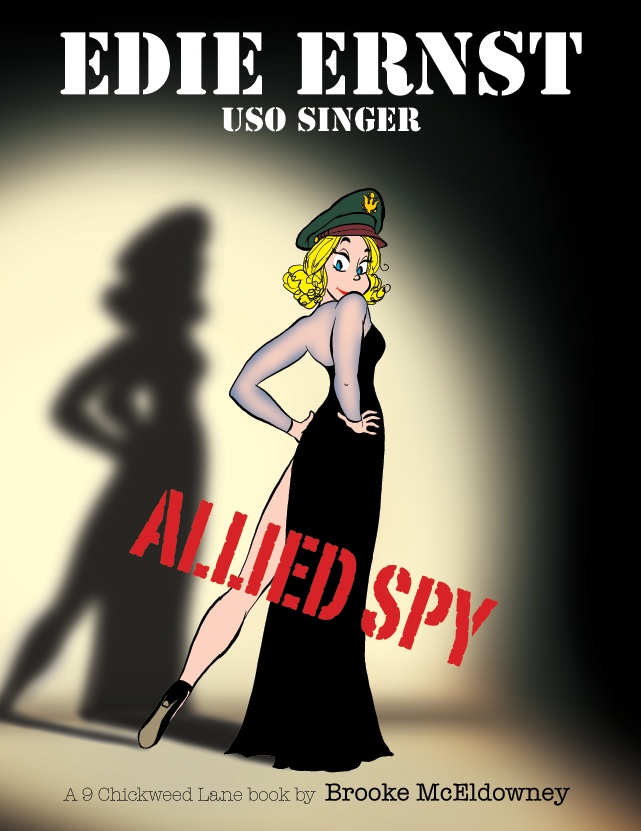
 Jeanne:  I also have two that quickly came to mind.  One is Edie Ernst, Allied Spy by Brooke McEldowney which is actually a collection of comic strips from his comic 9 Chickweed Lane which revolves around the lives of the Burber women: daughter Edda, mother Juliette, and grandmother Edna aka “Edie.”  Readers know Edna as a cranky old woman, always ready with a harsh word for her daughter or granddaughter.  This series of strips tells us about Edie as young woman during World War II and gave me a whole new view of the character.  I did a longer review which you can read here.


The other book—or books, because the story is in two parts—is Connie WillisBlackout and All Clear.  In the future, students at Oxford can travel back in time to observe important historical events.  The books follow several students who are in different parts of England during World War II, experiencing what it was like for ordinary people, civilians and soldiers on the British home front, during the Blitz. The full review of these books is here.

Thursday, May 26, 2011

Book News from Nevermore!

For the uninitiated, the Nevermore Book Club meets every Tuesday at 11 a.m. at Main. Participants share what they’re reading, often leading to some lively discussions. It’s very informal and a lot of fun. The library supplies coffee; doughnuts come from The Blackbird Bakery! Director Jud Barry leads the group. Everyone is welcome to show up with a book and join in!

Here are some of the books discussed:


Reality is Broken: Why Games Make Us Better and How They Can Change the World is the somewhat audacious claim of Jane McGonigal (306.487 MCG Main). Director Jud Barry read an excerpt in which the author and her husband race to clean the bathroom because they’re playing an online game in which you earn points by doing real life chores. Book club members immediately saw the possibilities and are anxious to try it out in their own households.

Andrew Johnson by Annette Gordon-Reed (973.81 GOR Main) This brief biography of Johnson is a part of the “American Presidents” series and was written by the author of The Hemingses of Monticello and Thomas Jefferson and Sally Hemings. Our reader felt that Gordon-Reed’s view of Johnson was somewhat narrow and not very sympathetic and didn’t really deal with his amazing rise from illiterate tailor to President.

Swan Song by Robert McCammon has another reader riveted! It is a post-apocalyptic novel that follows the lives of a handful of survivors, including a girl called Swan. A devilish figure called The Man with the Scarlet Eye is seeking to destroy her, but a ragtag group is determined to keep her safe. The book is often compared to Stephen King’s The Stand and has won praise for the excellent characterization as well as its plot.  It was a co-winner of the Bram Stoker Award and was a World Fantasy Award Best Novel nominee, and many have commented on the compelling characterization.

Sacrifice by S.J. Bolton (SSB F BOL Main) is a thriller set in the Shetland Islands. When a body is uncovered in a bog, the local police think it’s a prehistoric burial but Dr. Tora Hamilton immediately disagrees—ancient women didn’t wear nail polish. This was the first thriller by Bolton, who now has four novels to her credit and is viewed as an up and coming thriller writer. She creates intriguing, flawed characters and develops her settings so well that it’s almost like visiting the place. Folklore often figures into her work. These aren’t cozies, and there are some rather gritty scenes.

Edie Ernst, USO Singer—Allied Spy? By Brooke McEldowney (741.5 MCE Main) chronicles the World War II adventures of a young singer who falls in love with an American soldier and a German officer. The story is told in comic strip format, but the black and white art is as expressive as a vintage movie. It got raves from one reader and convinced another to check it out!


Jacqueline Winspear’s Maisie Dobbs series has captured the attention of another reader! These books are set after World War I when former nurse Maisie uses knowledge of psychology to become a private investigator. The setting is well done, and Winspear has a real feel for the time period. Maisie has had an eventful life, including the loss of a love in the War. The books are a good mix of history, mystery, and a bit of romance. Our reader has completed the first two books, Maisie Dobbs and Birds of a Feather, and is looking forward to the next book in the series.

Bring a book and join us next Tuesday!

Tuesday, May 3, 2011

Edie Ernst, USO Singer-- Allied Spy


Edie Ernst USO Singer—Allied Spy by Brooke McEldowney (741.5 MCE Main)
Reviewed by Jeanne


Juliette rushes to the hospital after learning her elderly, cantankerous mother, Edna O’Malley, had collapsed. She finds Edna to be her usual irascible self, but then Edna surprises Juliette by asking, “Did I ever tell you how I met and fell in love with your father?” Juliette replies, “I never heard you use the word ‘love’ in the same sentence, for that matter in the same hemisphere, with any mention of Dad.” Edna then proceeds to tell her daughter about her youth. She was Edie Ernst, a young, idealistic USO singer during World War II. She remembers her first meeting with Lt. Bill O’Malley, but not exactly what she said. It was enough to have her summoned to meet a colonel who wants to know if she speaks German. When she says she does, he offers her the opportunity to serve her country—by singing to enemy POWs. She’ll be gathering intelligence information, but to a lot of people she will appear to be a traitor, giving comfort to the enemy. Edie is torn, but in the end decides to risk her reputation for the greater good of service.

Also, Lt. O’Malley will be her OSS contact, and Edna finds him very attractive. Even more so after he gives Edna her first ever kiss.

Edie, renamed Eva to sound more German, is sent to POW camps in the UK where the German soldiers are as receptive as were the Americans. All but one: a German officer. The German officer, as Edna describes him. He regards her with disdain, but sings like an angel. Edie is fascinated and infatuated. She asks him to teach her how to sing with such emotion. His response is a “withering look of disdain,” which, of course, only makes her more determined to confront him.


Thus starts one of my favorite recent stories. It’s nuanced, with well-developed characters and an intriguing plot. In some ways, it’s an old fashioned tale; it deals with loyalty, honor and love.

I suppose at this juncture I should tell you that this story is told in comic strip form. Not graphic novel, but strips that ran daily for some 11 months, keeping me on the edge of my seat each morning as I waited to read the next installment.These strips have now been collected into a book, so you can read the whole story at one sitting. If you do –and I hope you will—take note how almost every strip ends with a line that will give you pause. I hate to call it a punchline, because makes the whole thing sound cheap. The humor grows out of situation and character and is often poignant.

McEldowney does a marvelous job of explaining a situation through his characters. For example, Juliette asks if Edna was in any danger. Not from the prisoners she replies, then goes on to explain,” Well, there was this little thing called ‘The War’… and you have no idea how hot feelings can run at such a time. . . . Somehow people knew I had been visiting a POW camp and I could feel their hostility. I consorted with the enemy. . . . There was also the problem with being a Yank. Americans got a reputation for arrogance when we entered the war. We strode in among a population that had been frustrated and battered for years. . . and they quickly hated us more than they did their actual enemy.”

In those lines, Edna sums up a situation more elegantly and compassionately than many books I’ve read. That’s part of the appeal of this book for me.  There’s a personal view of history, yet it’s viewed with the perspective time gives.  Most of all, it feels real.

Brooke McEldowney is a man of many talents. His background in both art and music (he was a professional musician for a time, playing the viola) shines through his strips.  They’re literate but accessible.  He has a fluid style and in this series uses shading to grand effect.  It’s like reading a classic black and white movie like “Casablanca.” The appeal is visceral, however.  He engages our emotions. In the forward for the collection, McEldowney reveals his reason for doing this story. He found an item that had belonged to his father when he was a young man, and he decided he wanted to tell a story to remind us that those members of the “Greatest Generation” were that, but were also young men and women first.  He wanted us to look at our parents and grandparents not as icons or crotchety caricatures but as human beings.  By the end of the story, our view of Edna has changed in a profound way, and in a way that can cause us to rethink the way we have perceived some of those we love.

Coincidentally, not long after I re-read this series I found my father’s own cache of photos and a few letters he had had written while overseas in WWII.  Among them was a note which said there were two things he wanted to do for sure when he got home and nothing should stop him.  One was to get a life time subscription to Reader’s Digest.  I chuckled, but for the first time I pictured him as a twenty something young man, still a bit wide-eyed about the world

Thank you, Brooke McEldowney.

(P.S.  If you check for the book in our card catalog, please ignore the description of the book.  The description is for Pipgorn, the second of Brooke McEldowney’s strips.)