Wednesday, December 4, 2013

Nevermore Gets Historical: Revolutionary Summer, Coup, and How the States Got Their Shapes Too

Summary by Kristin

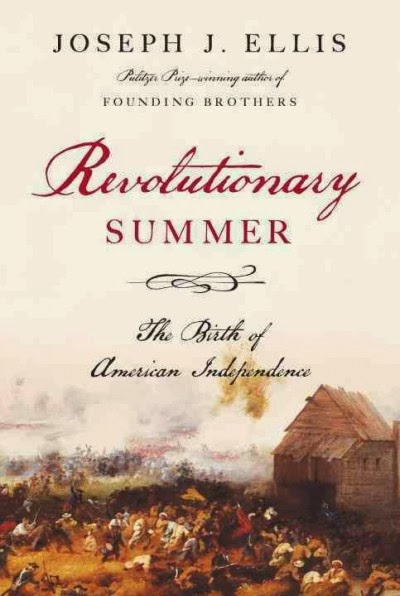
Jud started off the book club discussion with a couple of non-fiction books, including Revolutionary Summer: The Birth of American Independence by Joseph J. Ellis.  As one of several American history books that Nevermore members have read recently, this book focuses on the summer of 1776.  An outstanding part of this book was noted to be the importance of George Washington, not just as a great general, but as one who held the fledgling country together in a time of great change.  Also, this volume includes a small but important profile of Abigail Adams, as she urged her husband, John Adams, to “remember the ladies” in the newly declared independence.
 Another reader gave a thorough overview of Coup: The Day the Democrats Ousted Their Governor, Put Republican Lamar Alexander in Office Early, and Stopped a Pardon Scandal by Keel Hunt.  This was a story of political corruption in the 1970’s when Governor Ray Blanton was planning his last minute political pardons, including a possible pardon for James Earl Ray, assassin of Dr. Martin Luther King, Jr.  A bipartisan effort came together to install Lamar Alexander, the governor-elect, in office earlier than expected, so that Governor Blanton would not have a chance to make his pardons.  Of particular note was that the spirit of cooperation between Republicans and Democrats made Alexander’s gubernatorial term extremely productive.


Rounding out the non-fiction, another reader recommended How the States Got Their Shapes Too: People Behind the Borderlines by Mark Stein.  The previous volume (simply titled How the States Got Their Shapes) spawned a History Channel series of the same name, so the second book delves a bit deeper into the background of the people who purposefully or not, influenced the borderlines between the states.  While Thomas Jefferson is spread across much of the map, many other lesser-known individuals are highlighted in the struggle for governance of lands in the New World.

Monday, December 2, 2013

Spider Woman's Daughter by Anne Hillerman


 Reviewed by Jeanne

Officer Bernadette Manualito Chee is having breakfast with some other members of the Navajo police when she witnesses a dear friend being shot.  Joe Leaphorn, the legendary lieutenant, lies gravely wounded as the shooter speeds off. 

 Even though she is relieved of duty, Bernie is determined to fulfill the promise she made to Leaphorn that she would find the one who did this.  She begins by checking his current projects:  Leaphorn had continued to do some investigative work after his retirement as well as some consulting.  This leads her to a museum of Native American artifacts, where he was assisting with appraisals and provenance. The police are also checking through Leaphorn’s old cases to see if someone he arrested holds a grudge.  Then there’s the disappearance of Leaphorn’s girlfriend Louisa, which leads to questions of a domestic dispute.

Aside from the case, Bernie is dealing with family issues.  Her younger sister Darlene is charged with caring for their elderly mother, but Darlene is feeling trapped and rebellious.  She’s making some questionable choices and associating with people Bernie doesn’t approve of, leading to more friction between the sisters.

I was a long time fan of Tony Hillerman.  His books about the Navajo policemen Jim Chee and Joe Leaphorn introduced me to the fascinating culture and landscape of the Southwest while being extremely well- plotted mysteries.  When I read that his daughter Anne was going to continue her father’s work, I was both hopeful and apprehensive: I wanted more stories about Chee and Leaphorn-- but let’s face it, it’s often very difficult for one writer to duplicate another’s style effectively.

Anne Hillerman solved the problem neatly but using Bernadette as her main character, enabling her to create a fresh perspective and a new “voice.” The style is slightly more emotional and less detached than her father’s, but not jarringly so.  Where Tony would describe a scene and let the reader draw conclusions, Anne is more likely to explain.  She also tackles some issues of reservation life—alcoholism, health, the elderly—which her father treated more obliquely.  Anne uses Bernie’s relationships to good advantage, giving the readers a closer glimpse of Navajo family life but without letting the story lapse into soap opera.

The mystery itself is based partly on events from A Thief of Time, arguably one of her father’s best books, but you don’t need to have read it or any of the previous books to enjoy this one.  The book is well-plotted, but several reviewers said they figured out whodunit early on and found some of the attempts at misdirection to be handled a bit poorly.  I found the villain’s exposition to be more than a little unbelievable—think James Bond baddie explaining his plan in great detail as Bond faces Certain Death—but overall I found this to be a very readable, engaging book and I’ll certainly try her next one.  The writing itself is polished, nicely descriptive without bogging down in detail, and the characters are well done. Like her father, a sense of place is crucial to Anne’s story. Navajo art and artifacts play a pivotal role in the book, and Hillerman does a good job of describing not just the appearance of the items but the emotional connection they have for the Dineh.  She’s also not afraid to shake up the status quo. In short, this is a promising start to a new chapter in the lives of some beloved characters. Finally, I really liked seeing Jim and Bernie happily married, and enjoying  a true partnership.

Spider Woman’s Daughter is recommended for fans of traditional mysteries, especially those with a Southwest or Native American setting. 

Wednesday, November 27, 2013

Collision 2012 by Dan Balz


Reviewed by Jeanne

Every four years America elects a president.  Nowadays, it seems that the four years in between is spent discussing the NEXT election even as Americans all say they’re sick of politics. As I write this, however, a look at the NY Times bestseller list has two books on current politics and one on historical politics in the top five non-fiction, which means we may not be as disinterested as we profess to be.  Although partisan titles generate much of the interest, there still seems to be some room for more neutral reporting such as this book.

Balz is a political writer for the Washington Post and as such, had a front row seat for the 2012 election.  He gives a lucid, even-handed account of the missteps and triumphs by the various campaigns, from Rick Perry’s memory lapse about what departments he would cut to Obama’s disengaged performance in the Denver debate.  Interviews with some of the participants long after the election give a better perspective on some events—and I thought it spoke well that Balz was on good enough terms with these candidates to be granted an interview.

While some reviewers took the book to task for not being gossipy enough or for not being analytical enough, I found it to be refreshing.   Some of the post-election books I’ve read revel in name-calling and blaming everyone in sight, leaving the reader disliking everyone.  This doesn’t interest me.  Neither does a long legal discourse of the current election laws; Balz contents himself with noting how the laws affect the campaigns and campaign strategy.

The Republican primaries take up nearly two thirds of the book, leaving only the last section to the general election.  Given the number of candidates, the information on each is limited; some almost to the way the Romney campaign dealt with each challenge. Even so, there are interesting tidbits about each candidate’s approach to the campaign, and how their strategies and assumptions played out. For example, Jon Huntsman, who had been in China for several years as U.S. Ambassador, was stunned at the way the political climate had changed while he was away. (In case you’ve forgotten—or tried to block it out—the other candidates included Rick Perry, Michele Bachmann, Ron Paul, Herman Cain, Rick Santorum, Tim Pawlenty, and Newt Gingrich.)

There are two elements I found particularly interesting in the book.  One is the way in which the near- instantaneous public reactions to events took place.  In years past, after a debate the spin doctors would meet with reporters in an attempt to color news stories about the event, so that readers and TV viewers would get the most positive view possible.  In 2012, anyone with a computer could see reactions in real time via twitter.  By the end of the debate, there was nothing left to spin. In some ways, this is a replay of the shift decades earlier when the new medium of television showed a handsome, relaxed John Kennedy debating the untelegenic, tired Richard Nixon, changing campaigns forever.

The other fascinating element was how the Obama campaign used voter data to a degree no other campaign ever had before, and how they challenged certain assumptions.  Before an election, a great deal is made of the undecided voters.  But are these voters really undecided?  The Obama staff concluded that a good portion are not; if pushed, they have indeed already made a decision.  They may call themselves that because they don’t like their party’s nominee or because they hope to find a reason to vote that will make them happier about the choice, but when the time comes they will vote the way they’ve always voted. That meant that at the end the Obama team concentrated not on “Undecideds” but on people who tended to vote Democratic but who didn’t always vote. Their focus was getting people to go to the polls, not to try to sway those who were on the fence.

If you want a sensational view of the presidential election of 2012, look elsewhere.  But if you enjoy a neutral view of the way things work in elections, then this is a book for you.
Monday, November 25, 2013

Nevermore Fiction Picks: Z: A Novel of Zelda Fitzgerald, Saving Fish From Drowning, Spider Woman’s Daughter


Fiction topics sometimes seem to go in cycles, with more than one book at a time taking on some event or personality.  Sometimes there’s a simple explanation, as with the 50th anniversary of the JFK assassination bringing out so many books, but others are a bit more obscure.  This year sees not one but two novels about Zelda Fitzgerald, wife of F. Scott.  The first is Z: A Novel of Zelda Fitzgerald by Therese Anne Fowler, which has been described as a fictional autobiography.  Zelda is a teenage Southern belle when she meets the dashing young officer Scott Fitzgerald at a dance.  They came from two very different worlds, but Zelda believed love would conquer all and headed north to become half of a golden couple amid the glitter of the Jazz Age.  Reviewers have been particularly taken with the way Fowler brings that era to life, with flappers, famous folk such as Ernest Hemingway, and glamorous locations in Paris, New York, and the Riviera. Like Plath and Hughes, people tend to divide up in camps favoring one partner over the other (and blaming one or the other!) The second book featuring a fictional Zelda just came out in October:  Guests on Earth by Lee Smith.  This one is set in the mental hospital in North Carolina where the young  Evalina has been sent to live after her mother’s death, a convenient way to get rid of her.  She finds a home among the staff and patients, including Zelda Fitzgerald.

    Our reviewer found Saving Fish From Drowning by Amy Tan to be very different from her other books and not just because it’s narrated by a ghost.  Bibi Chen doesn’t let her untimely death get in the way of going on the art and culture tour she had arranged so she joins them in spirit form.  The tour crosses over into Myanmar when they’re taken deep into the jungle by a group of natives.  Culture clashes and confusion abound. Our reviewer thought that the portrayal of Burma was very interesting, and noted that Tan had strong political views that came through in this book.  Others noted the dark humor of the novel.


Finally, fans of Tony Hillerman can look forward to reading Spider Woman’s Daughter by his daughter Anne Hillerman.  Officer Bernadette Manualito, wife of Jim Chee, sees Joe Leaphorn shot and critically wounded.  Even though she’s on administrative leave, Bernie sets out to honor her promise to Leaphorn to find his assailant. The book is true to the originals, though Anne’s tone is a bit different than her father’s. Both have an obvious love and empathy for the region and its people.  The mystery itself is competently done, even though there’s a lot of explaining at the end.

Friday, November 22, 2013

Anthem for Jackson Dawes by Celia Bryce


Reviewed by Kristin

Megan can’t believe she has to be on the pediatric ward of the hospital.  After all, she is fourteen. Well, almost fourteen.  Having cancer is bad enough, but being in a ward with flying elephants on the wall makes it even worse.  The only other teenager is a rather forward boy named Jackson who seems to be loved by all the little kids, parents and nurses.  Megan just can’t stand how he is so cheerful in dealing with the fact that he is sick too.

Though Megan finds Jackson annoying, she is also drawn to him.  Even Megan’s mother is dazzled by Jackson’s appeal.  Jackson has a kind of charm and is able to convince the staff to let him wander about the hospital as he pleases.  The younger children enjoy his antics, and he is kind and comforting to them as they also face being sick in the hospital.  Megan’s friends have promised to text and to visit, but that turns out to be harder than it sounds.  Many of Megan’s friends find her illness hard to understand.  Even her best friend Gemma doesn’t quite understand what Megan is experiencing.  Megan begins to look forward to her interactions with Jackson, and finds herself missing him when he is not there.

Because the book is set in England, some of the language is slightly different.  The exclamations of “Rubbish!” and “Brilliant!” add to the flavor of the setting.

As is natural for all children and teenagers, (and perhaps any person dealing with a serious illness,) Megan is very egocentric and feels that she and her problems are the center of the universe.  Part of her growing-up process is realizing that there are others affected by her diagnosis.  Megan has the support of her mum, dad and 96-year-old grandad.  As the family is dealing with her cancer, Megan begins to see that the adults have vulnerabilities as well.  While the adults are in the background, this story focuses on Megan’s experiences.  The book does describe some of the side effects of her treatment, but it does not dwell on them.  The story is much more about the interactions between Megan and her home and hospital friends.

This is a coming-of-age book with a teenage girl going through a tougher than usual time.  Along the way she finds different friendships than she might have expected.  Because it is about young adults with cancer, this book immediately reminded me of The Fault in Our Stars by John Green.  Although this is a young adult book, I still found it to be a touching story that will appeal to people of all ages.  The characters remain innocent with only a touch of romance involved.  I won’t give away any huge plot twists, but I will say that this story will make you laugh and cry as the characters go through the ups and downs of illness and friendship

Wednesday, November 20, 2013

Dawn to Decadence, Josephine Earp, Richard Burton & Barnaby

Jud opened Nevermore with From Dawn to Decadence:  500 Years of Western Life by Jacques Barzun.  The book examines the way that various revolutions—political, religious, artistic—affected European culture, leading to the world as we know it today. The book begins right after the Protestant Reformation, and examines many of the pivotal figures in the history of ideas, leading to what the author sees as a post-decadent society in which humanity seems to have lost its way.   Barzun is very good at bringing the arts into his discussions, which may be why Jud enjoys his writing so much, referring to it as his favorite sleep-inducing literature. Light reading it is not, but it is a well done and insightful tome from a respected scholar.

Another sort of Western history—the American West, that is—was brought up with Lady at the O.K. Corral:  The True Story of Josephine Marcus Earp by Ann Kirschner.  Josephine was Earp’s fourth common-law wife and had quite a colorful history of her own, albeit one that she mostly wanted to be kept quiet.  She was the daughter of a Prussian Jewish couple and spent her early years in New York where she acquired her distinctive accent.  The family moved to San Francisco in 1870 when Josephine was ten.  She later ran away from home and became (among other things), an actress and dancer before she met Wyatt.  Our reviewer is finding it to be a very interesting account of a woman and an era.  He also is intrigued by a different view of Wyatt Earp than is usually encountered.


The Richard Burton Diaries is a compilation of the private diaries of the British actor starting from his teenage years up until 1983. Burton wrote of his daily life, including his encounters with other celebrated folk but our reviewer says there aren’t a lot of juicy details.  There are, however, many accounts of bodily functions.  All in all, it’s an unvarnished look at an acclaimed actor who struggled with insecurity and jealousy while remaining a sharp observer of the world. Editor Chris Williams supplies annotations to flesh out some entries.

Finally, Jud brought in Barnaby by Crockett Johnson. Today Johnson is best known as the author of the Harold and the Purple Crayon books, but a decade earlier he had a small but avid following for his strip Barnaby whose fans included Dorothy Parker and Louis Untermeyer.  Barnaby is a little boy who has a fairy godfather—a short, stubby, somewhat inept, cigar-chomping, Irish fairy godfather named Jackeen J. O’Malley who is given to exclaiming “Cushlamochree!”   Barnaby’s parents believe he’s making this all up, of course, even after Mr. O’Malley decides to run for Congress.  The campaign is still believable today, even though the strips ran in 1942. 

Monday, November 18, 2013

Judging a Book By Its. . . Title


Comments by Jeanne

While not as popular as judging a book by its cover, book titles can help make or break a book.  Some are just so nondescript they’re forgettable which is why I can’t remember any just now.  Other titles are so popular that they’ve been used repeatedly by many authors.  If someone asks for The Search or The Quest or The Rescue, there are many possibilities.  Is it The Search by Nora Roberts, Grace Livingston Hill, Iris Johansen, or Jerry Jenkins?  Even saying that it’s an Amish story only helps a little, because there are books by that title by both Suzanne Woods Fisher and Shelley Gray Shepard.

A few years back I remember great confusion over two “big” books due out, one by Douglas Preston& Lincoln Child and the other by Patricia Cornwell.  Both were entitled The Book of the Dead. One was delayed in publication for a few months and I always wondered if it was because of the titles. 

Then there are the titles based on famous poems or phrases.  Just take a look for the lines of “Stopping by the Woods on a Snowy Evening” and you’ll find books entitled And Miles To Go, Miles to Go, Promises to Keep, and Before I Sleep.  There are variations galore on “Now you see me/him/her,” quotations from Shakespeare, the Bible, popular songs, and nursery rhymes.

Then there are great titles that become classics but do have the potential to mislead readers. Zen and the Art of Motorcycle Maintenance is certainly in that category because it baffled readers  hoping to repair their Harley; To Kill A Mockingbird is not a guide to hunting; and nobody knows what A Catcher in the Rye is.

On the other hand, there are some that sound so intriguing that one wants to read the book just to see if it can possibly live up to that title or to at least find out what the heck it means.  Here are some of my favorites:

If I’d  Killed Him When I Met Him by Sharyn McCrumb

Hitchhiker’s Guide to the Galaxy by Douglas Adams

I Still Miss My Man (But My Aim Is Getting Better) by Sarah Shankman

When In Doubt, Add Butter by Beth Harbison

Maybe He’s Just a Jerk by Carol Rosen

He’s Just Not That Into You by Greg Behrendt

So Long, And Thanks for All the Fish by Douglas Adams

Beware the Naked Man Who Offers You His Shirt by Harve Mackay

Mama Makes Up Her Mind and Other Dangers of Southern Living by Bailey White

Saturday. . . My Day to Wear the Underwear! by Allen Jennings has a title that both intrigues and hints at what it was like to grow up in "'old' Fries, Virginia."

Finally, there’s the great title which prompted this column:  Chose the Wrong Guy, Gave Him the Wrong Finger by Beth Harbison.

Kristin favors titles by Lewis Grizzard, especially Elvis Is Dead and I Don’t Feel So Good Myself.  She also likes The Grass is Always Greener Over the Septic Tank by Erma Bombeck and Monsters Eat Whiny Children by Bruce Eric Caplan.

And, at a recent meeting of the Nevermore Book Club Jud serendipitously presented a book about craft beer-making which he said he had picked up because of the title:  The Audacity of Hops by Tom Acitelli.

Does anyone else have a favorite title?